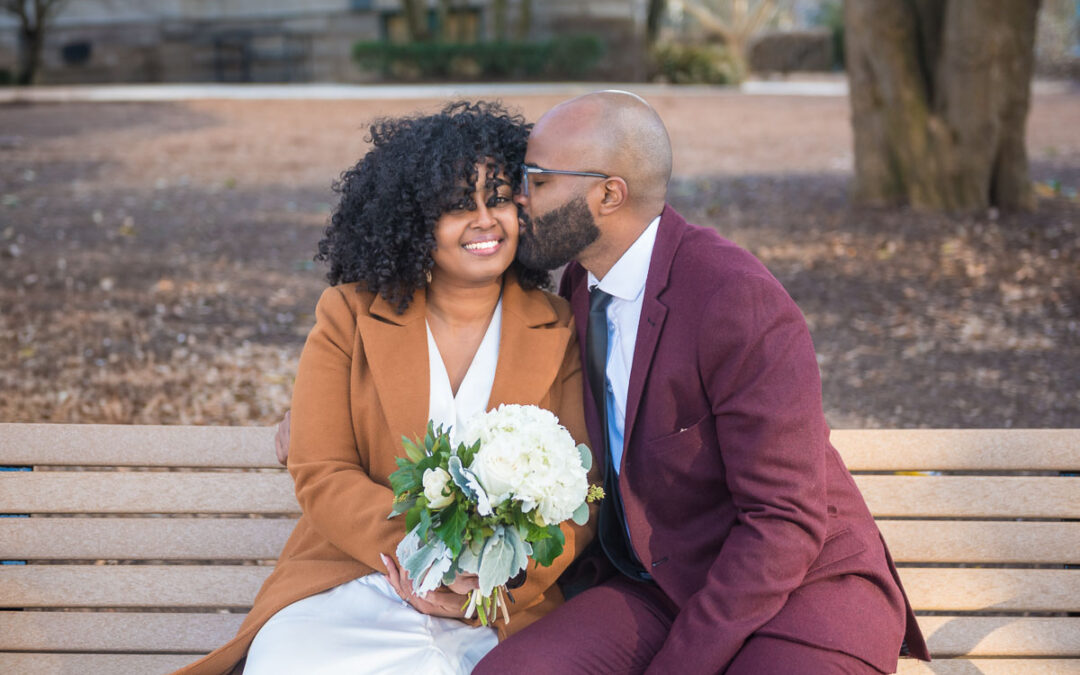
For most Atlanta elopements, 2 hours of photography is enough. It comfortably covers a 15- to 20-minute ceremony, family photos with a few guests, and about 45 minutes of relaxed couple portraits. You’ll want 3 to 4 hours if you’re adding getting-ready photos, a second location or photos at dinner. Below are the real elopement timelines we plan with our couples, including 1-, 2- and 4-hour sample schedules you can copy and adjust.
How Long Does an Elopement Take?
The ceremony itself is short. Most elopement ceremonies last 10 to 20 minutes, depending on whether you read personal vows, include a reading or add a ritual such as a unity ceremony or a ring warming. A courthouse ceremony can be as brief as 5 to 10 minutes, although the full visit, including check-in, security and waiting for your turn, usually takes 30 to 60 minutes.
Everything around the ceremony is what shapes your timeline: getting ready, travel between locations, hugs and toasts with guests, family photos and portraits. That’s why two elopements with the same 15-minute ceremony can need very different amounts of photography.
How Many Hours of Photography Do You Need for an Elopement?
Here’s how the most common coverage lengths work in practice:
Coverage
Best for
What it usually includes
30 to 60 minutes
A portrait session (no ceremony)
Couple portraits in two or three spots at one location
2 hours
Most elopements and courthouse weddings
Arrival, the ceremony, family and guest photos, and about 45 minutes of couple portraits
3 hours
A second location or a longer guest celebration
Everything in 2 hours, plus travel to a second spot or more time with guests
4 hours
Getting ready, ceremony, portraits and dinner
Final getting-ready moments, the ceremony, full portraits, a toast and the start of dinner
In our studio, coverage that includes a ceremony starts at 2 hours. Courthouse ceremonies always start at 2 hours of coverage. Courthouses run on their own schedule, and it’s common to wait well past your appointment time. Two hours means we’re there for the whole experience, from the nervous wait to the ceremony to your first portraits as a married couple, without anyone watching the clock or needing to add time on the day. Shorter portrait sessions are available if you don’t need your ceremony photographed. Weekend dates (Friday through Sunday) are the most requested in the event industry and tend to book far in advance. If you’re hoping for a short weekend elopement, a little flexibility goes a long way. Reach out with your date and we’ll check what’s possible, and remember that weekdays give you the most options. Every elopement is a little different, so if your plans don’t fit neatly into these options, contact us and we’ll talk through what works for your day. You can compare the options on our Atlanta elopement packages page.
Sample Elopement Timelines
These are sample schedules based on the elopements we photograph most often around Atlanta. Treat the times as a starting point. We adjust every timeline to your location, guest count and the light on your date.
About 1 Hour: A Portrait Session
This is for couples who want beautiful portraits to commemorate their marriage without ceremony coverage, for example after a quick courthouse visit on another day.
4:30 p.m. Photographer arrives. A few detail photos: rings, bouquet and vow books (10 minutes).
4:40 p.m. Couple portraits in two or three spots at one location (40 minutes).
5:20 p.m. A few final photos, such as a champagne toast or a walk together.
5:30 p.m. Coverage ends.
A portrait session is more flexible than ceremony coverage. It can happen on a different day from your ceremony, at whatever time and place gives you the best light, and outdoor sessions can be rescheduled for bad weather under our inclement weather policy. If you want your ceremony photographed, plan for at least 2 hours.
2 Hours: A Weekday Courthouse or Garden Elopement
This is the timeline most of our elopement couples choose. It gives you the ceremony, time with your guests and portraits that never feel rushed.
4:00 p.m. Photographer arrives. Details and candid photos as guests gather (15 minutes).
4:15 p.m. Couple portraits before the ceremony, while everyone is fresh (30 minutes).
4:45 p.m. Buffer for check-in, security or last-minute touch-ups (15 minutes).
5:00 p.m. Ceremony (15 to 20 minutes).
5:20 p.m. Hugs, congratulations and candid moments with guests (10 minutes).
5:30 p.m. Family and guest photos (15 minutes, for a short list of groupings).
5:45 p.m. Final portraits and a walk-out or toast (15 minutes).
6:00 p.m. Coverage ends.
For a courthouse ceremony, we plan the portraits around the building’s schedule. We also remind you about any photography permission forms your county requires; Fulton County, for example, asks for one in advance.
2 Hours: A Golden-Hour Elopement
If you’re marrying outdoors in spring, fall or winter, plan the ceremony so that your portraits land in the hour before sunset. In Atlanta, sunset falls around 5:30 p.m. in early December and close to 8:50 p.m. in late June, so we build this timeline backward from the sunset time on your date. The official sunset time assumes a flat, open horizon. In a city park or near tall buildings, the sun slips behind the tree line or the skyline earlier, often 20 to 45 minutes before the listed time, so we plan to finish outdoor portraits about 30 minutes before the official sunset. The example below uses a 6:45 p.m. sunset.
4:15 p.m. Photographer arrives. Details and guest candids (15 minutes).
4:30 p.m. Ceremony (15 to 20 minutes).
4:50 p.m. Congratulations and family photos (20 minutes).
5:10 p.m. Couple portraits in warm, low light (55 minutes).
6:05 p.m. A final toast or walk-out.
6:15 p.m. Coverage ends, about 30 minutes before sunset.
Summer golden hour in Atlanta is still hot and humid. For June through August, we usually recommend an indoor location or a very short outdoor portrait window.
4 Hours: Getting Ready, Ceremony, Portraits and Dinner
Choose this when you want the full story of the day, especially if you’re dreaming of an album.
3:30 p.m. Photographer arrives for final getting-ready moments: the dress, jewelry, letters and details (30 minutes).
4:00 p.m. First look or a private moment before the ceremony (15 minutes).
4:15 p.m. Travel to the ceremony location (30 minutes, including buffer).
5:20 p.m. Congratulations and family photos (25 minutes).
5:45 p.m. Couple portraits, which can include a second location (60 minutes).
6:45 p.m. Arrive at dinner: toast, first moments at the table and candid photos (45 minutes).
7:30 p.m. Coverage ends.
When 2 Hours Isn’t Enough
Two hours covers most elopements. Plan for 3 to 4 hours if any of these apply:
You want getting-ready photos: the dress, the details and the nervous-excited moments beforehand.
You’re using two or more locations, such as a courthouse ceremony followed by portraits in a garden or downtown.
You have more than about 15 guests or a long family photo list. Group photos almost always take longer than couples expect: someone steps away right when it’s their turn, the wind won’t cooperate, the light keeps changing, or strangers keep walking through the background of a public space.
You want photos at dinner or a toast after the ceremony.
You’d like an album that tells the story of the whole day, not only the ceremony and portraits.
When a couple isn’t sure, we usually recommend building the timeline first and then choosing the coverage, not the other way around. It’s the same approach we take for full weddings in our guide to how long you need a wedding photographer.
How to Build Your Own Elopement Timeline
Use these six rules of thumb as you plan:
Start with your ceremony time and work outward from it.
Plan portraits before guests arrive when you can. You’ll feel calmer and won’t need to leave your guests later.
Add 15 to 20 minutes of buffer for Atlanta traffic, parking and courthouse security.
Follow the light. Schedule outdoor portraits as far from solar noon as you can, when the sun is highest and the light is harshest. Solar noon shifts through the year, so we check it for your date. Late afternoon into the hour before sunset is usually best; if your ceremony is midday, we’ll often plan portraits earlier rather than after. For indoor portraits, any time works because we bring professional lighting.
Keep locations close together. Every move between locations can take 20 to 30 minutes in Atlanta traffic, time that isn’t spent on photos.
Have a weather plan. Your ceremony happens rain or shine, so choose a location with an indoor option you’d be happy to use.
Inviting family? Our guide to planning an elopement with family explains why family photos take longer than most couples expect and how to keep them moving.
Elopement Timeline FAQ
How Long Does the Process of Eloping Take?
The ceremony usually takes 10 to 20 minutes, and most couples plan 2 to 4 hours for the full day, including portraits and a celebration. Planning the elopement itself usually takes a few weeks to a couple of months, depending on how popular your date and location are.
Who Usually Pays for an Elopement?
Most couples pay for their own elopement, since the costs are much lower than a traditional wedding. Sometimes parents or family members contribute, often by covering the photography, the dinner or a celebration afterward.
Is 1 Hour of Photography Enough for an Elopement?
For a portrait session, yes. One hour gives you relaxed couple portraits in a few spots at one location. If you want your ceremony photographed, we recommend, and require, at least 2 hours, especially at a courthouse, where wait times are hard to predict.
Should We Take Portraits Before or After the Ceremony?
We usually recommend before. You’re fresh and relaxed, your hair and makeup are at their best, and you won’t need to leave your guests after the ceremony. If you’d rather keep the first look for the ceremony itself, portraits after work well too. We’ll plan the timing with you.
What Is the Best Time of Day to Elope?
For outdoor elopements, schedule your portraits as far from solar noon as you can, since that’s when the sun is highest and the light is harshest. Late afternoon into the hour before sunset usually gives the softest, warmest light. Solar noon shifts through the year, so we check it for your date. For indoor elopements, choose whatever time suits your plans, because we bring professional lighting.
Can We Add More Time on the Day?
Often, yes, if your photographer’s schedule allows. It’s always easier to plan the right amount of time up front, so tell us about everything you’d like photographed and we’ll recommend the right coverage.
Do You Help Us Plan Our Elopement Timeline?
Yes. Every elopement collection includes a planning and logistics call where we build your timeline together, around your location, guests and the light on your date. If posing makes you nervous, we’ll guide you through that too. See how we help camera-shy couples.
Plan Your Elopement Timeline With Us
For most couples, 2 hours is the right amount of elopement photography: enough for the ceremony, your people and portraits that never feel rushed. Plan more time for getting ready, a second location or dinner, and build your timeline around the light.
To elope, you decide what kind of day you want and what you want photographed, pick a date and a place with a weather backup, get your marriage license, book an officiant and a photographer, and plan a simple timeline. That’s the whole process, and most couples can do it in a few weeks. We have photographed elopements, courthouse weddings and micro weddings around Atlanta since 2008, and this is the step-by-step plan we walk our couples through, with Georgia details where they matter.
What Does It Mean to Elope?
Today, eloping usually means a small, planned, intimate ceremony: just the two of you, or the two of you with a handful of your closest people, such as parents or a best friend. It skips most of the structure of a traditional wedding day. There’s no long reception timeline, no big guest list and no months of logistics, and it isn’t secret or rushed unless you want it to be.
Once your guest list grows past about 20 people, you’re usually planning a micro wedding. The planning steps below still apply. You’ll just give more time to the guest experience.
How to Elope in 10 Steps
Decide what kind of elopement you want.
Decide what you want photographed.
Choose your date and time of day.
Choose a location with a backup plan.
Get your marriage license.
Find your officiant and check witness rules.
Book your photographer and other vendors.
Plan a simple timeline.
Look and feel your best.
Decide how to share the news and celebrate.
Step 1: Decide What Kind of Elopement You Want
Start with the feeling, not the logistics. Talk through a few questions together before you book anything:
Is it just the two of you, or will a few family members or friends be there?
Do you want a legal ceremony on the day, or a symbolic ceremony after a quick courthouse visit?
Would you rather be indoors somewhere historic and elegant, or outside in a garden?
Is the ceremony the main event, or do you also want portraits, a toast or a dinner afterward?
Your answers shape every step that follows. A courthouse ceremony with two guests needs a very different plan from a garden vow exchange followed by dinner for ten.
Before you book a photographer, decide whether you want your ceremony photographed, a portrait session to commemorate your marriage, or both. They are different kinds of bookings:
Ceremony coverage is event coverage. Your ceremony happens at a set time and place, with your officiant and guests, so it goes ahead rain or shine and needs a real indoor backup plan. With us, coverage that includes a ceremony usually starts at 2 hours; if your plans are unusual, reach out and we’ll talk through what works.
A portrait session is a commemorative experience. It can happen on any date, at any time and in any location that gives you beautiful photos, including a different day from your ceremony. Because nothing else depends on it, an outdoor portrait session can be rescheduled if the weather turns.
The day of the week matters too. Weekdays (Monday through Thursday) are in far lower demand than weekends, so they offer the most flexibility and the best value. Weekends (Friday through Sunday) are the most requested dates in the event industry and are priced to reflect that demand. You can compare our weekday and weekend elopement collections to see how each one works.
Step 3: Choose Your Date and Time of Day
Pick your date with the light and the season in mind, not only the calendar.
Time of day: for outdoor photos, the most flattering light comes close to sunrise or sunset. The sun sits lower in the sky, skin tones look soft and warm, and no one has to squint. Midday sun casts hard shadows under the eyes and nose. If midday fits your plans best, choose shade or an indoor space, or plan for a lighting assistant.
Indoors: light is far less of a concern because we bring professional lighting, so an indoor elopement can happen at any time that suits you.
Season: Atlanta summers are hot and humid. For summer dates we recommend indoor spaces, and our Atlanta summer elopement tips cover heat, humidity and backup plans. Spring, fall and winter are the best seasons to elope outdoors.
Step 4: Choose a Location With a Backup Plan
Georgia weather can change in an hour, so choose a place where you would be happy to say your vows whatever the forecast. A strong elopement location:
has an indoor space, or a covered space you’d be happy to use, if it rains or the heat spikes;
is private enough that you’re not working around crowds, tourists or other events;
photographs well both for your ceremony and for your portraits;
fits the size of your group, including anyone who needs easy access.
Public parks can work, but they come with crowds, permits and no plan B. A private venue, a historic building, an elegant rental home or a small event space usually gives you a calmer day. For ideas, see our guide to places to elope in Atlanta, where every location we suggest has an indoor option. If you’re planning an outdoor portrait session rather than a ceremony, our inclement weather policy explains how weather rescheduling works.
Step 5: Get Your Marriage License
A marriage license is what makes your elopement legal. The rules come from the state where you marry. In Georgia, the license comes from a county probate court:
You both need to be there in person, with a valid photo ID and proof of age. If either of you was married before, bring proof the marriage ended (for example, a divorce decree).
If at least one of you lives in Georgia, you can apply in any county. If neither of you lives in Georgia, apply in the county where the ceremony will take place.
Fees vary by county. The standard fee was $56 to $77 at the courts we checked, and completing a premarital education program lowers it.
After the ceremony, the signed license goes back to the probate court within 30 days.
Hours, fees and appointment rules differ from county to county, so check your probate court’s website before you go. If you’re planning a courthouse ceremony, our guide to courthouse weddings in Georgia walks through the process county by county.
Step 6: Find Your Officiant and Check Witness Rules
Your officiant signs your license, so choose someone who is legally able to perform marriages in the state where you marry. You have three common options:
A friend or family member who gets ordained. Many couples love this because it makes the ceremony deeply personal. Our Atlanta elopement guide explains how to get ordained in Georgia online.
A professional officiant, who can also help you write a short ceremony and keep it on track.
A courthouse ceremony, where available. Some Georgia probate courts perform ceremonies and others don’t, so ask your county.
Ask your officiant or probate court whether your county’s license needs witness signatures. If it does, a friend, a family member or your officiant can often help you arrange them.
When the guest list is small, your photos become the way everyone else gets to share the day. Book your photographer early, especially for a weekend date, and look for someone who is used to small, fast-moving days and can guide you through posing if you feel awkward on camera.
Most elopements need 2 hours of photography, enough for the ceremony, a few family photos and a relaxed portrait session. Plan 3 to 4 hours if you want getting-ready photos, a second location or photos at dinner. Our elopement timeline guide shows sample 1-, 2- and 4-hour timelines so you can see exactly what fits.
Other vendors to consider:
An officiant (see Step 6).
A florist for a bouquet, boutonnière and a few small details.
A hair and makeup artist, so you feel photo-ready without the stress.
A restaurant, private dining room or caterer if you’re celebrating afterward.
Step 8: Plan a Simple Timeline
An elopement timeline should feel relaxed, not rushed. A few things make the biggest difference:
Take couple portraits before guests arrive if you can. You’ll have unhurried time together, and you won’t need to step away from your guests later.
Keep the ceremony at the center. Most elopement ceremonies last 10 to 20 minutes, and courthouse ceremonies can be even shorter.
Leave buffer time for traffic, parking and courthouse security lines.
Plan around the light, as in Step 3.
We plan every timeline with our couples, so you won’t be figuring this out on your own. You can see full sample schedules in our elopement timeline guide.
Step 9: Look and Feel Your Best
Small details show up in close-up portraits, so a little preparation goes a long way:
Do a makeup trial about a month before your date, whether you hire an artist or do your own.
Choose a transfer-proof lipstick so kissing photos don’t leave marks on your partner.
Use translucent powder to take down shine. This goes for everyone in the photos, because shine can’t be fully removed later.
Pack a brush or comb for wind, humidity and the drive over.
Wear comfortable shoes or bring a second pair for walking between locations.
Step 10: Decide How to Share the News and Celebrate
Eloping doesn’t mean leaving out the people you love. Decide ahead of time how and when you’ll tell family and friends:
Tell your closest family before the day, and invite them if you’d like them there.
Include loved ones in part of the day, such as a toast, a dinner or a video call during the ceremony.
Share the news afterward with a phone call, a card or a wedding announcement with a favorite photo.
Plan a celebration later, anything from a private dinner or champagne toast to a relaxed party with the people who couldn’t be there.
Does Eloping Make You Legally Married?
Yes. Eloping is legally the same as any other wedding. If you have a valid marriage license, a qualified officiant performs the ceremony, and the signed license is returned to the probate court, you are legally married, whether you had two guests or two hundred.
Some couples marry legally at the courthouse first and hold a symbolic ceremony somewhere else later. That works well too. The courthouse visit makes it official, and the second ceremony can be as personal as you like.
How to Elope FAQ
How Long Does It Take to Plan an Elopement?
Most couples can plan an elopement in 4 to 8 weeks. Weekend dates and popular venues book further ahead, so give yourself more time if you have a specific Saturday or venue in mind. Weekday elopements are often possible on shorter notice.
Can You Elope Without Anyone Knowing?
Yes. You can marry with just your officiant, and any witnesses your county requires, and share the news afterward. Many couples still tell a parent or close friend beforehand, or invite one or two people to be their witnesses.
Do You Need Witnesses to Elope in Georgia?
Ask your county probate court or your officiant. They can tell you whether your license needs witness signatures. If it does, a friend, family member or your officiant can often help you arrange them.
Can We Elope at the Courthouse?
Yes, if your county offers courthouse ceremonies. Some Georgia probate courts perform them and others don’t, and a few have their own rules for photography. Some counties, including Fulton County, ask for an advance photography permission form. Our courthouse weddings in Georgia guide covers the details.
Do You Propose Before Eloping?
Most couples do get engaged first, but there’s no rule. Some couples decide to elope together without a formal proposal, and others plan a surprise proposal and elope soon after.
How Long Does an Elopement Ceremony Take?
Most elopement ceremonies last 10 to 20 minutes. A courthouse ceremony can take as little as 5 to 10 minutes, although the whole visit, including check-in and security, often runs 30 to 60 minutes.
Start Planning Your Elopement
Knowing how to elope comes down to a few clear decisions: the kind of day you want, what you want photographed, a date and a place with a backup plan, your license and officiant, and a simple timeline. Get those in place and the rest falls into place too.
If you’re eloping in Atlanta and want a team that will guide you through every step, from choosing a location to posing you naturally on the day, meet your Atlanta elopement photographer or tell us about your plans. We’d love to help.
Planning Your Perfect Elopement with Jaimie Dee Photography
Eloping celebrates your unique relationship in a deeply personal and intimate setting. At Jaimie Dee Photography, we focus on capturing every authentic moment and expression with a perfect mix of candid warmth and cinematic elegance, ensuring your elopement photos are as unique as your love story.
Whether it’s a quiet courthouse or a breezy outdoor park, every setting offers its own charm and romance. Our goal is to help you navigate the details smoothly, from securing necessary permissions for courthouse weddings to choosing the perfect scenic backdrop for your vows.
What We Offer:
Flexible Photography Options
Whether you want the full narrative of your ceremony captured or prefer a series of intimate wedding portraits, our services are tailored to fit your vision.
Expert Guidance
We offer help & guidance through handling the logistics, ensuring that everything from obtaining venue permissions to personal touches like having a friend or professional officiate is discussed in advance.
Adaptable and Stress-Free
Our adaptable planning approach means we’re prepared for last-minute adjustments or weather issues, making sure your day is as stress-free as possible.
Explore this guide for essential insights and tips on creating an elopement that reflects your personality and love.
Exploring Your Elopement Photography Options
At Jaimie Dee Photography, we understand that every couple’s elopement is uniquely personal, reflecting their distinct love story and preferences. That’s why our photography packages are designed to cater to diverse needs:
Wedding Portraits + Ceremony Packages
These comprehensive packages are perfect for couples who desire a complete visual narrative of their special day. It includes capturing the quiet moments of preparation, the emotionally charged ceremony, and the intimate wedding portraits that follow. This option is ideal for those who:
Value Tradition: Couples incorporating traditional elements or customs into their ceremony often opt for this package to ensure these significant moments are beautifully documented.
Have Meaningful Ceremony Locations: If the ceremony location holds special sentimental value, couples typically prefer to capture both the setting and the event in detail.
Wedding Portrait Only Packages
Designed for couples who prioritize personalization and simplicity, this package focuses on capturing your connection in a variety of picturesque settings, without the ceremony coverage. It’s an excellent choice for those who:
Prefer Privacy: Some couples prefer a very intimate ceremony without photographers, opting instead for a dedicated portrait session before/ after in a scenic or meaningful location.
Seek Aesthetic Control: If the ceremony venue (ie: courthouses) lacks visual appeal, couples may decide against hiring a professional photographer to document the ceremony.
Are Budget Conscious: Choosing portrait-only sessions can be more budget-friendly, allowing for stunning photography that aligns with financial considerations.
Need Flexible Timing: This option allows for the scheduling of portrait sessions during optimal lighting conditions or even on a different day, providing the flexibility to avoid midday harsh lighting or inclement weather. This adaptability ensures that your portraits can be taken in the most flattering and comfortable settings.
Desire Comfort: Opting for a wedding portrait session during cooler parts of the day or in more controlled environments ensures a more comfortable and enjoyable experience.
Want Thematic Focus: Allows couples to creatively express themselves through stylized or thematic portraits, emphasizing their personalities without the constraints of a ceremony location.
Each of these packages are crafted with the understanding that your elopement should be as stress-free and enjoyable as possible. We ensure that whether you choose to have your elopement ceremony and wedding portraits photographed, or opt just for just the wedding portraits, your photography experience will reflect your personal style and the essence of your relationship.
Selecting the Perfect Venue for Your Elopement Photos
Choosing the right venue is crucial as it not only provides a beautiful backdrop but also sets the tone for your entire elopement, reflecting your personal style and the ambiance you envision. At Jaimie Dee Photography, we guide you through the process of selecting the ideal setting that makes your day truly memorable.
Courthouse Options:
Courthouses, with their unique blend of simplicity and solemnity, offer a distinctive setting for couples who appreciate the understated elegance of a more intimate ceremony. (Click here for our Courthouse Wedding Guide) While the interiors are typically more functional than decorative, they create a focused environment that emphasizes the personal commitment between you and your partner. For couples considering a courthouse, it’s important to note that some locations, such as Fulton County, require a permission form to be completed in advance for photography. Completing this form ensures that we can capture your ceremony without any interruptions. Although the aesthetic and space limitations might suggest a more practical use of resources elsewhere, the choice to document your ceremony in a courthouse is deeply personal and can be meaningful in its own right. For more information on the required permissions, please click on the link for the Fulton County Permission Form.
Outdoor Venues:
Piedmont Park: Ideal for couples who love nature and the cityscape. Its expansive green areas against the Atlanta skyline offer a dynamic and versatile setting. For more privacy and optimal lighting, weekday bookings are recommended. View more of our Piedmont Park photos.
Marietta Square: Vibrant and full of character, its historic buildings and colorful streets create a lively backdrop perfect for couples looking for spirited photographs. Explore our Marietta Square Photos.
Cator Woolford Gardens: A nominal fee grants access to this secluded garden that provides a fairy-tale setting, complete with manicured landscapes and architectural elegance, ideal for romantic elopement photos. See more at our Cator Woolford Gardens page.
Atlanta Botanical Gardens: Although a permit is required, the stunning floral displays and beautifully designed spaces make it an exquisite choice for nature enthusiasts. Check out our Atlanta Botanical Gardens photos.
Indoor Venues:
Ventanas: Its modern design with expansive windows offers a sleek, contemporary backdrop with panoramic views of the city, perfect for a chic and airy feel. See more photos on our Ventanas page.
Rhodes Hall: Located in the heart of Atlanta, this venue exudes the charm and elegance of a grand European castle, providing a majestic and timeless setting for your photos. Explore our Rhodes Hall Photos.
The Peachtree Club:(venue now closed as of October 2024 — featured here for portfolio reference): This rooftop venue offered breathtaking Atlanta skyline views and was a favorite indoor option for weather-proof elopements. (See our past Peachtree Club Photos)
When selecting your venues, consider logistical aspects like travel time between locations and accessibility. Our team at Jaimie Dee Photography is ready to assist you in navigating these details to ensure that your venue choice not only enhances your elopement experience but also aligns perfectly with your vision.
Legal Considerations for Elopements
Navigating the legal landscape of elopements doesn’t have to be daunting. At Jaimie Dee Photography, we provide detailed guidance to make sure all legal aspects of your day are clear and straightforward, ensuring your focus remains on celebrating your love.
How to Get Ordained in Georgia Online
Adding a personal touch to your elopement by having a friend or loved one officiate can deeply enhance the intimacy of the ceremony. Here’s a straightforward guide on how your loved one can become legally ordained through the Universal Life Church (ULC) and what steps to follow to officiate your wedding in Georgia:
Get Ordained Online:
Visit the Universal Life Church website where your friend can complete a simple ordination form. The process is free, quick, typically taking just a few minutes, and is legally recognized in Georgia.
Prepare for the Ceremony:
Check with the local county probate court where the wedding will occur to understand any specific requirements or documentation needed. This can vary from county to county, so it’s crucial to confirm these details in advance.
While some counties may not require registration, it’s common to be asked for proof of ordination. Order necessary documents from the ULC’s Minister Store if required.
Performing the Wedding:
Once ordained, your loved one is ready to officiate your wedding. Ensure you follow these steps:
Contact the county probate court for any final clarifications on documentation.
Your friend/ family member should familiarize themselves with the process of conducting the ceremony, which can be reviewed in the ULC’s guide on How to Perform a Wedding.
Handling the Marriage License:
In Georgia, marriage licenses are issued by the probate court and must be returned there within 30 days of the wedding date. The license does not have an expiry date and there is no waiting period from issuance to wedding day.
During the ceremony, your officiant friend will fill out the license. When completing it, they should list their official title as “Minister,” the ceremony type as “Religious,” and denomination as “Non-Denominational.” Use their personal address or that of their ministry for any required address fields.
By following these steps, you can ensure that your wedding ceremony is not only personalized but also complies with Georgia state laws. For more detailed information and to get started with the ordination process, visit the Universal Life Church’s official page.
This approach not only personalizes your ceremony but also creates a meaningful experience that reflects your unique relationship.
If you would prefer instead to hire a professional ordained minister for your elopement wedding, we are happy to make recommendations.
Rules and Regulations Specific to Venues:
Choosing the right venue for your elopement involves navigating specific rules and requirements, particularly when it comes to permissions and protocols for photography. We’re here to help you understand and manage these details so that your day goes smoothly:
Fulton County Courthouse:
Photography Permission: To have your ceremony photographed at Fulton County Courthouse, a permission form must be completed and approved in advance. You can access and submit this form here.
Outdoor and Garden Venues:
Cator Woolford Gardens and Atlanta Botanical Gardens: Both of these stunning venues require a photography permit. These permits ensure that your session is officially sanctioned and that you have exclusive access to the most picturesque parts of the gardens during your reserved time.
City of Roswell Outdoor Spaces: Planning to capture your special moments in one of Roswell’s beautiful outdoor settings? Remember, the city mandates a photography permit for all such activities. This is to manage the spaces effectively and maintain the beauty of the area.
Venue Rentals: If your elopement or portrait session is taking place indoors, such as at a private venue or rental space, you will need to secure the location by renting it. While we do not handle the bookings directly, we provide guidance on how to reserve these spaces to ensure that your event is beautifully housed without any logistical hassles.
Understanding and complying with these regulations is key to ensuring that your elopement is not only magical but also seamlessly organized. We strive to provide you with all the information you need to make informed decisions about your venue and help facilitate any necessary arrangements.
Weather Considerations and Backup Plans
Weather can be unpredictable, especially in Atlanta. Planning for all possibilities is key:
Indoor Alternatives: Always have a backup indoor venue, such as one of the recommended locations above, to avoid any disruptions caused by bad weather.
Timing Your Elopement: Consider the time of year and typical weather patterns. Early spring and late fall are often ideal for milder weather.
Testimonials from Happy Couples
⭐️⭐️⭐️⭐️⭐️
“Choosing Jaimie Dee Photography to capture our elopement was the best decision we could have made. Their ability to blend candid and cinematic photography captured our day perfectly. The photos are breathtaking, and they truly tell the story of our love.”
– Rachel & Tom
⭐️⭐️⭐️⭐️⭐️
“The team at Jaimie Dee Photography was incredible! They made us feel comfortable and captured beautiful, natural moments. Even our ceremony in Piedmont Park, with unpredictable weather, turned out amazing thanks to their preparedness and skill.”
– Mia & Jordan
Final Steps: Booking Your Elopement Photography
Schedule Your Consultation
Now that you understand the breadth of services and the depth of our commitment, the next step is to secure your date with us. We invite you to fill out our contact form and schedule a consultation. During this call, we can discuss your specific needs, venue choices, and any other personal touches you want to add to your day.
Why Book Now?
Booking your elopement photography with Jaimie Dee Photography not only ensures that you have professional, empathetic, and skilled photographers capturing your day, but also includes exclusive benefits:
Special Offer: Currently, we are offering a $500 credit towards printed product upgrades. This includes beautifully crafted albums, canvases, and other bespoke print products that turn your wedding memories into art.
Peace of Mind: Knowing that every detail of your photography is handled professionally allows you to focus on enjoying your special day.
Conclusion
Your elopement is a celebration of your unique story. At Jaimie Dee Photography, we are honored to help you tell that story through beautiful, timeless photographs that you will treasure for a lifetime. With detailed planning, personalized attention, and our extensive experience, we ensure that your elopement photography is a seamless and joyful part of your wedding experience.
Remember, each moment is fleeting, but our photos will make those joyous memories last forever. Let’s create something beautiful together. Book your session today.
Celebrate your wedding day with breathtaking city skyline views at the Piedmont Park Greystone Wedding Venue!
Capturing Timeless Moments: Piedmont Park Greystone Photos
Nestled in the heart of Atlanta lies a gem that has become the backdrop for countless love stories: Piedmont Park’s Greystone. As a wedding & portrait photography studio, we’ve had the privilege of capturing many of these incredible tales, and we’re here to share why Piedmont Park Greystone photos stand out in the local Atlanta wedding photography market.
A Historic Venue with Modern Charm
Greystone at Piedmont Park is not just any venue; it’s a piece of Atlanta’s rich history. With its historic architecture juxtaposed against the modern skyline of the city, it offers a unique blend of the past and present. The venue’s stone facade, grand archways, and expansive terraces speak of timeless elegance, making it a favorite among couples looking for that classic touch.
The Perfect Canvas for Every Photographer
What makes Greystone truly special for photos is its versatility. Whether you’re looking for a serene lakeside shot by Lake Clara Meer, a romantic sunset silhouette against the Atlanta skyline, or a candid moment in its lush surrounding greenery, Greystone has it all. The venue’s diverse landscapes and settings mean that every wedding album tells a different story, each as captivating as the last.
Why Piedmont Park Greystone Photos Shine
Natural Lighting: With its open terraces and vast outdoor spaces, Greystone is bathed in natural light, ensuring that every photo captures the true essence of the moment.
Scenic Backdrops: From the tranquil waters of Lake Clara Meer to the iconic Atlanta skyline, every angle offers a breathtaking backdrop, adding depth and drama to your photos.
Architectural Beauty: Greystone’s historic architecture, with its intricate details and grandeur, adds an element of sophistication to every shot.
Seasonal Splendor: Whether it’s the vibrant hues of fall, the blossoms of spring, or the golden glow of summer, every season brings a new facet of beauty to Greystone, making it perfect for year-round weddings.
A Photographer’s Dream
For us, a wedding & portrait photography studio, Piedmont Park’s Greystone is more than just a venue; it’s a canvas that brings our artistic visions to life. Its blend of natural beauty, historic charm, and modern elegance makes it a dream to work with. Every corner tells a story, every backdrop sets the mood, and every moment becomes a timeless memory.
In conclusion, if you’re looking for a venue that offers both charm and photographic potential, Piedmont Park’s Greystone is the place to be. And for those couples who’ve chosen this iconic venue, we’re here to ensure that your Piedmont Park Greystone photos capture the magic of your special day.
The Marietta Courthouse (or Cobb County Courthouse) is a great place to take wedding photos! Whether you’re eloping, or getting married at a wedding venue on the square, there are so many opportunities all around for great photo ops!
How to Get Married at the Marietta Courthouse
The Marietta Courthouse, also called the Cobb County Courthouse, sits right on Marietta Square, so you can say your vows and step outside for portraits in minutes. Start with your marriage license from the Cobb County Probate Court at 32 Waddell Street in Marietta. The license is $56, or $16 if you complete a premarital education program, and certified copies are $10 each.
Cobb County Magistrate Court holds wedding ceremonies at set times, and schedules can change, so check our guide to courthouse weddings in Georgia for current Cobb County details and how it compares with Fulton, DeKalb and Gwinnett. When you’re ready to plan your photos, reach out to our team.
3 Reasons Why You Should Have Your Wedding Photos Done at the Marietta Courthouse
Below are some of our favorite reason to take photos at the Marietta Courthouse & surrounding areas (like Marietta Square itself!)
1. There are Rustic Brick Walls Everywhere!
Bricks on bricks on bricks. In some areas, the GROUND is even made of bricks! If you’re looking for painted bricks, or bare/ exposed bricks, there are so many options to choose from right next to the Marietta Courthouse! Great for a rustic feel/ vibe for your photos.
2. The Marietta Mural at Marietta Square
The Marietta Courthouse is also right next to the giant Marietta Mural on Marietta Square! If you love an urban vibe for photos, love vibrant colors, or your first or last name begins with any of the letters – M, A, R, I, E, T, T, or A, you’ll love this! This particular spot it also right next to the train tracks that run through the square.
In addition to this mural, there are also several other great murals nearby!
3. The Gazebo!
This gazebo, located in the middle of the square, is perhaps one of the most often requested locations in a Marietta Courthouse photo session. If you happen to schedule your photo session on a weekend, it’s not uncommon to have to wait in line to take portraits in this spot! Because of this, we HIGHLY recommend scheduling a weekday session whenever you can! You’ll experience less wait times (or no wait times) and a much lesser crowded Marietta Square.
Hi! We're Jaimie & Kyle (+Associates) with Jaimie Dee Photography. We're Atlanta photographers based in the metro area and service clients all over the globe. Jaimie Dee Photography was established in 2008. We're primarily a wedding and portrait studio. Our images are crisp, clean & colorful and strike a balance between classic and candid styled portraits. Aside from the photography, we help you craft the perfect photo experience - from the beginning planning stages to the finished artwork hanging on your walls. When you're in front of our camera, we'll also offer you gentle guidance through a combo of stationary and movement based poses. We'll help bring out your inner diva too - even if you're shy! If you're looking for a photographer in the metro Atlanta area or beyond, we'd love to meet you!