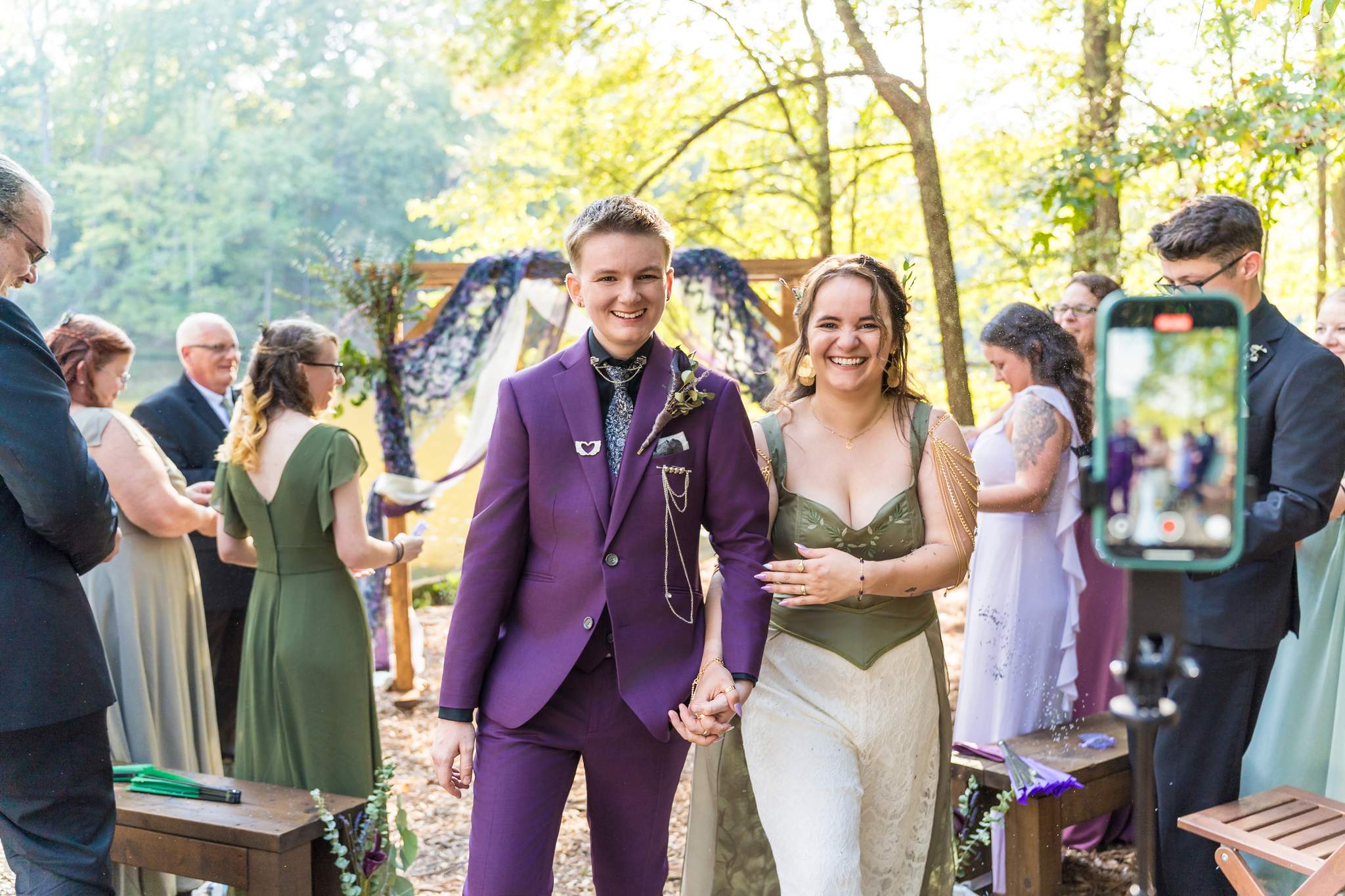
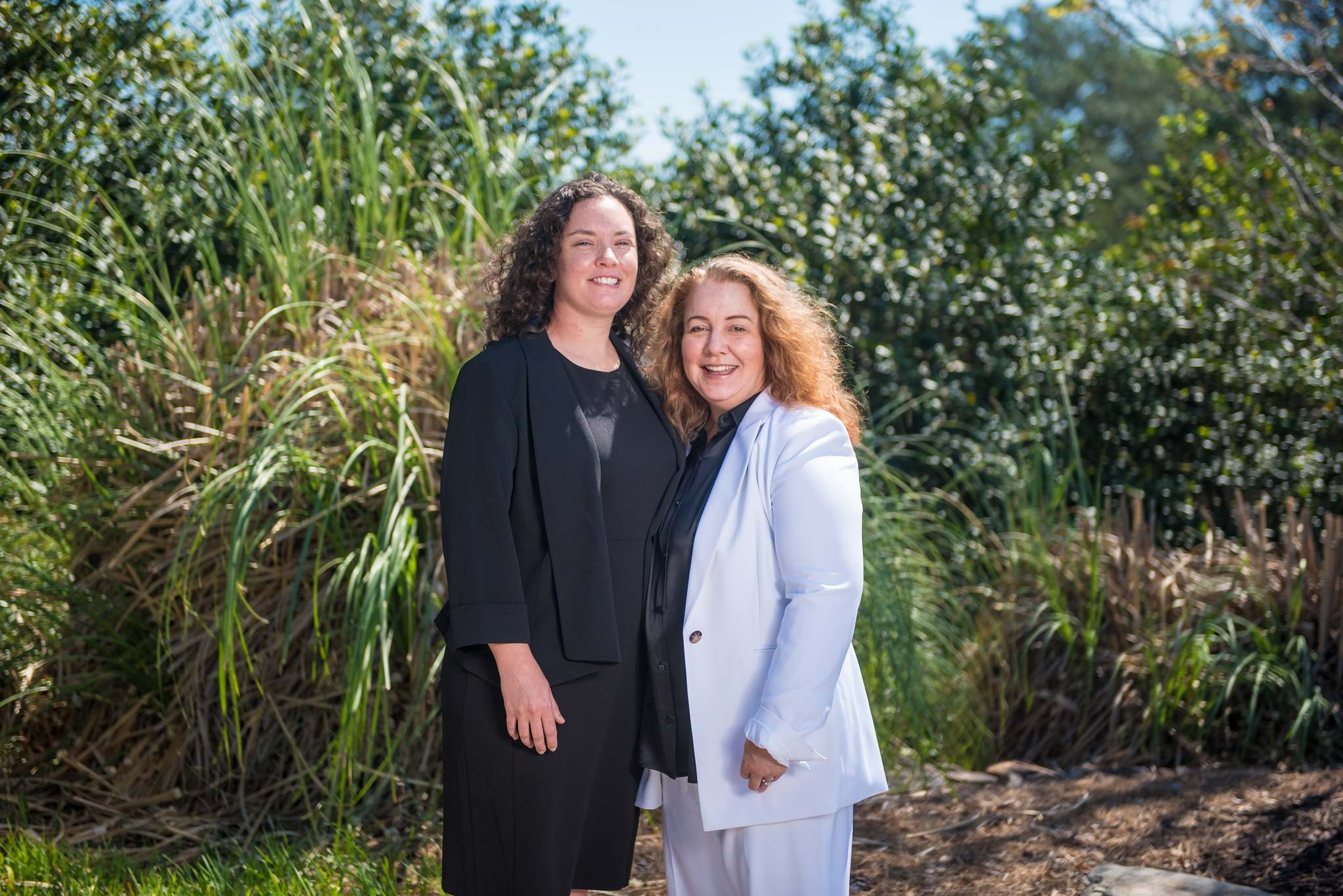
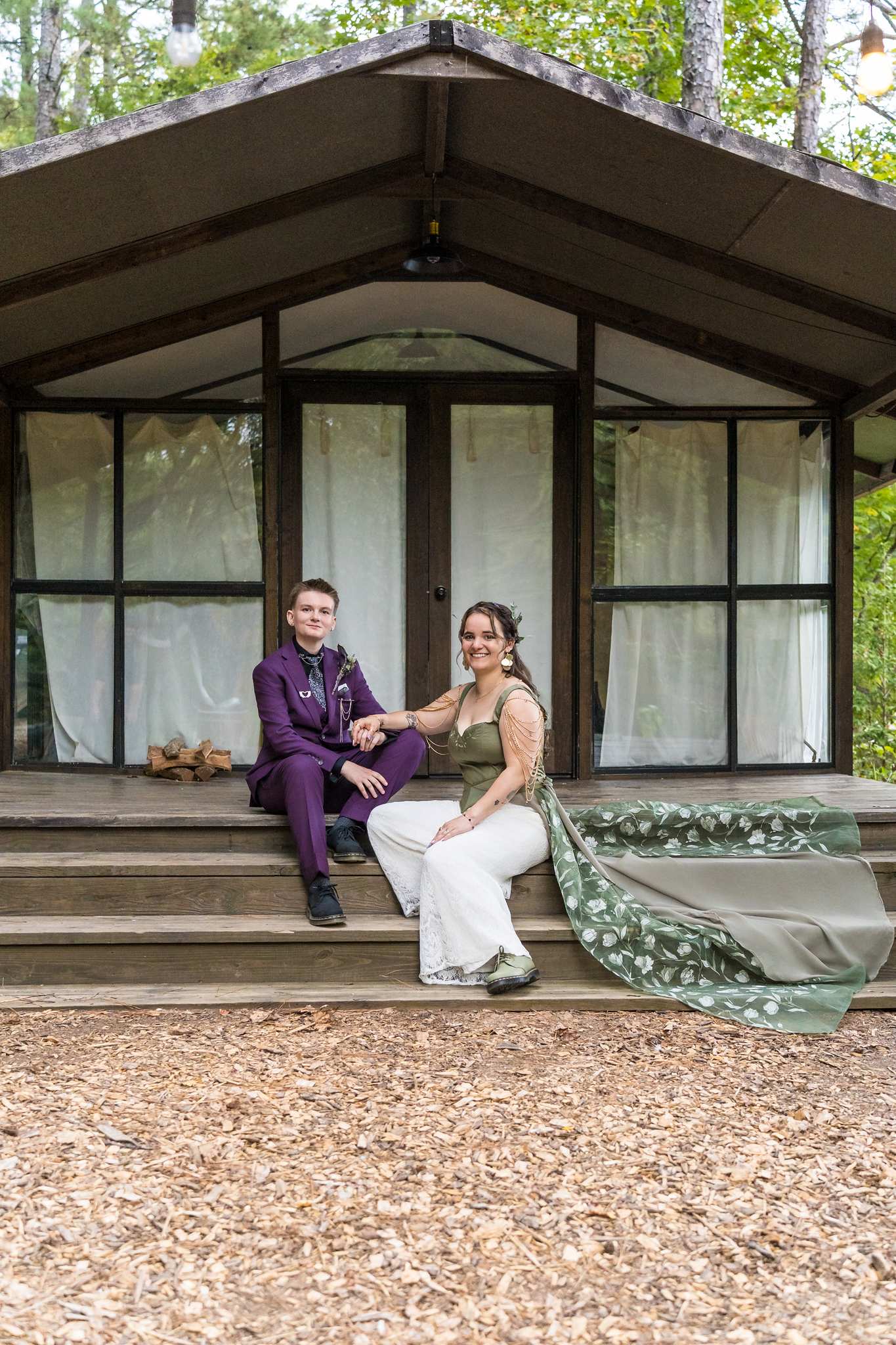
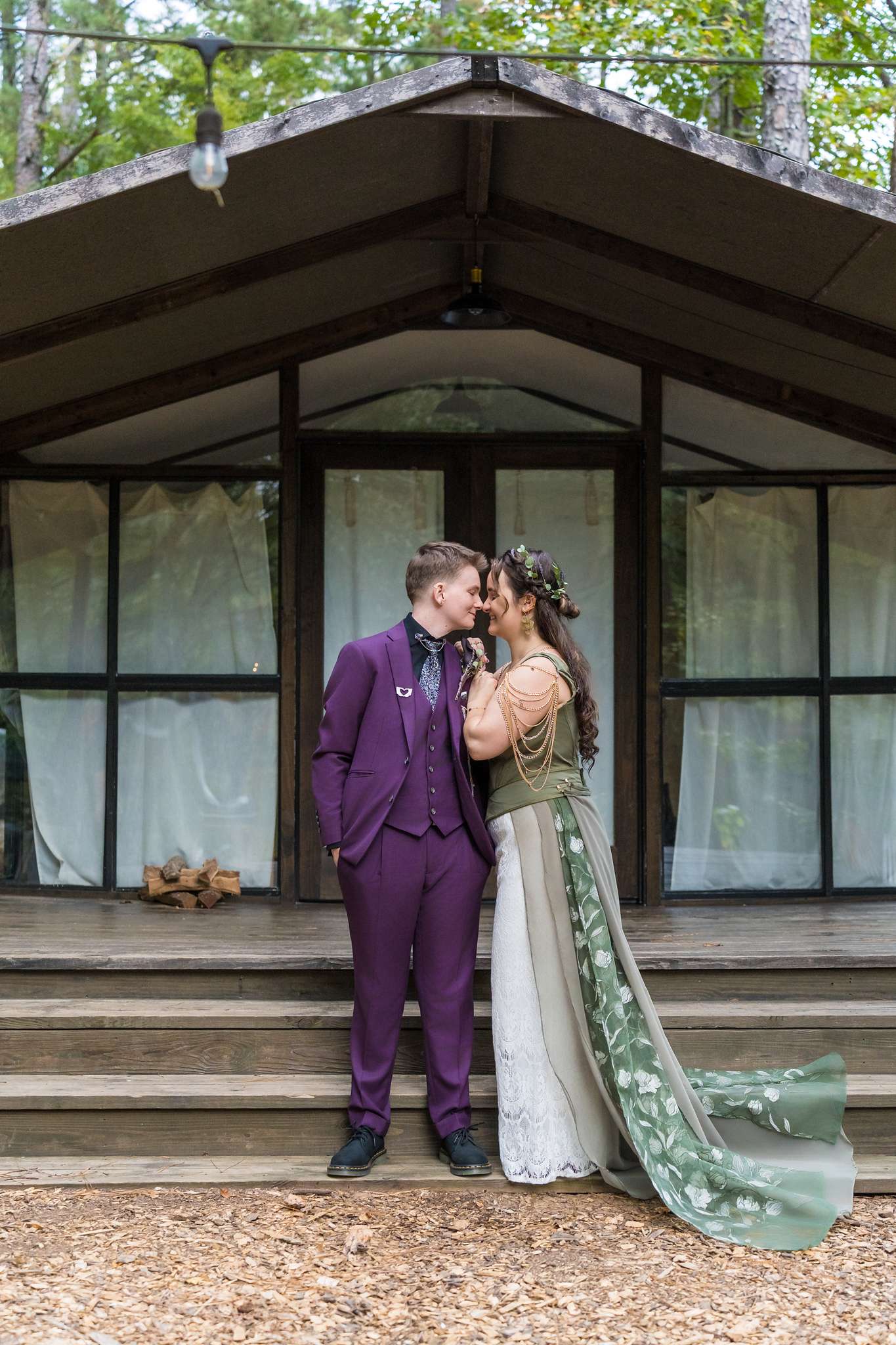
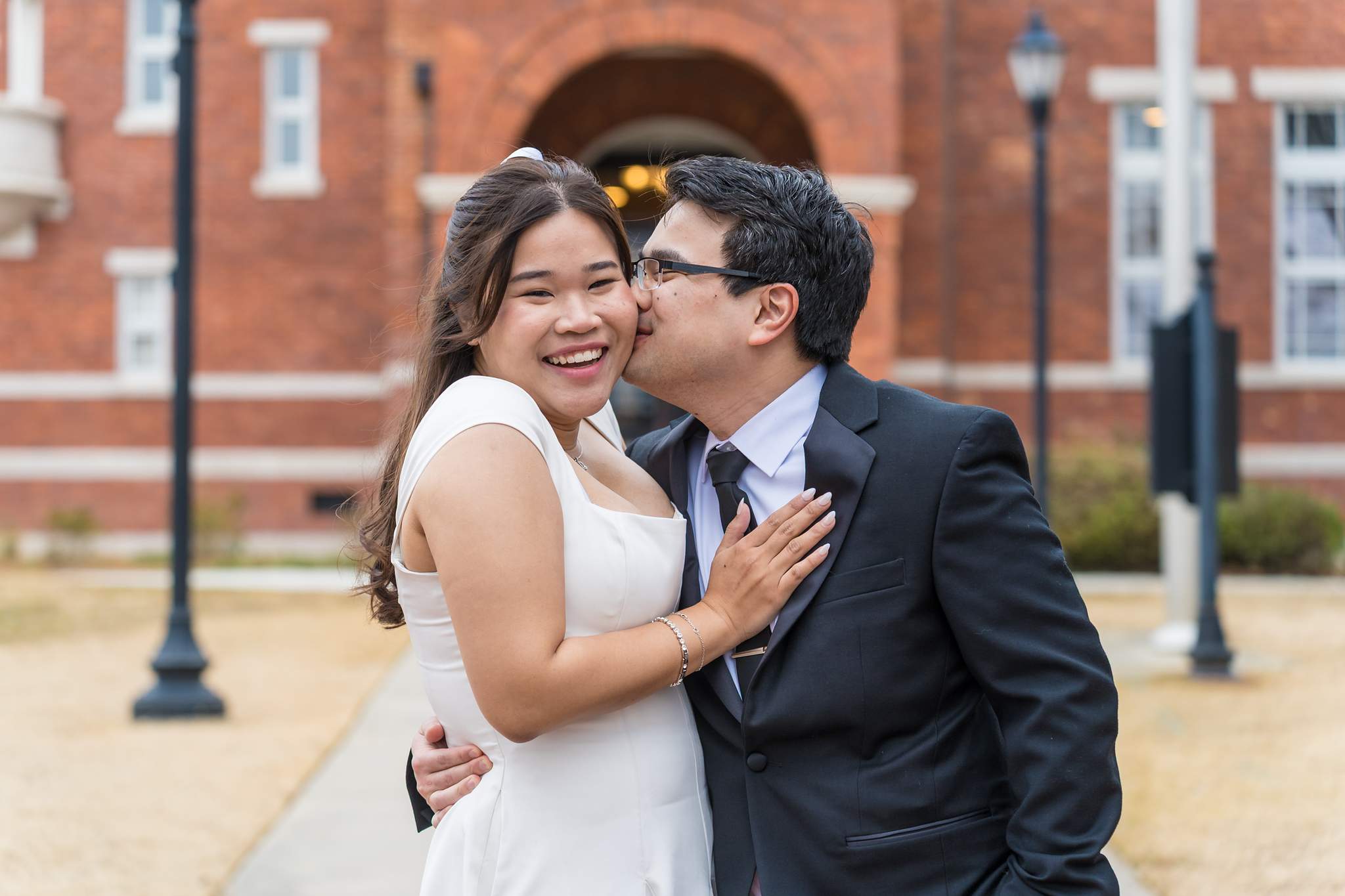
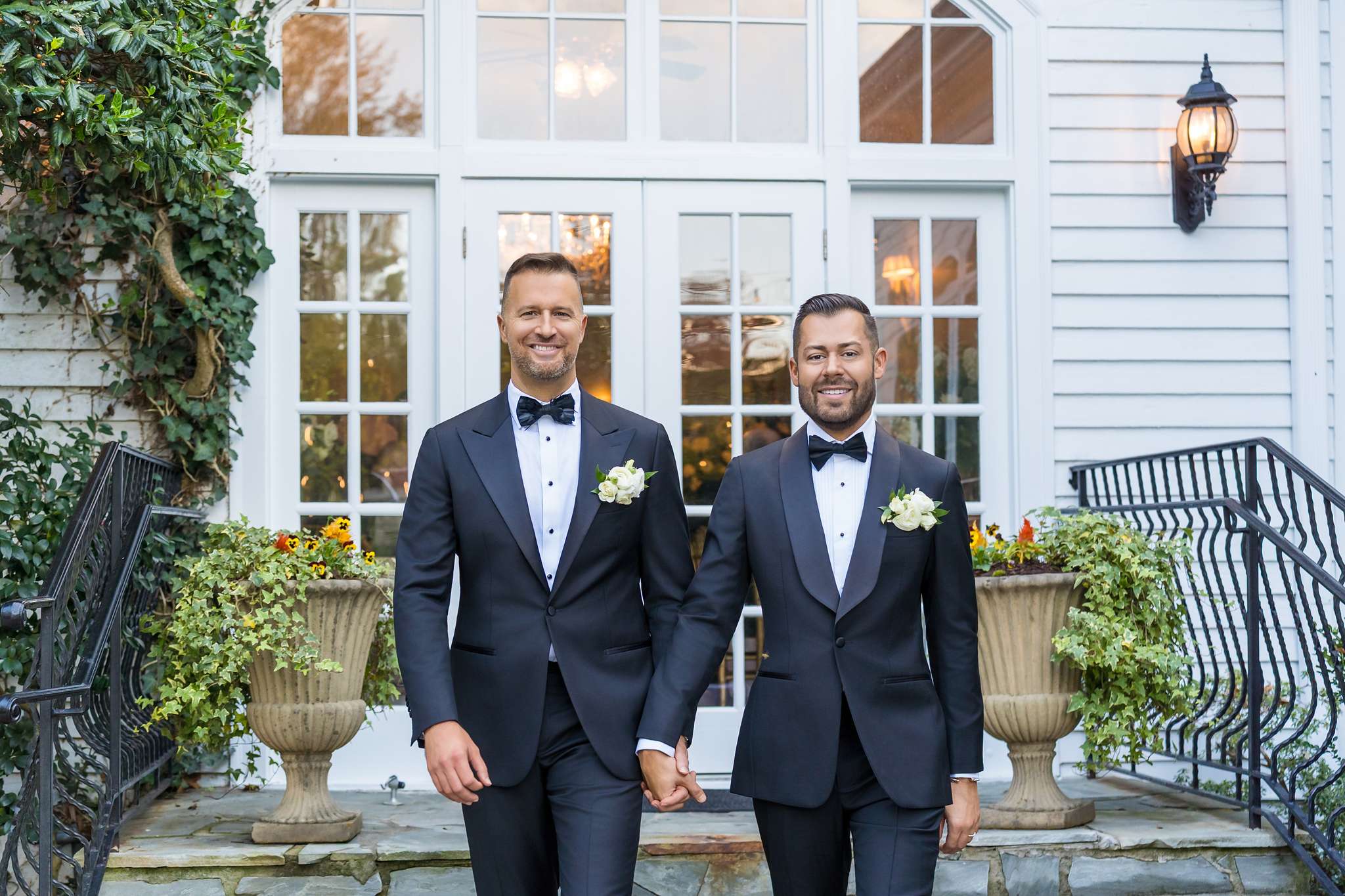
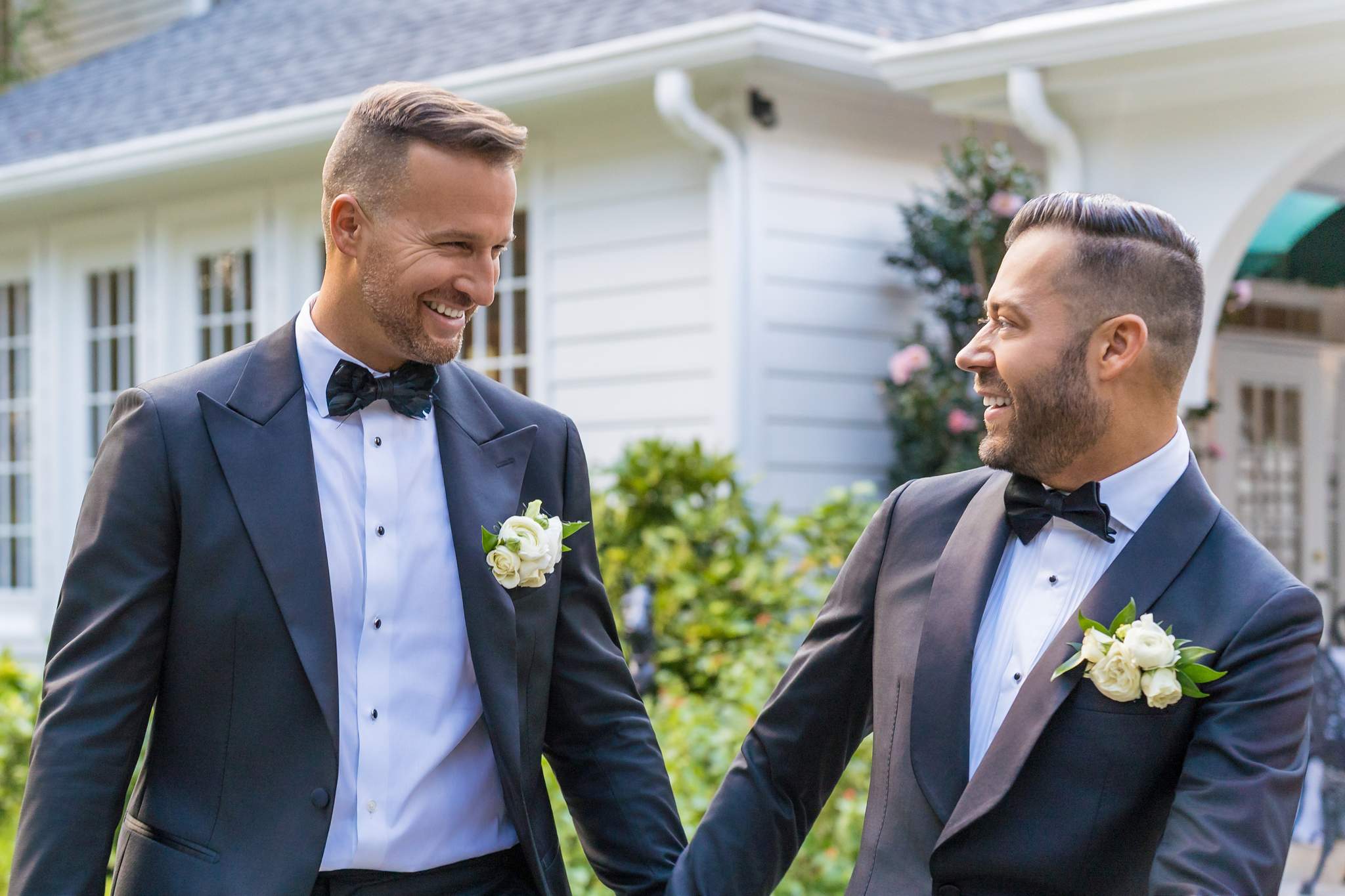
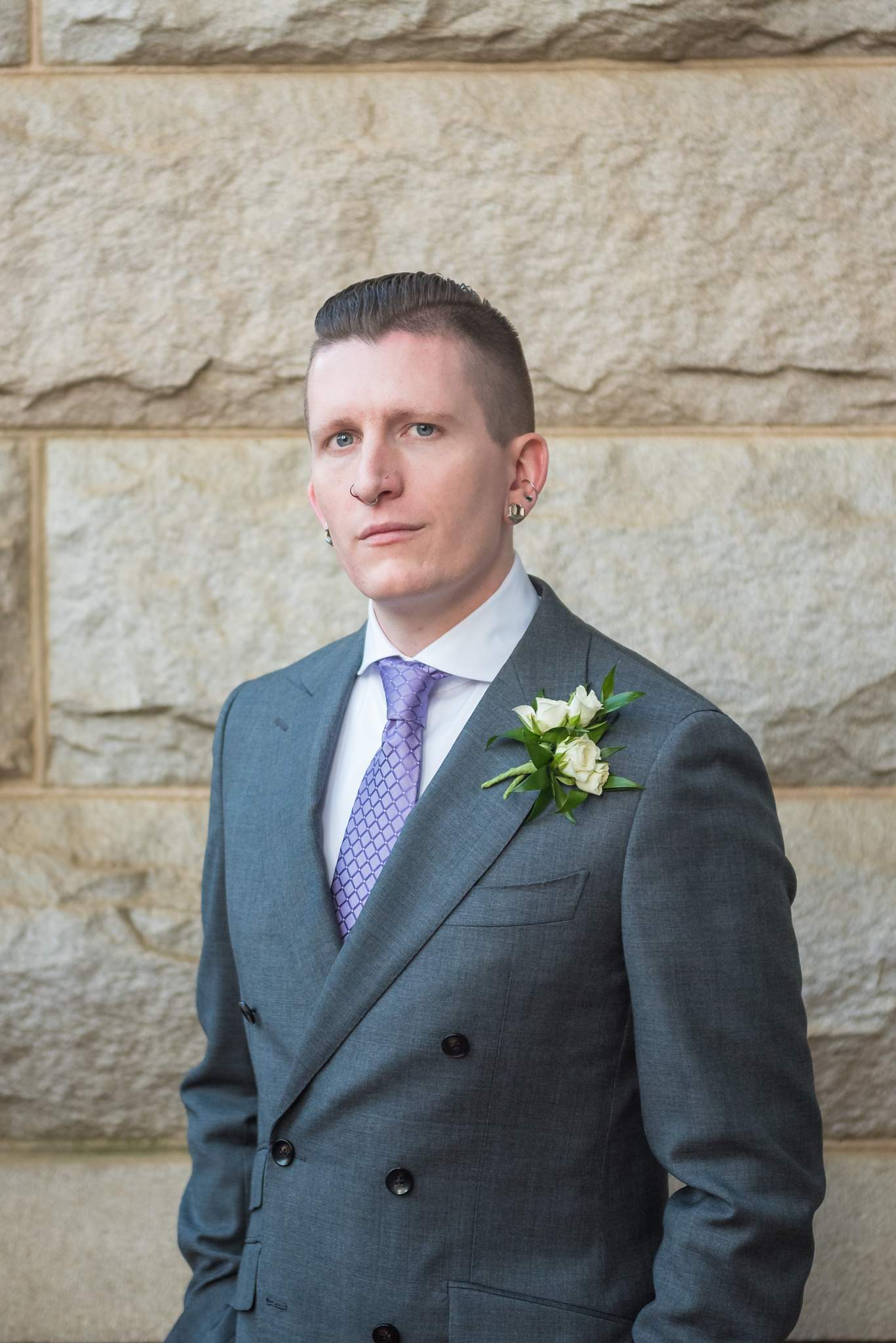
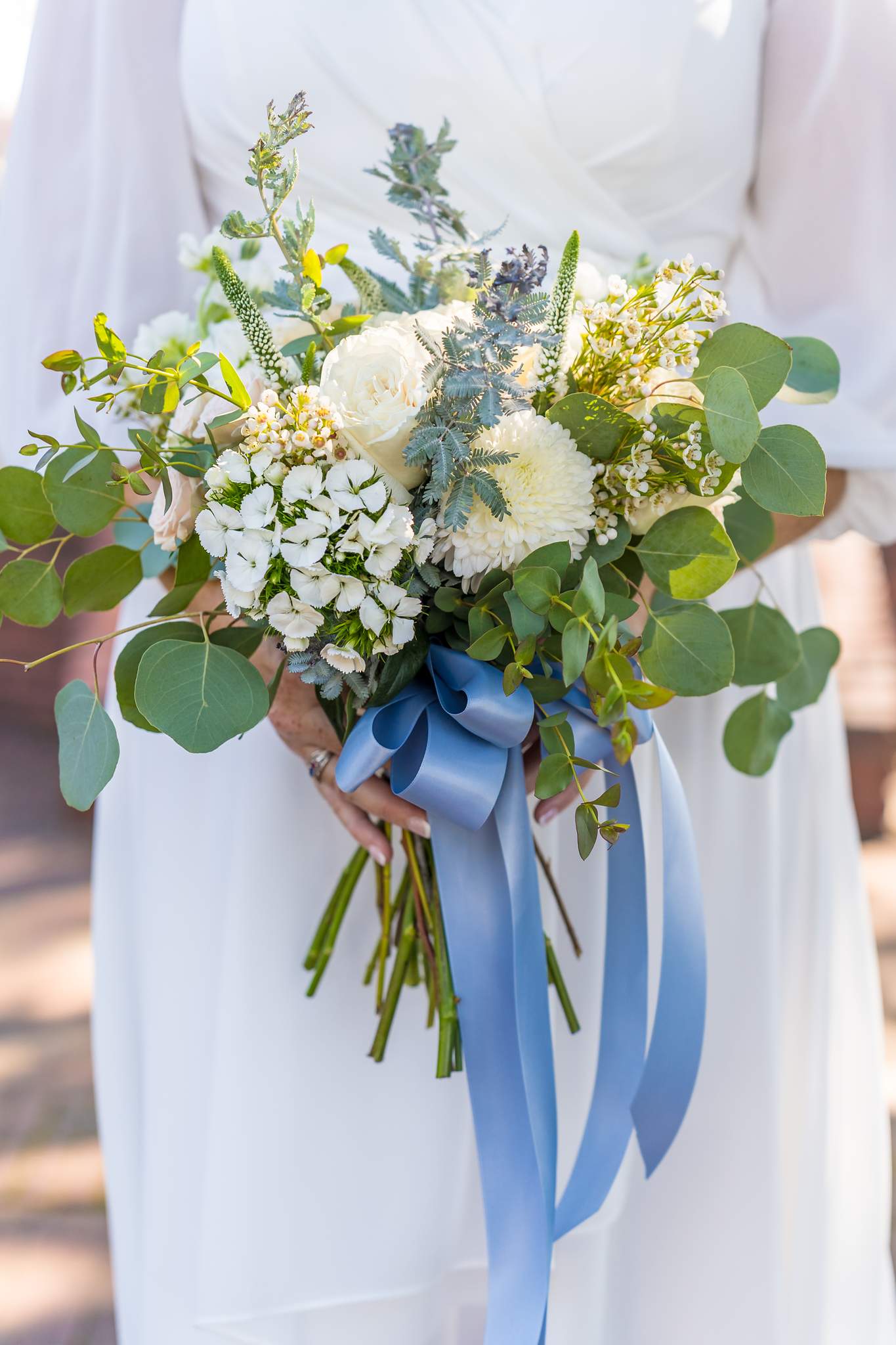
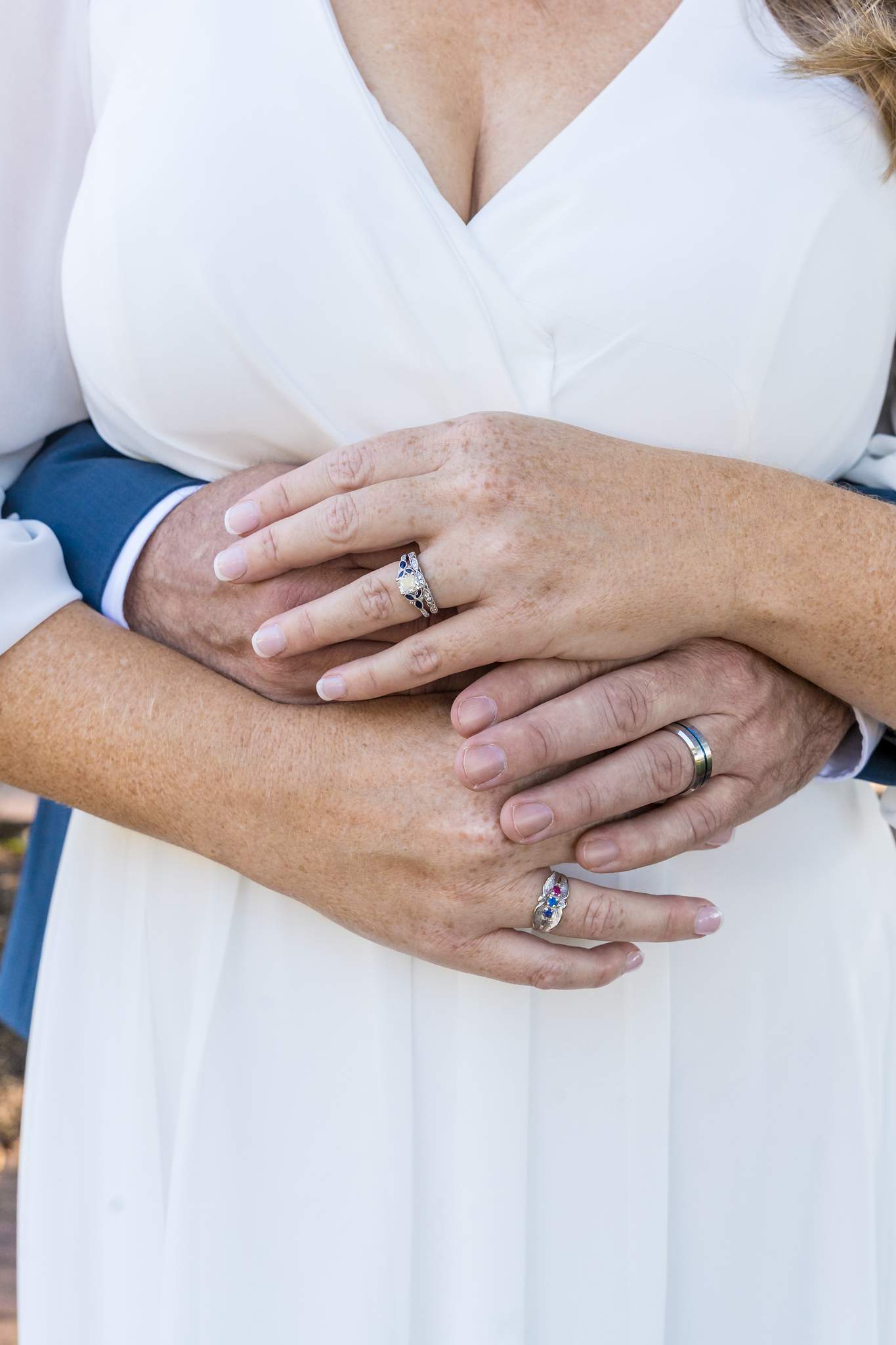
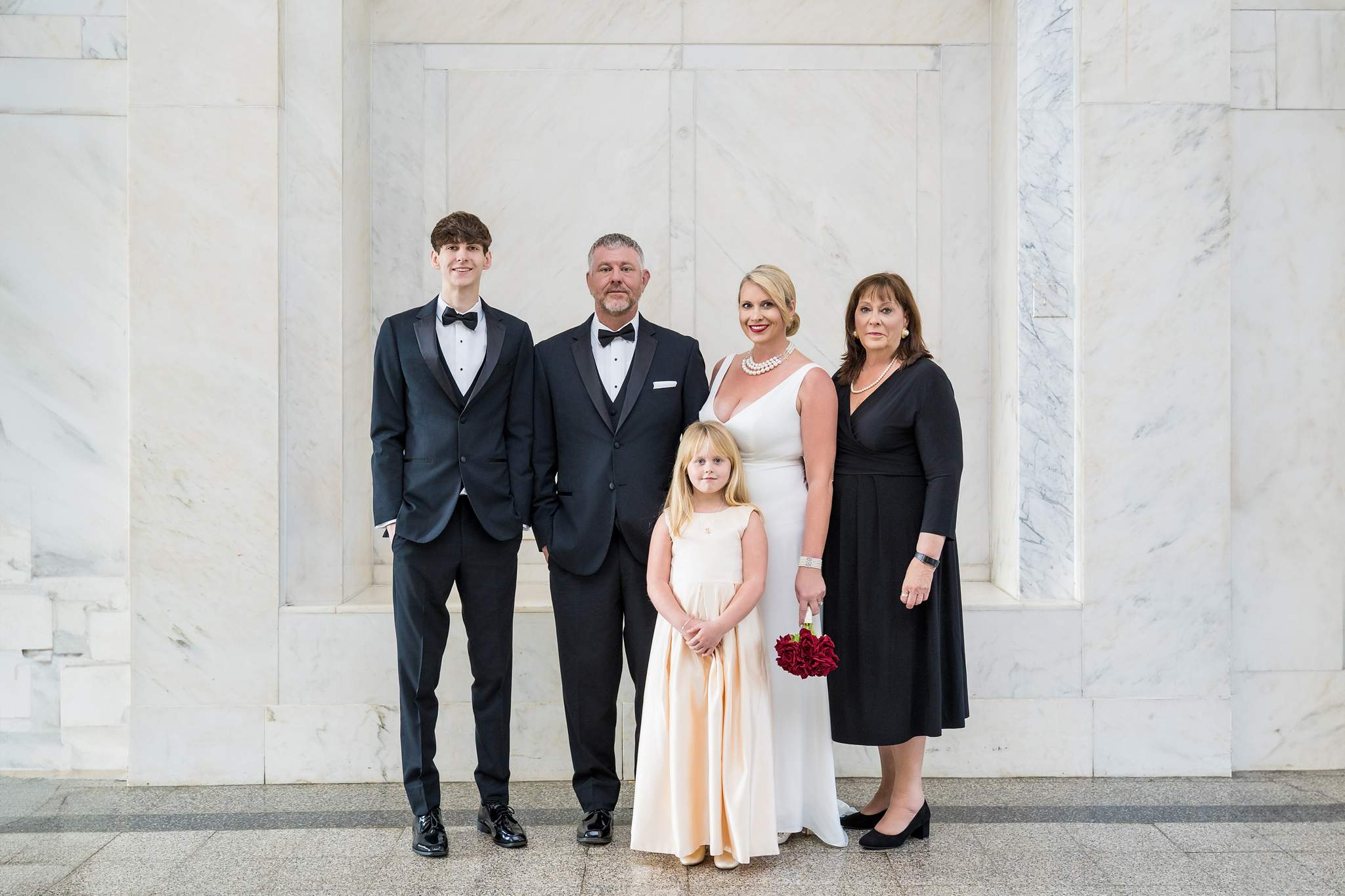
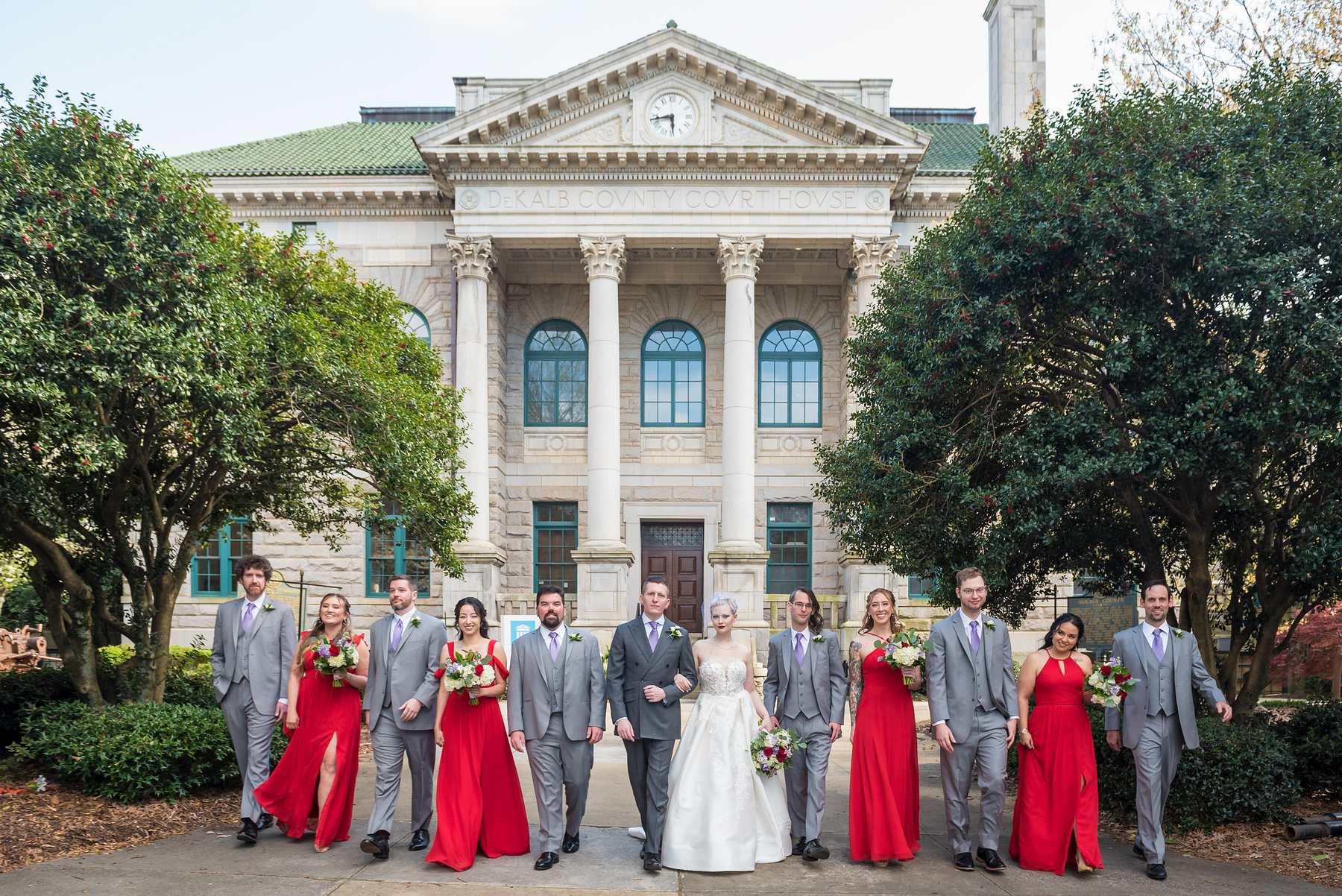
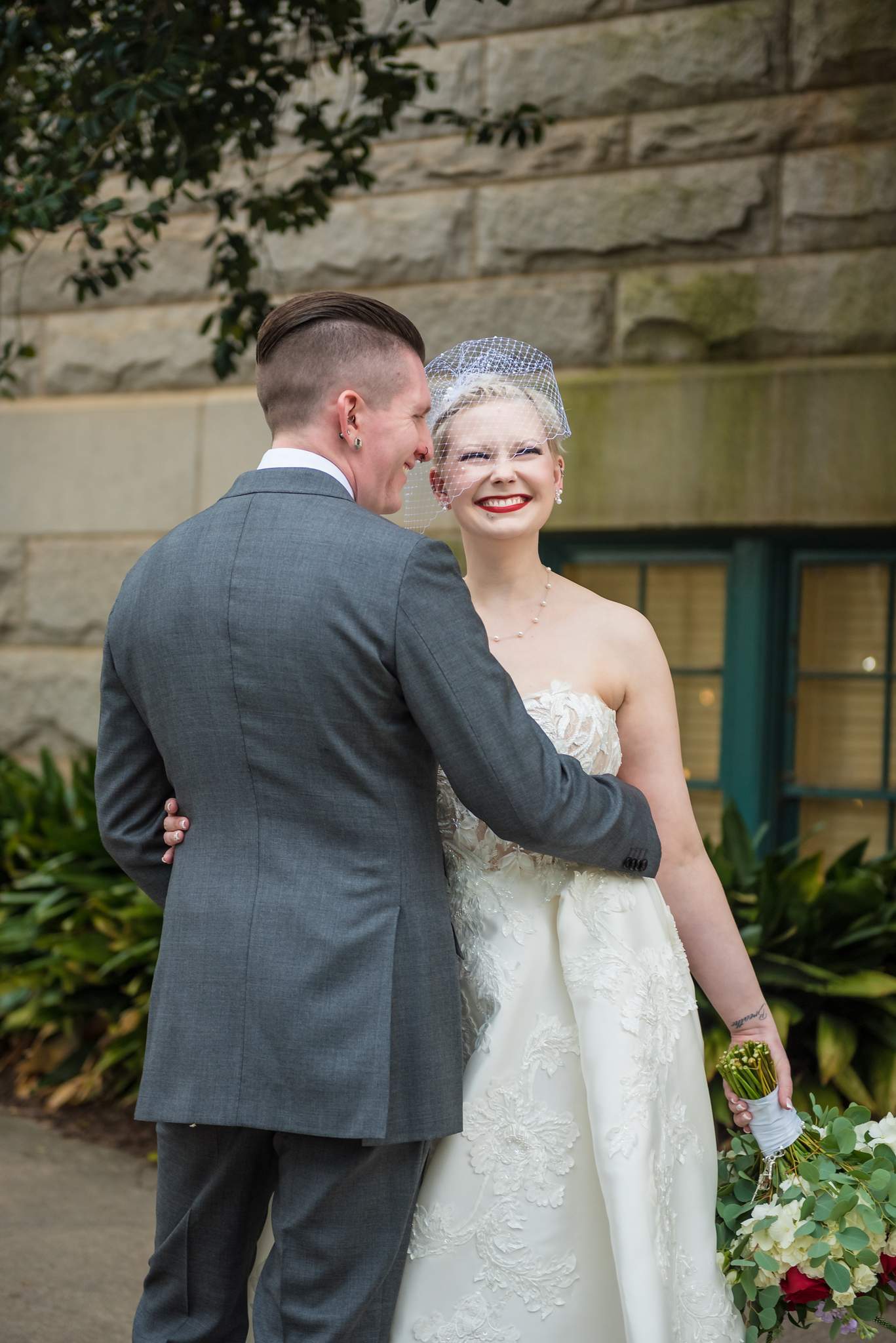
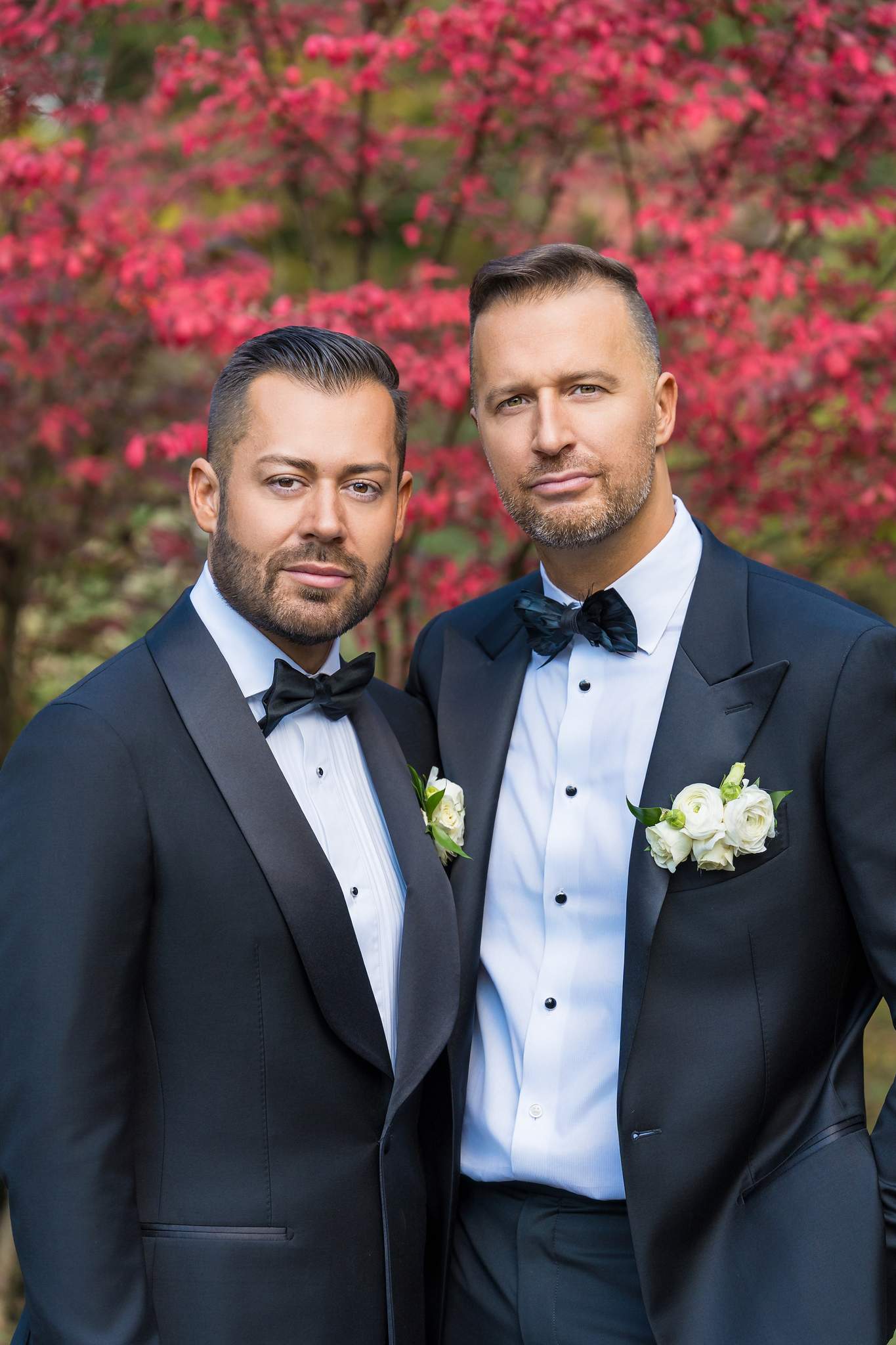
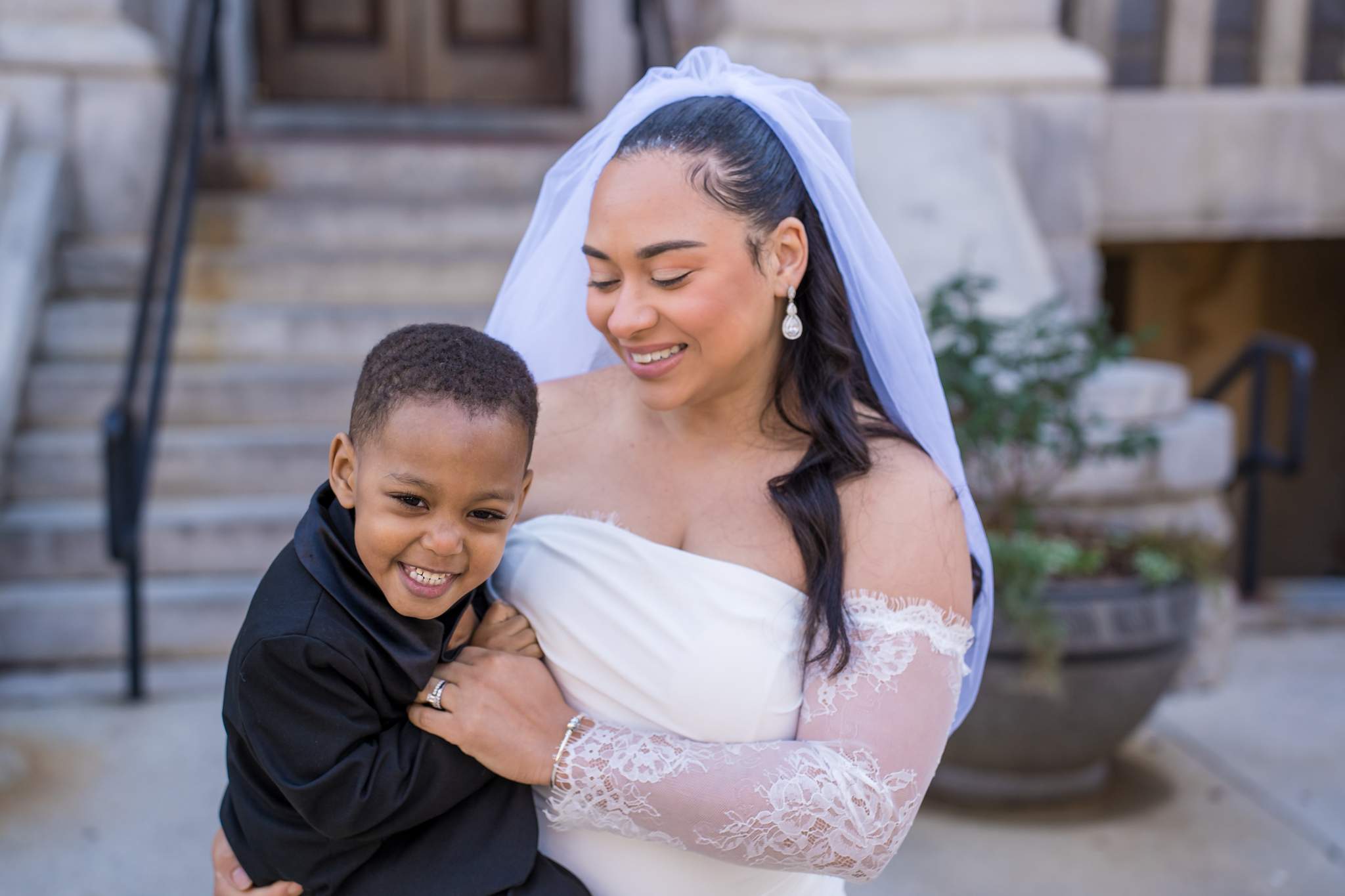
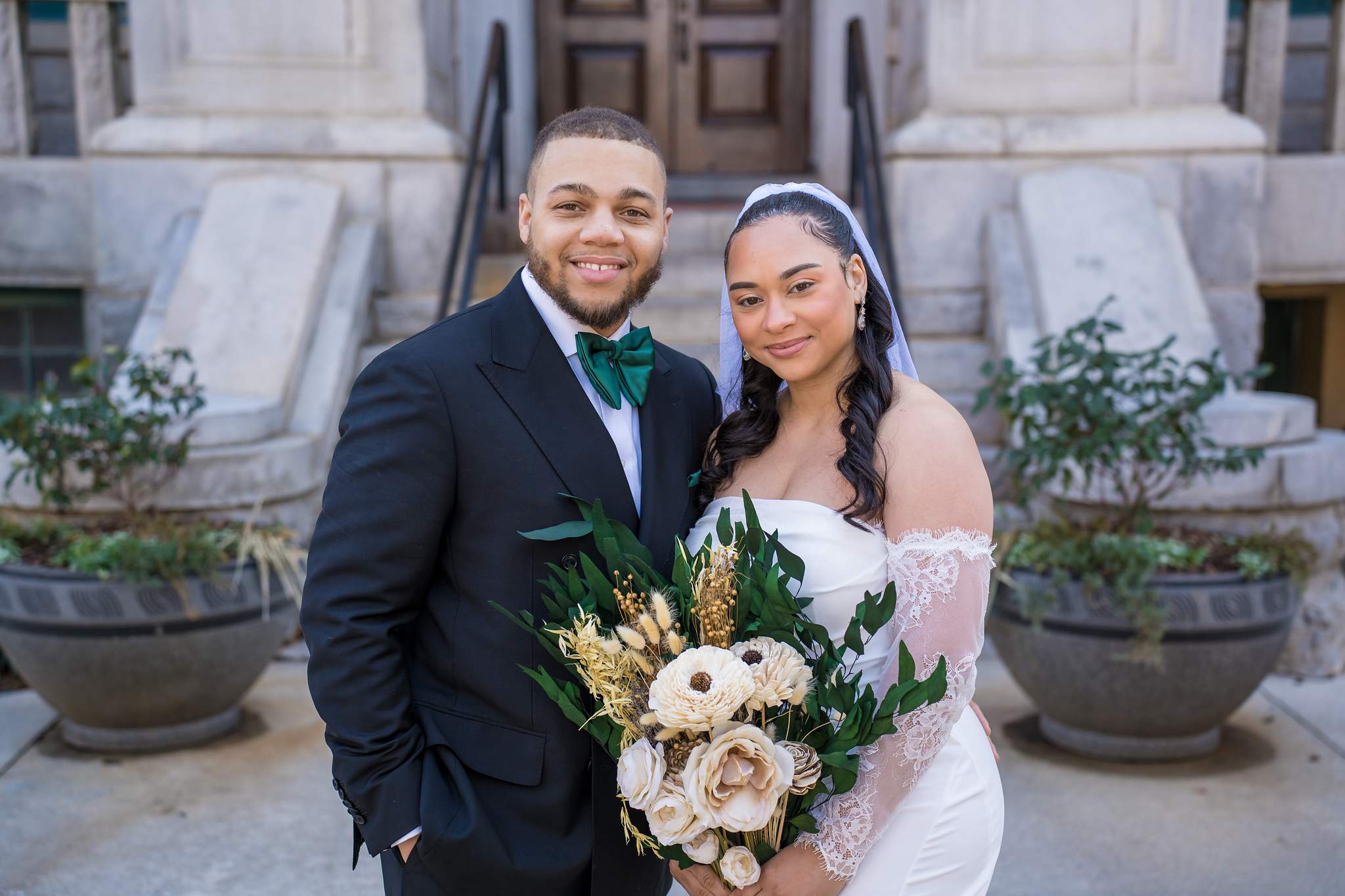
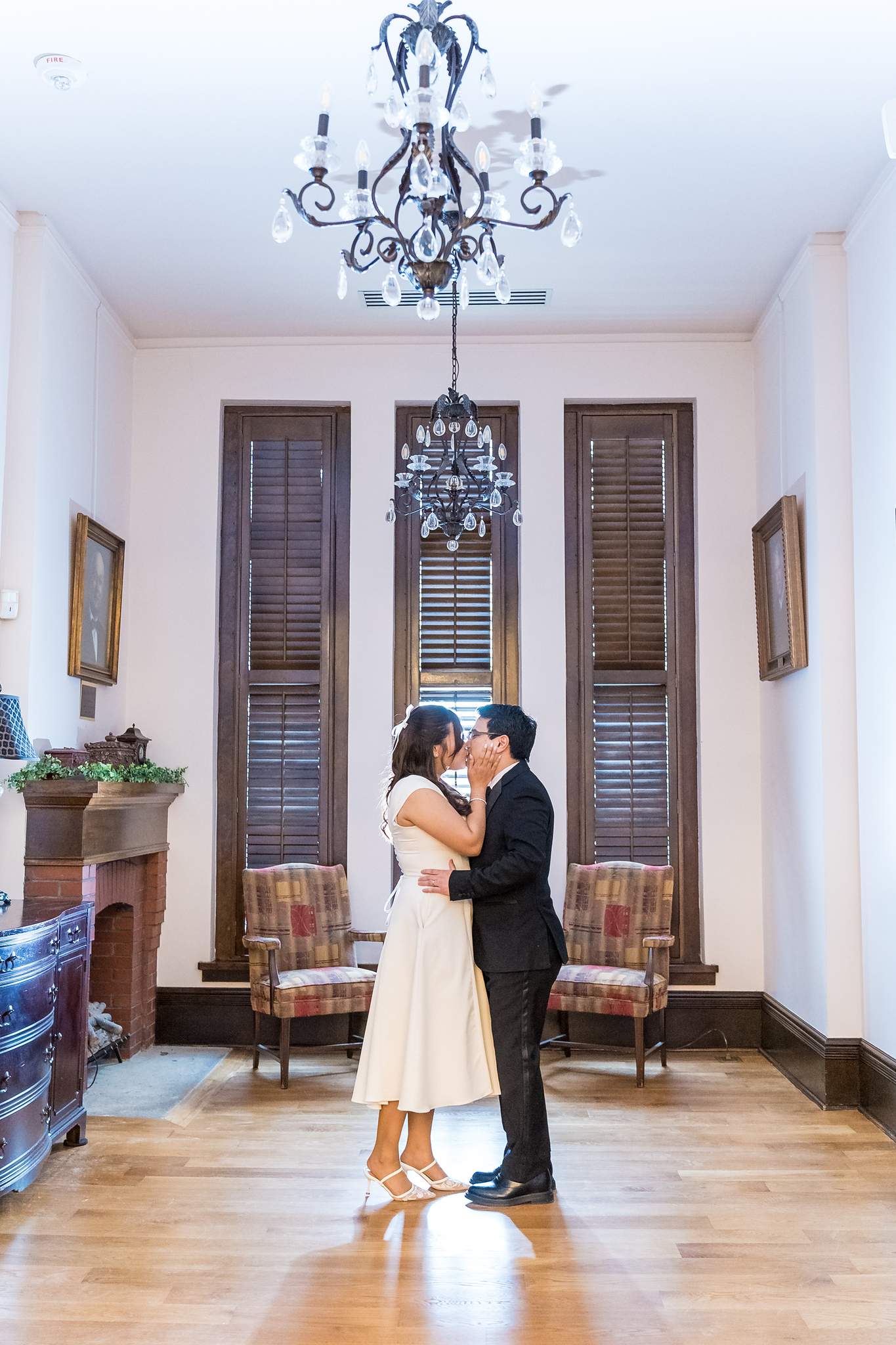
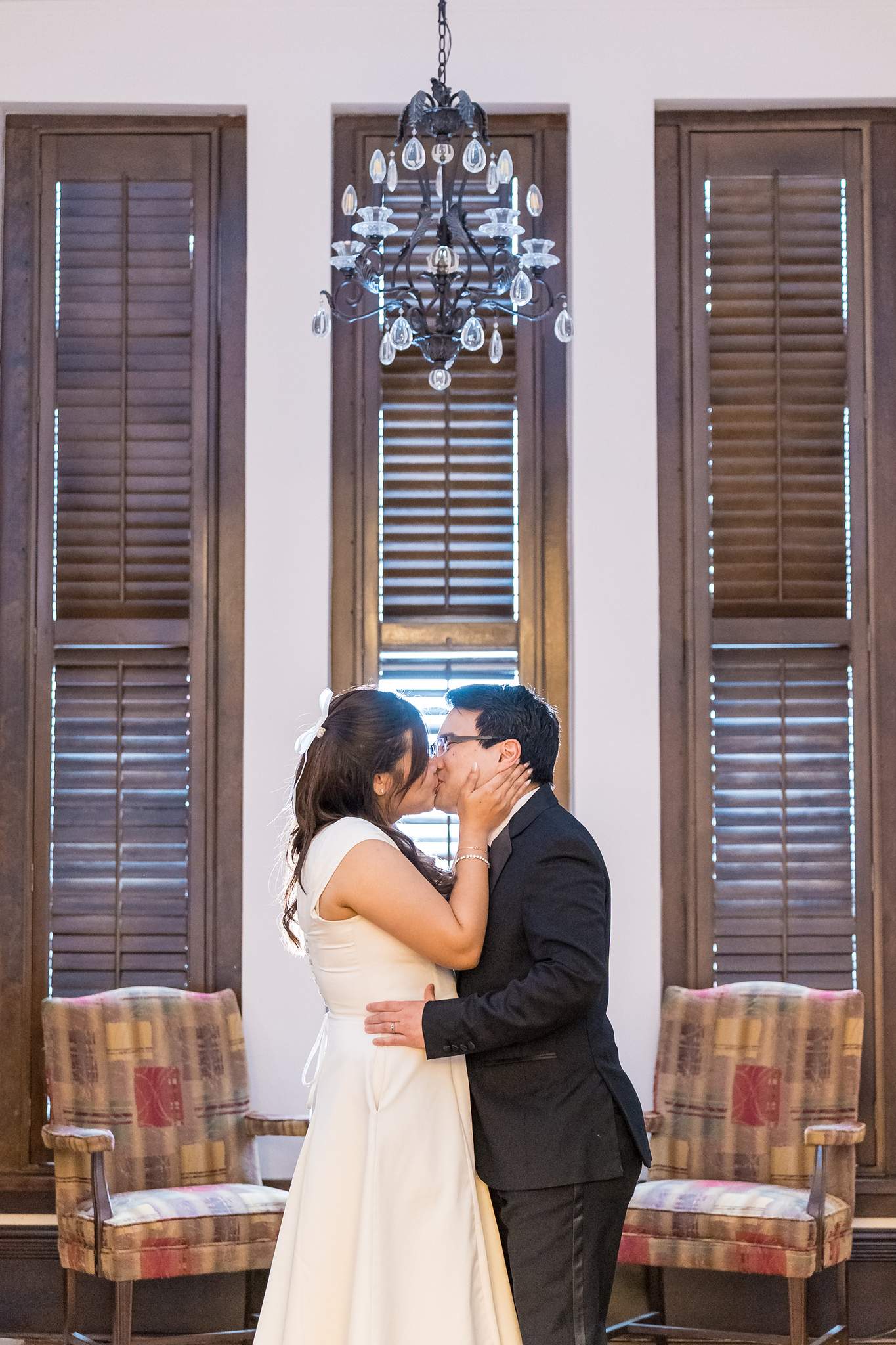
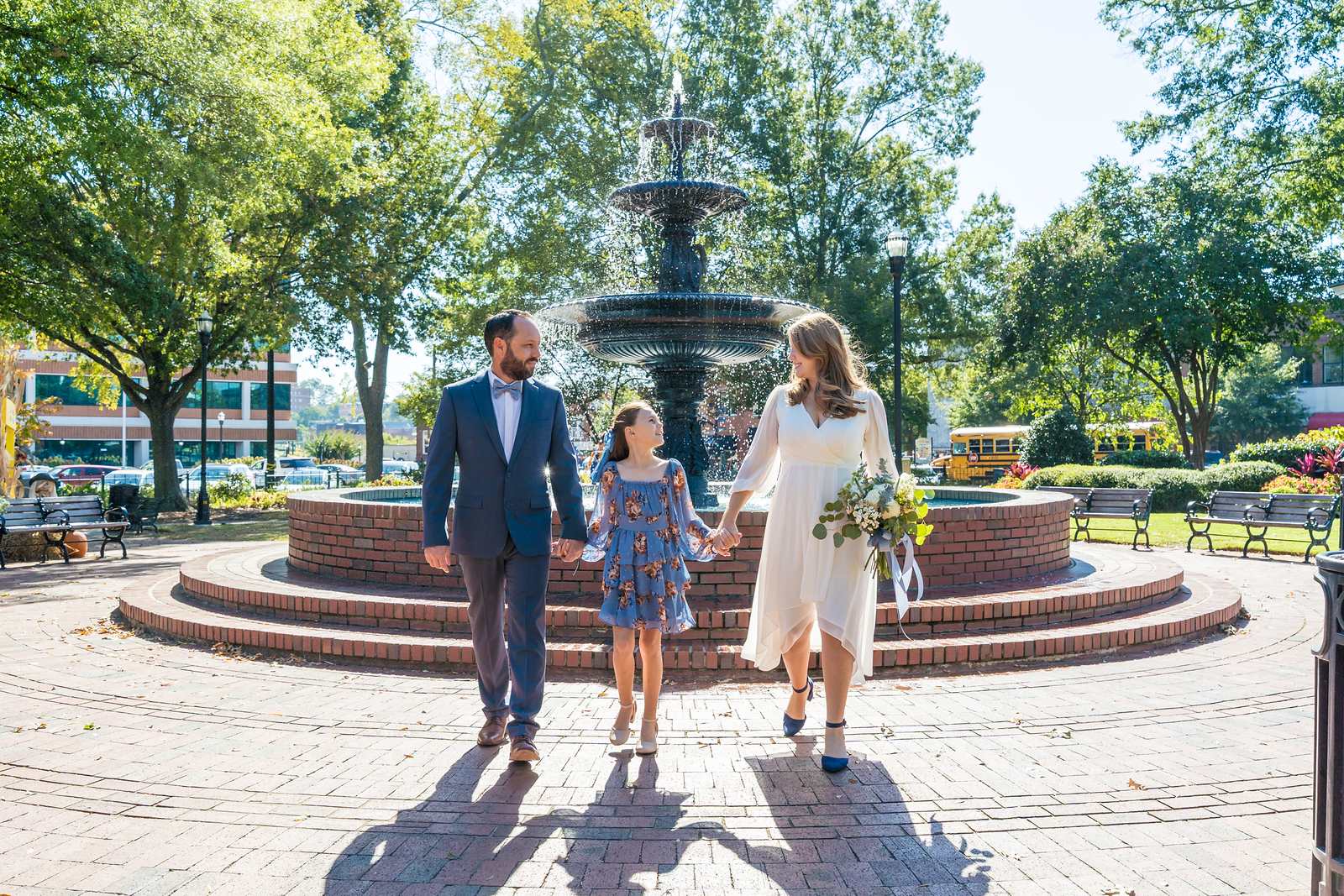
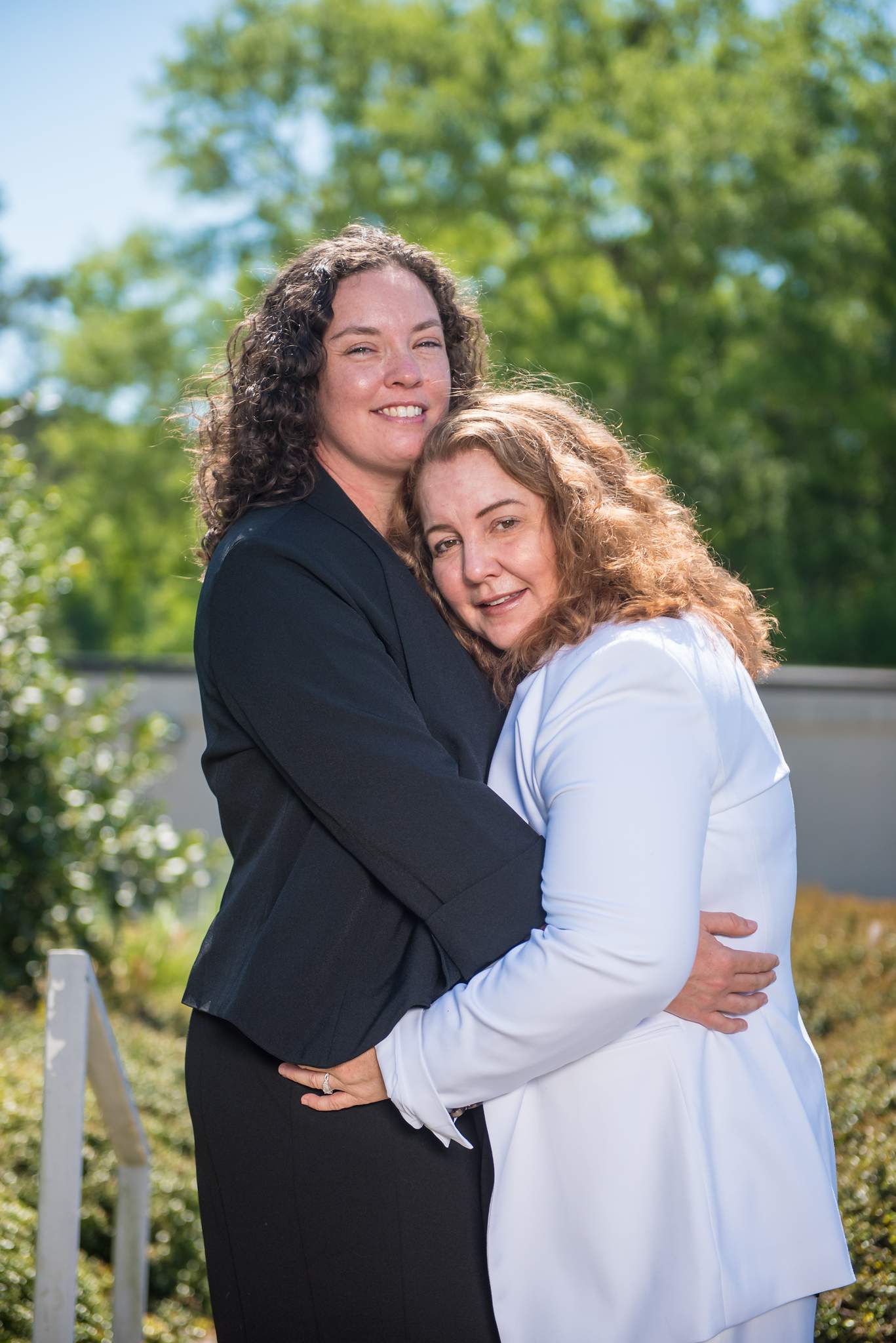
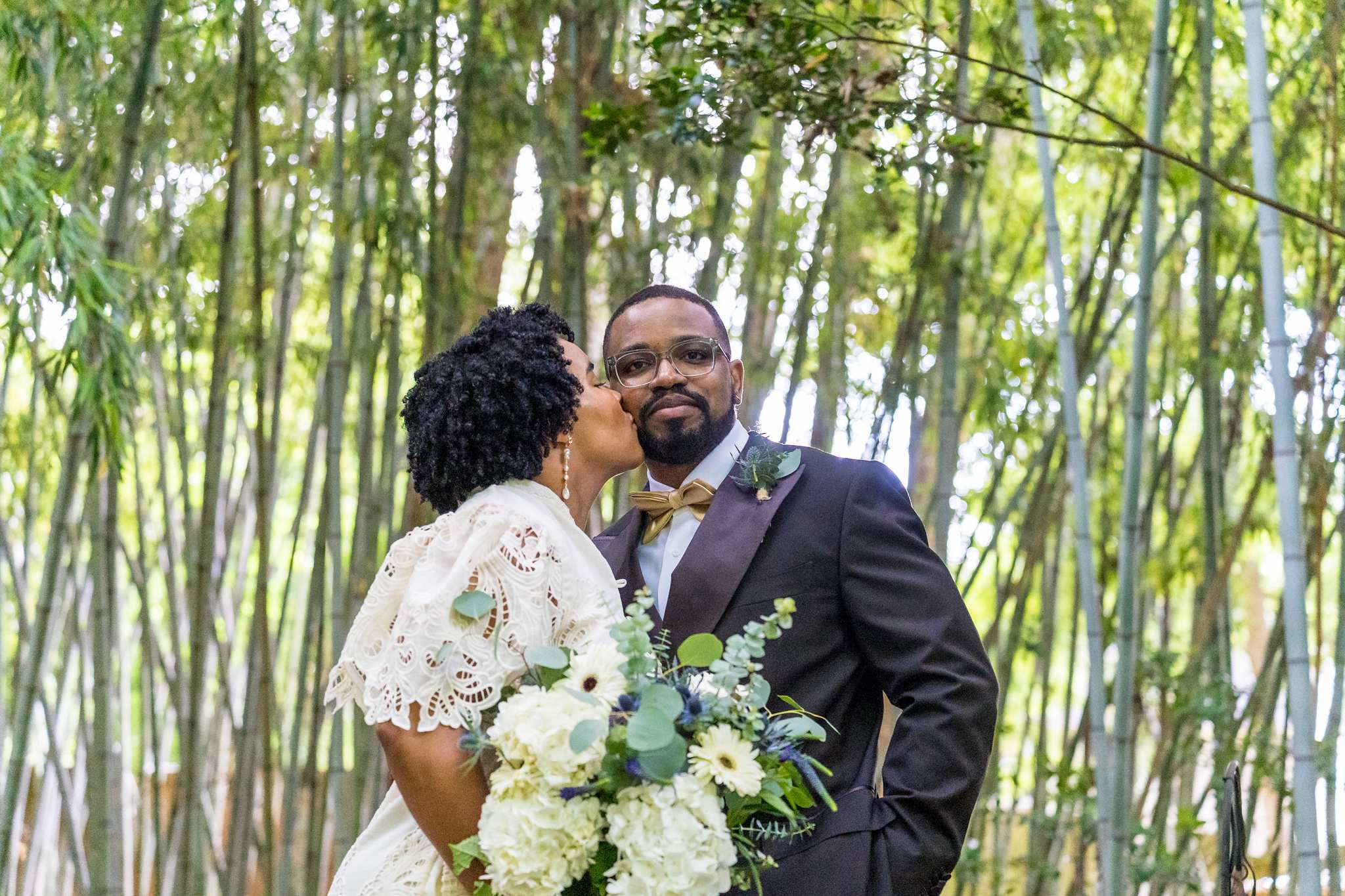
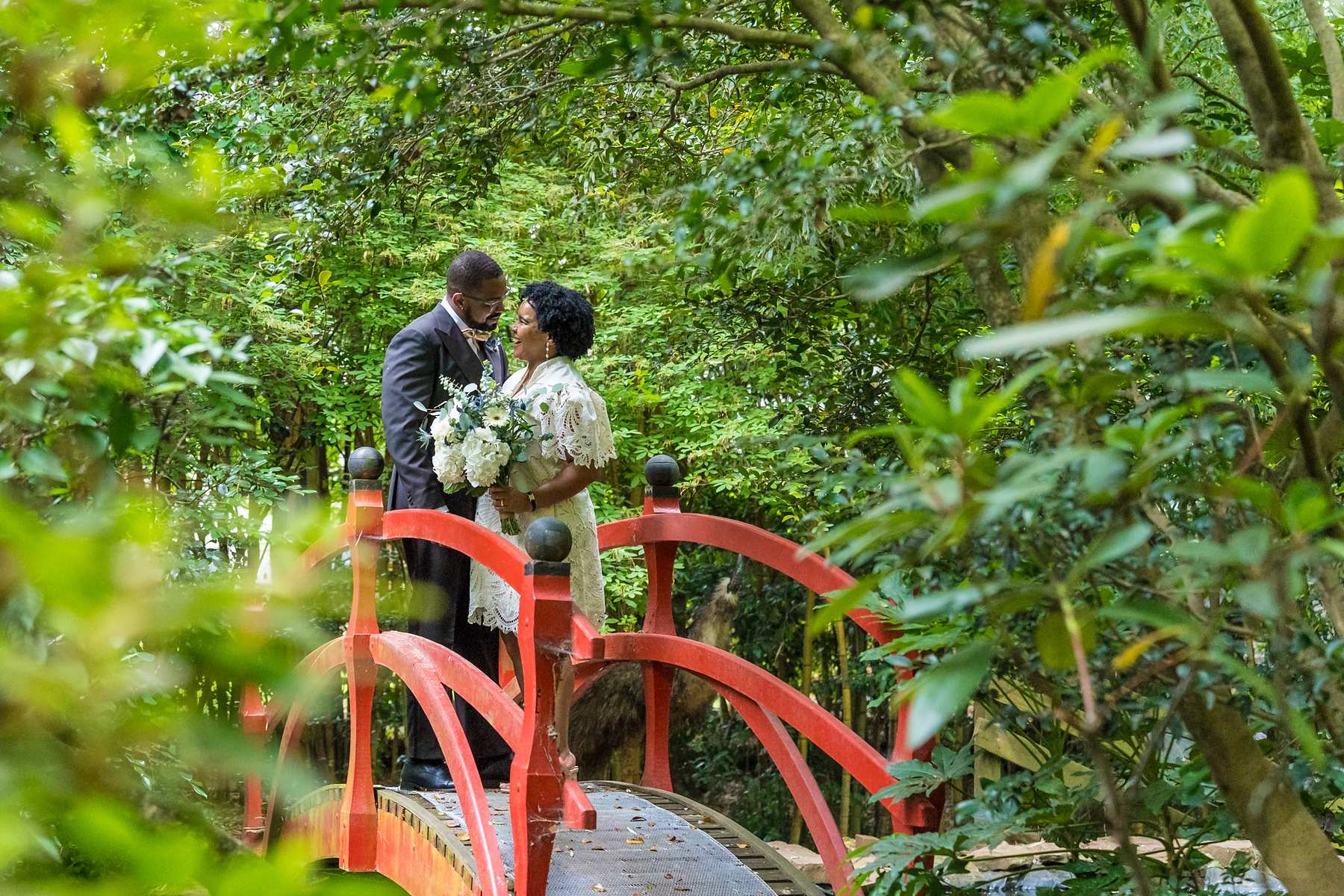
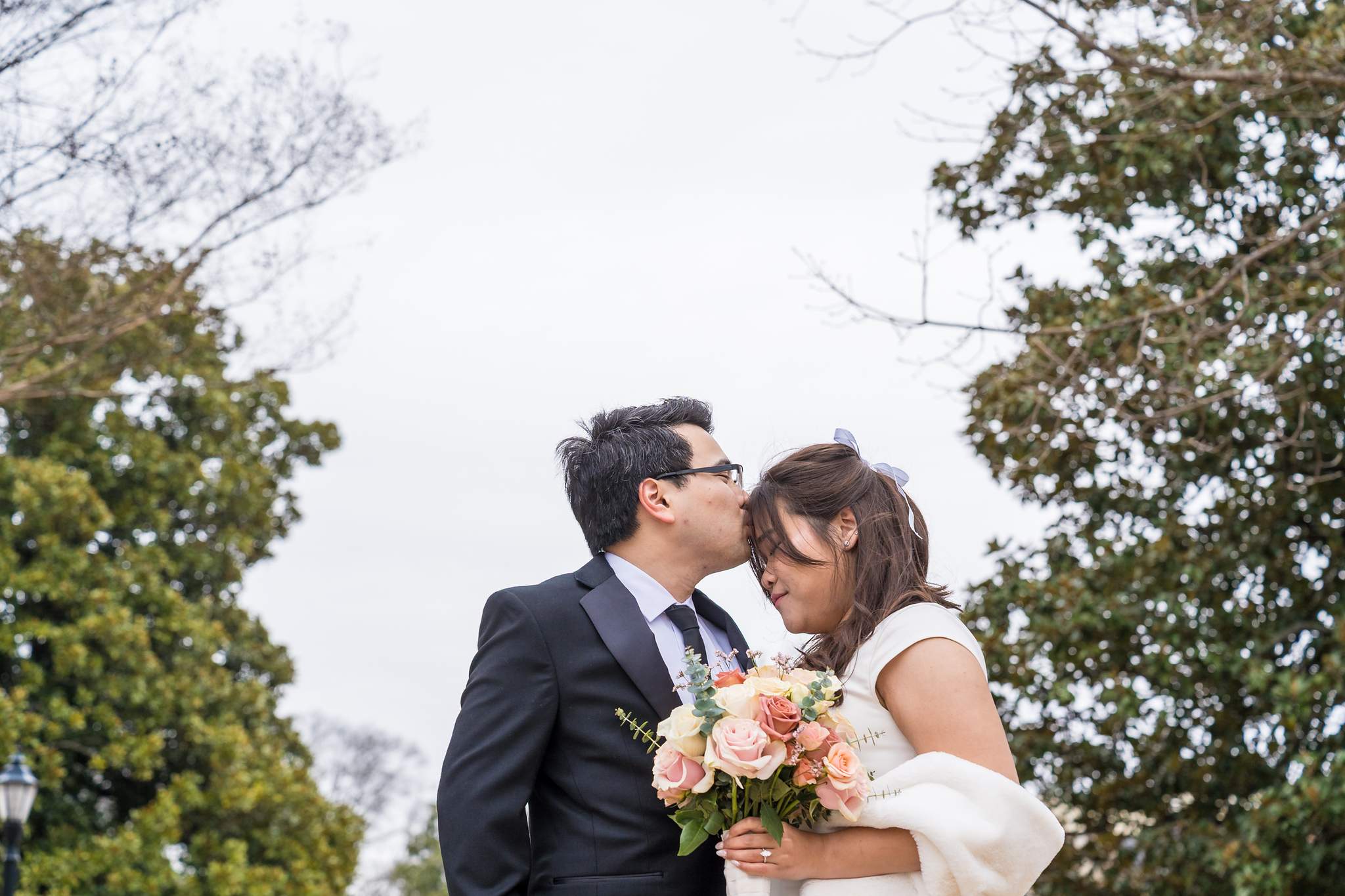
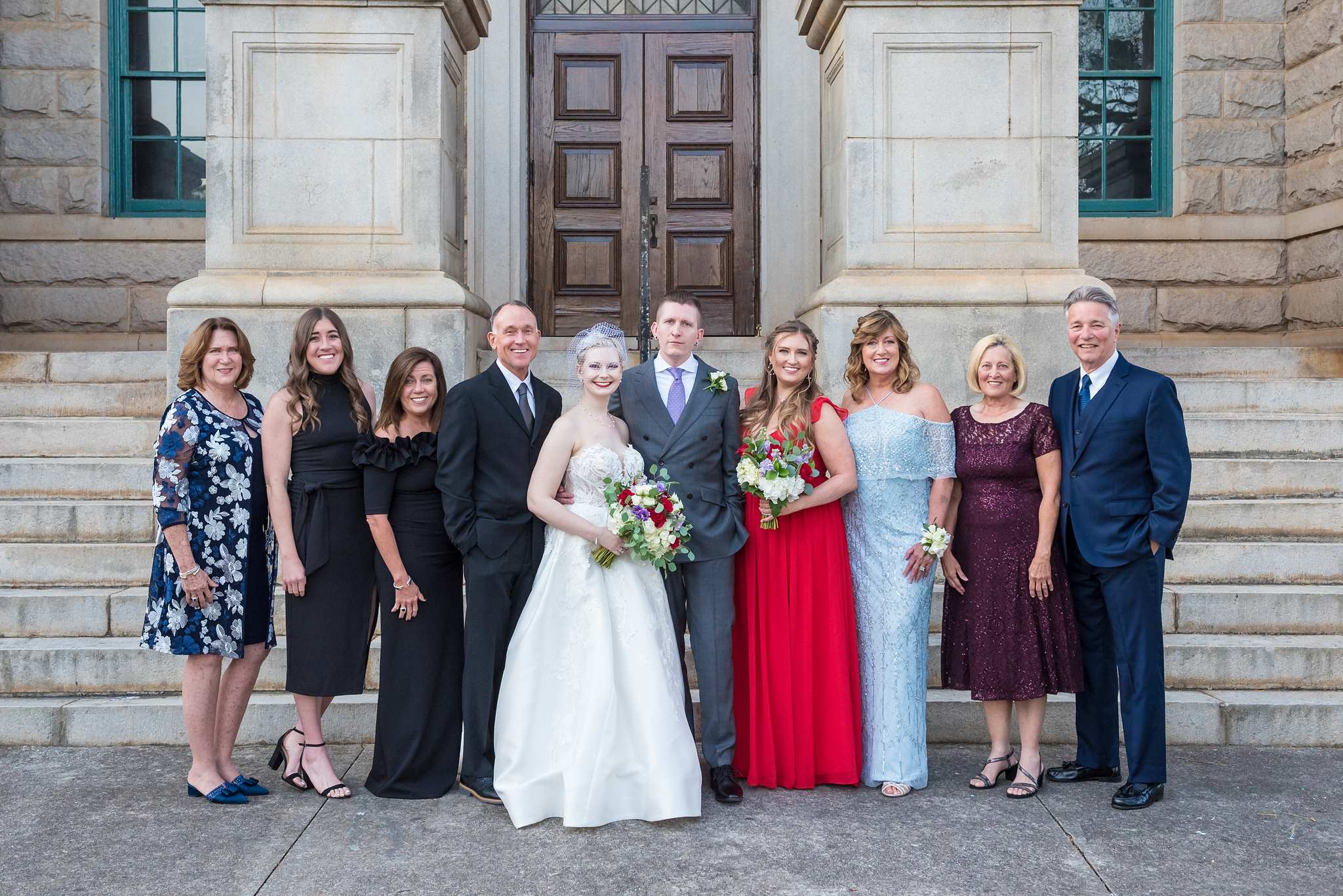
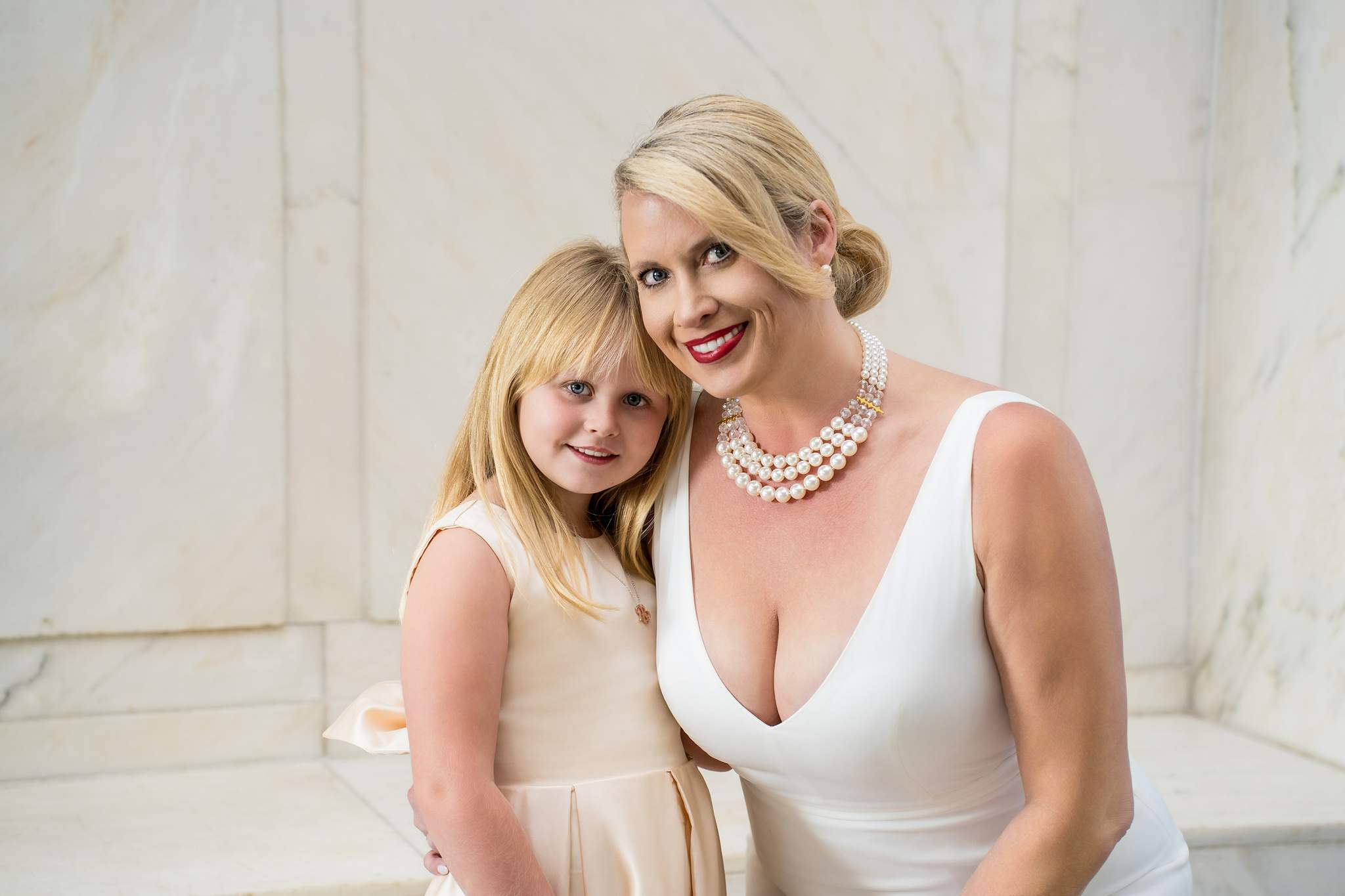
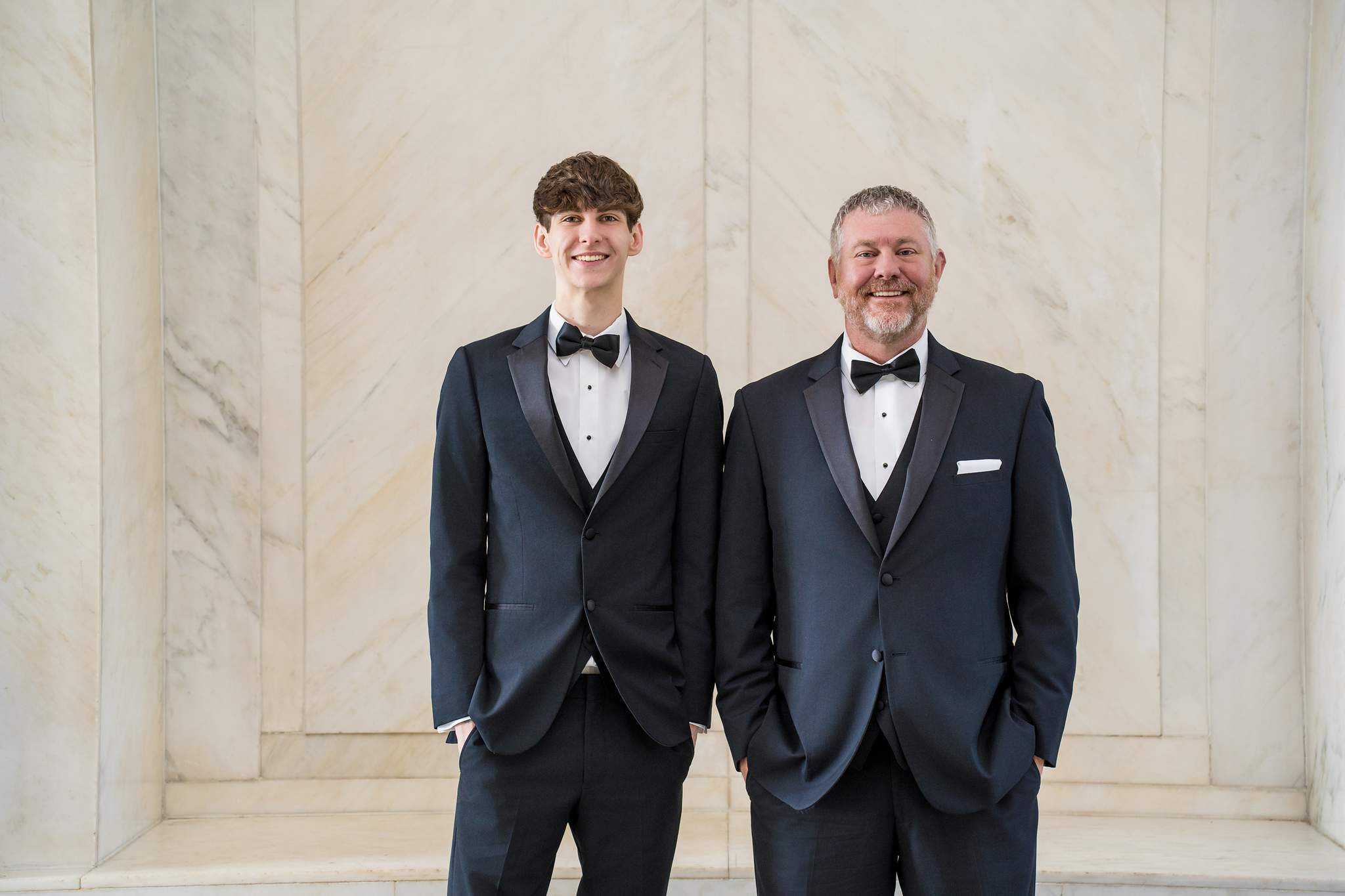
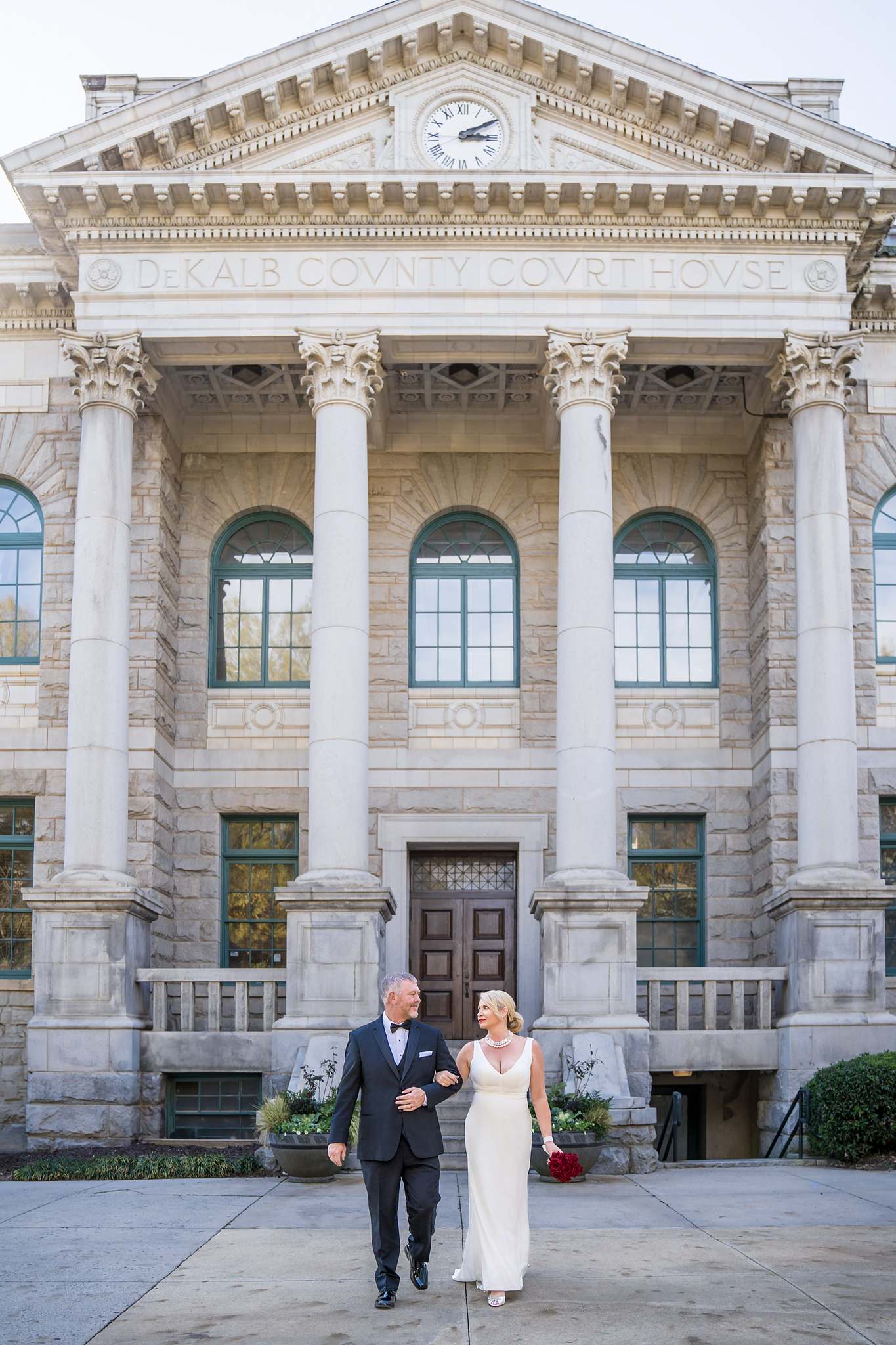
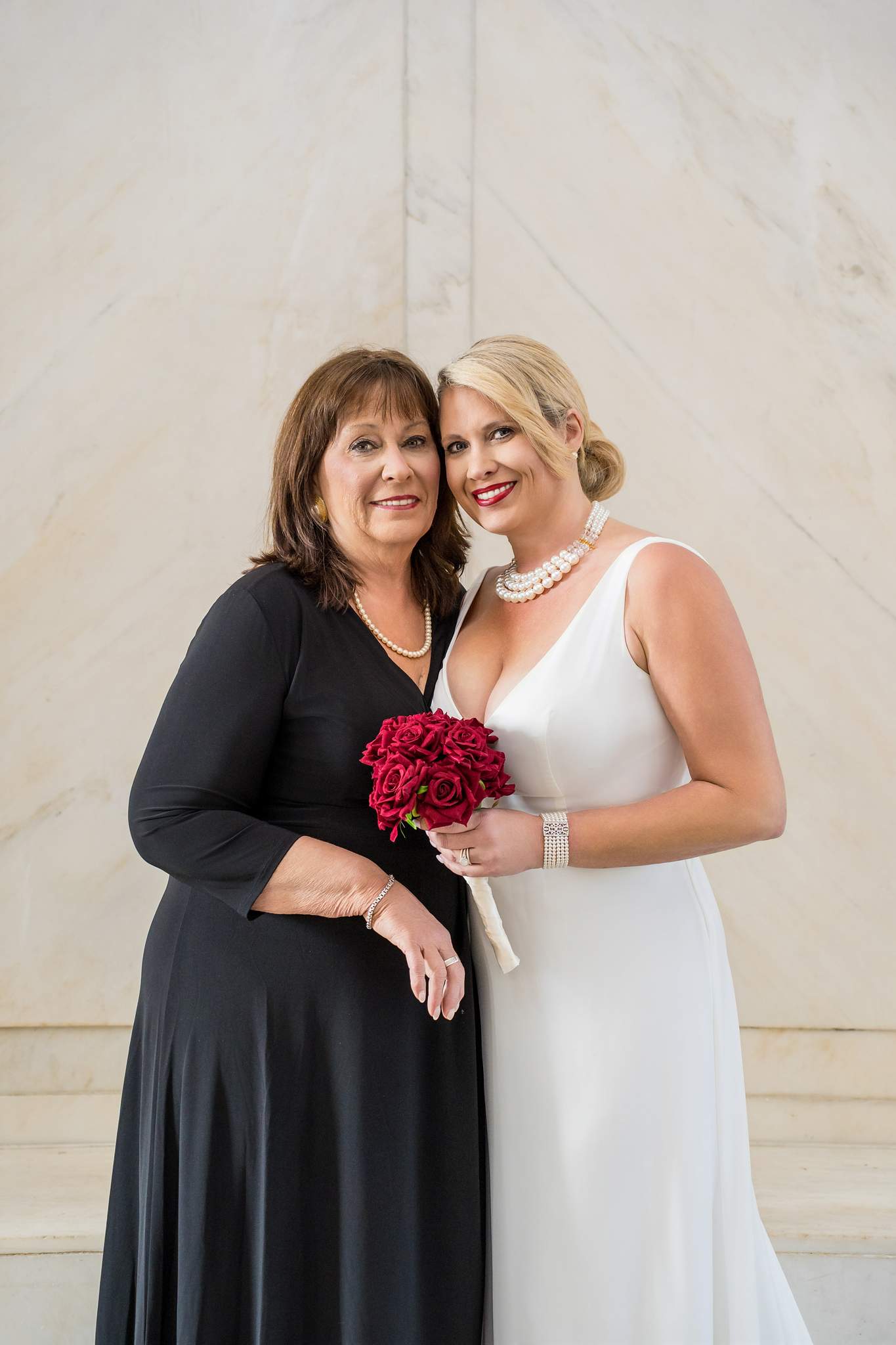
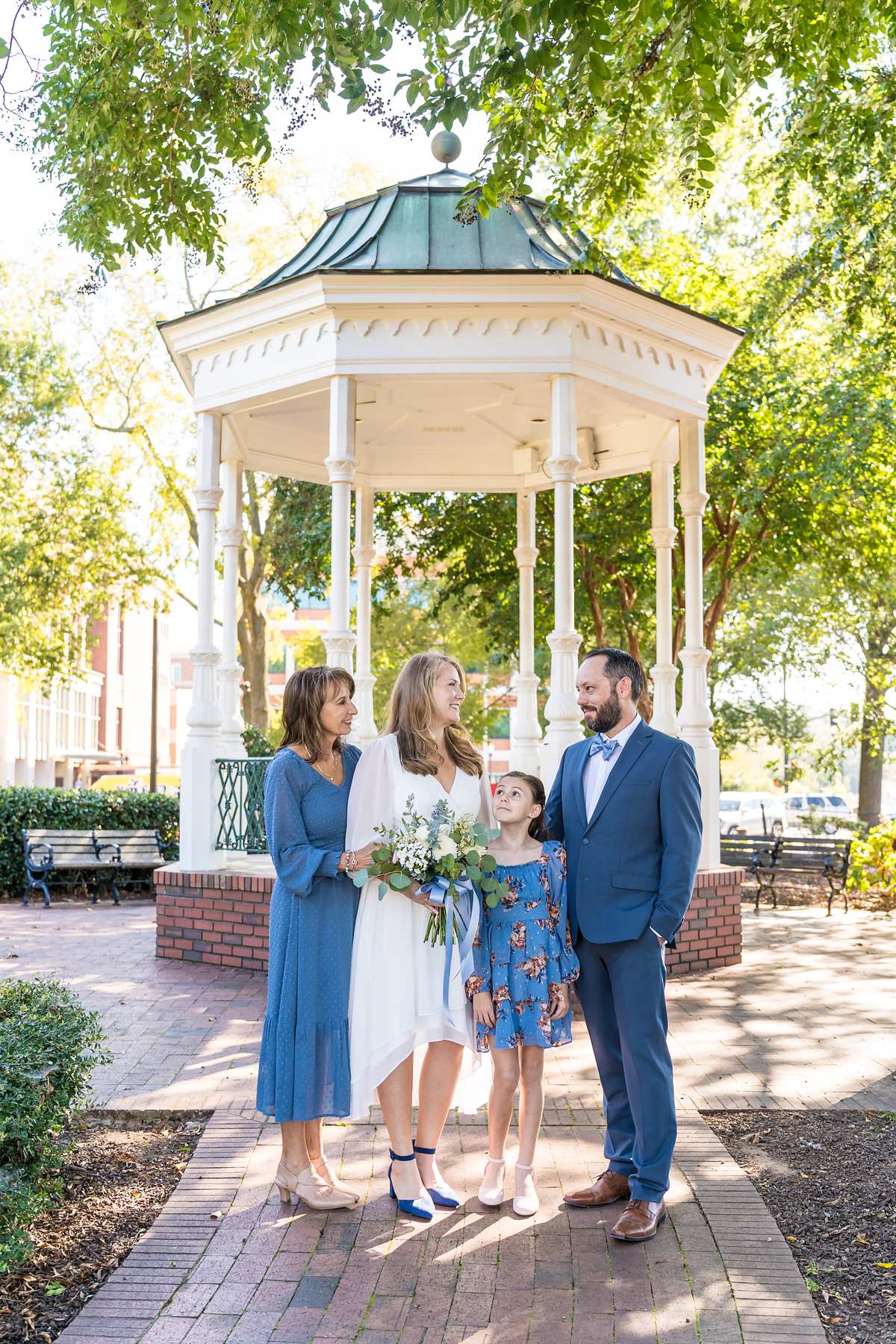
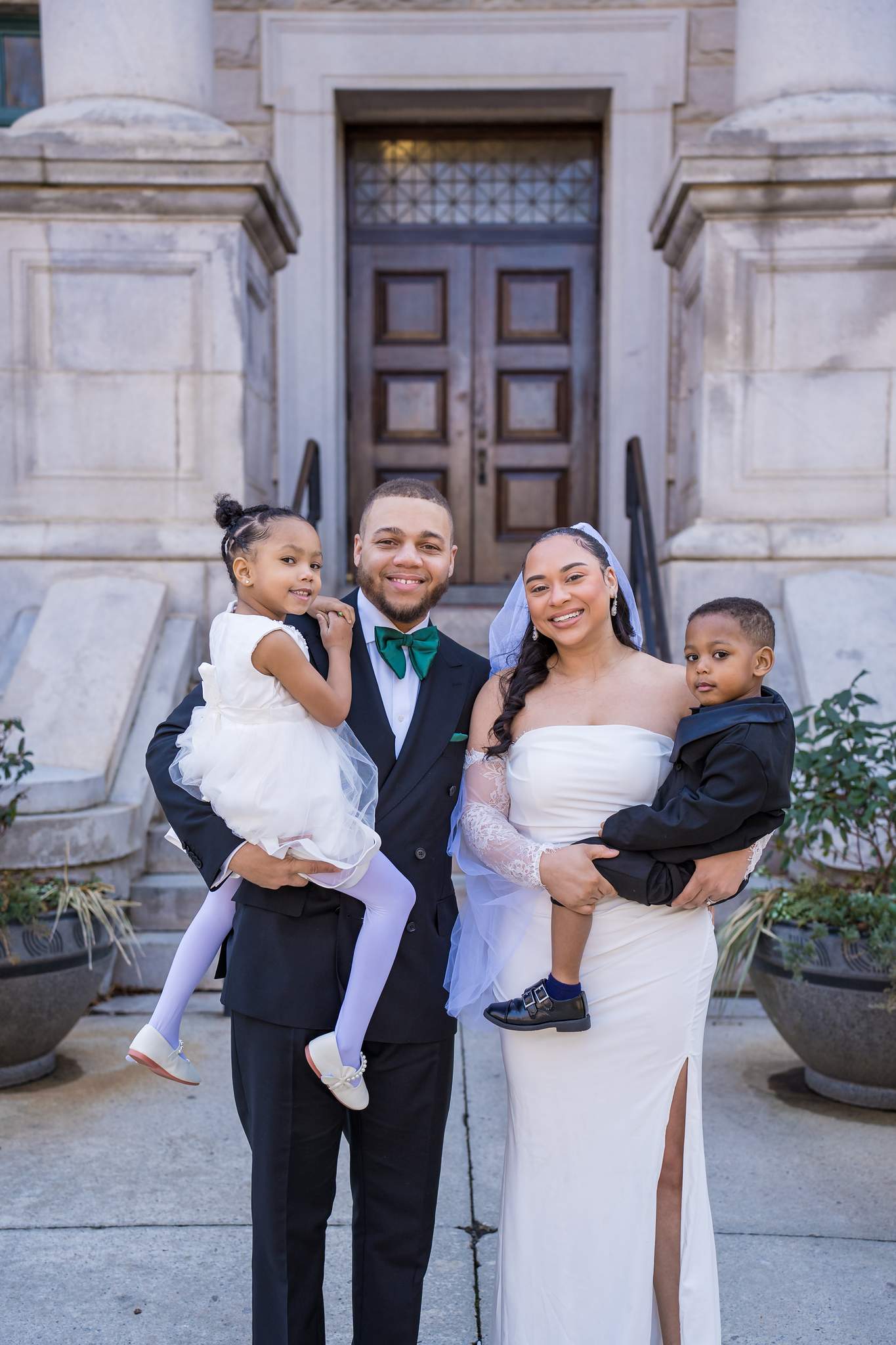
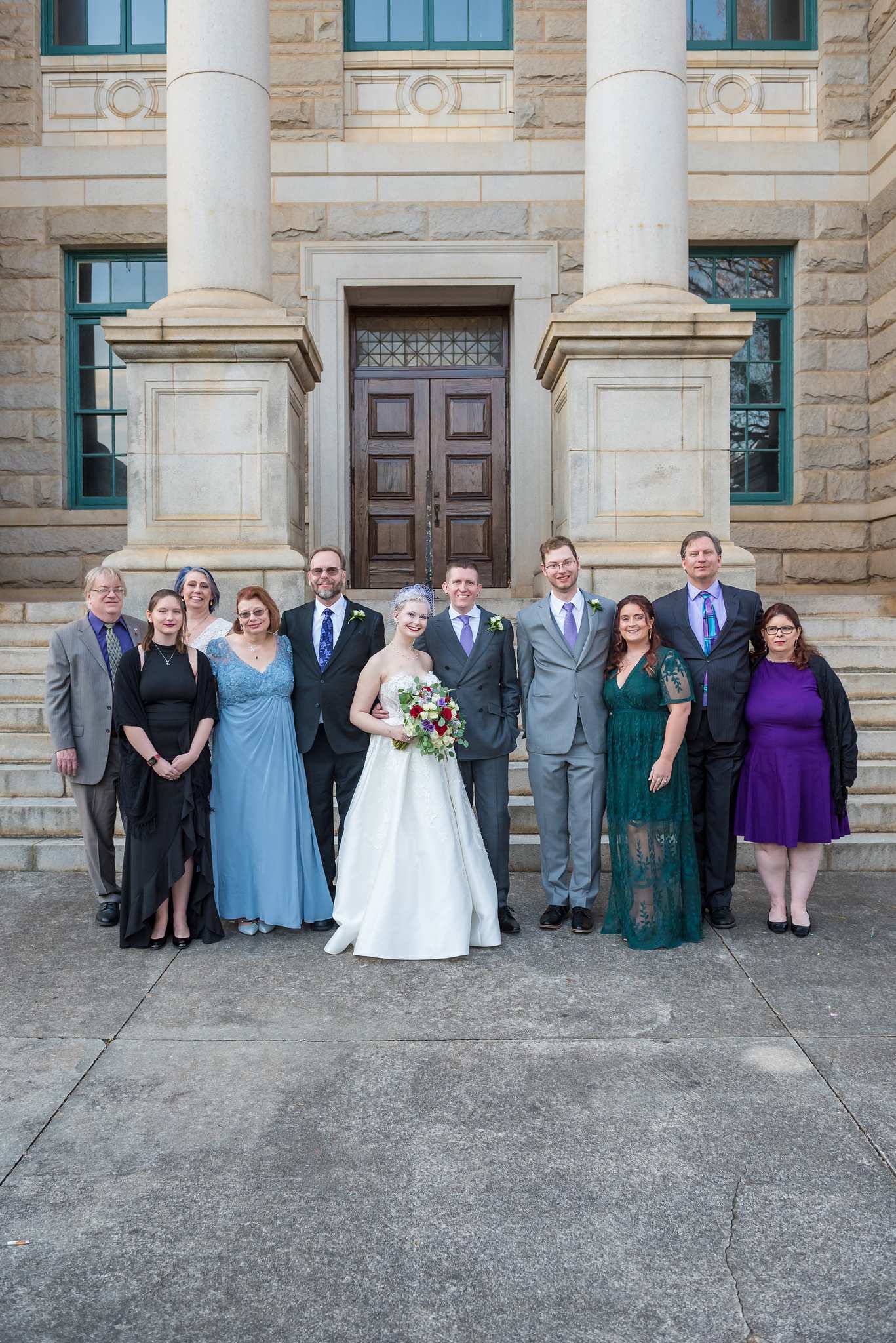
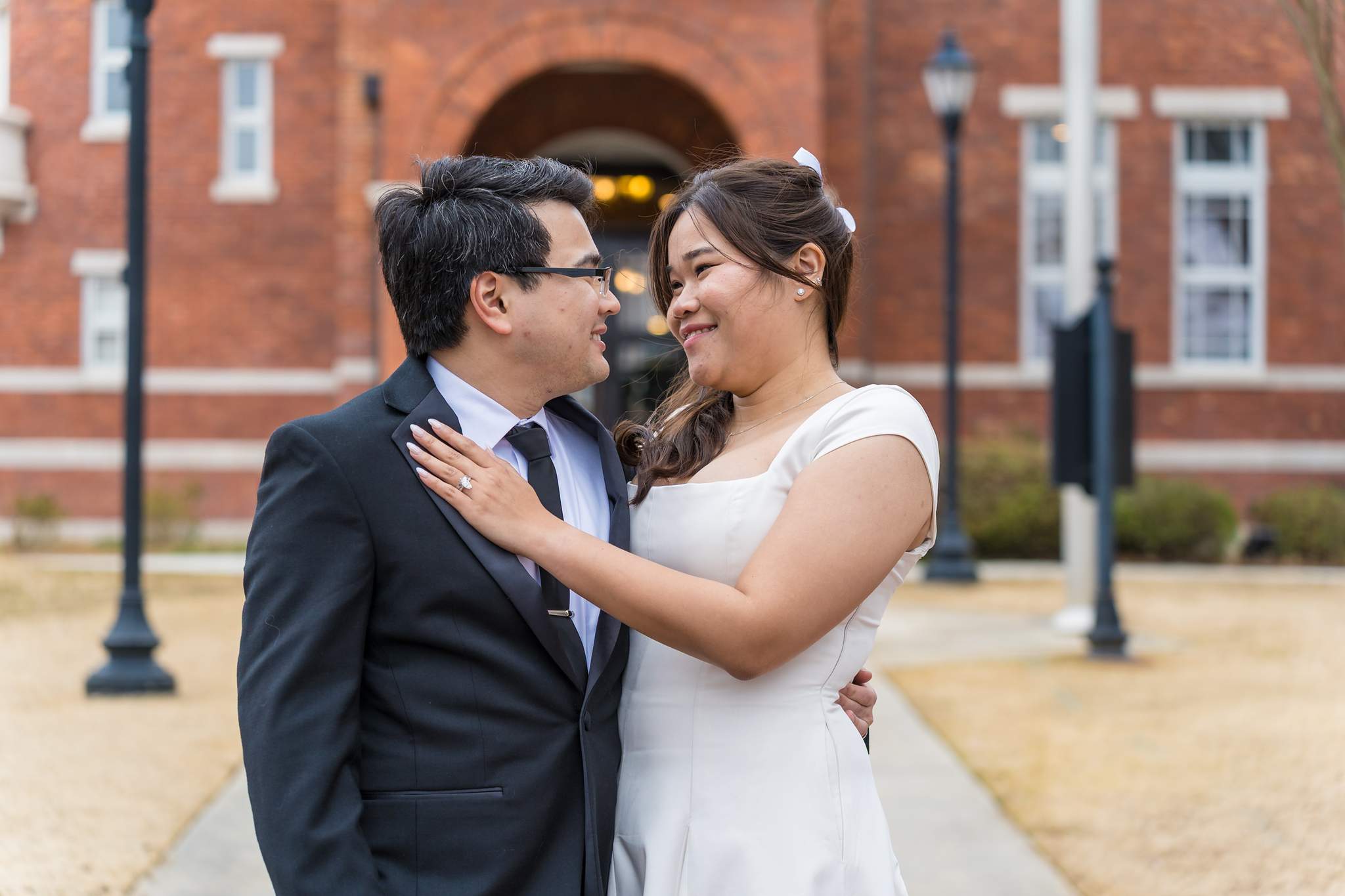
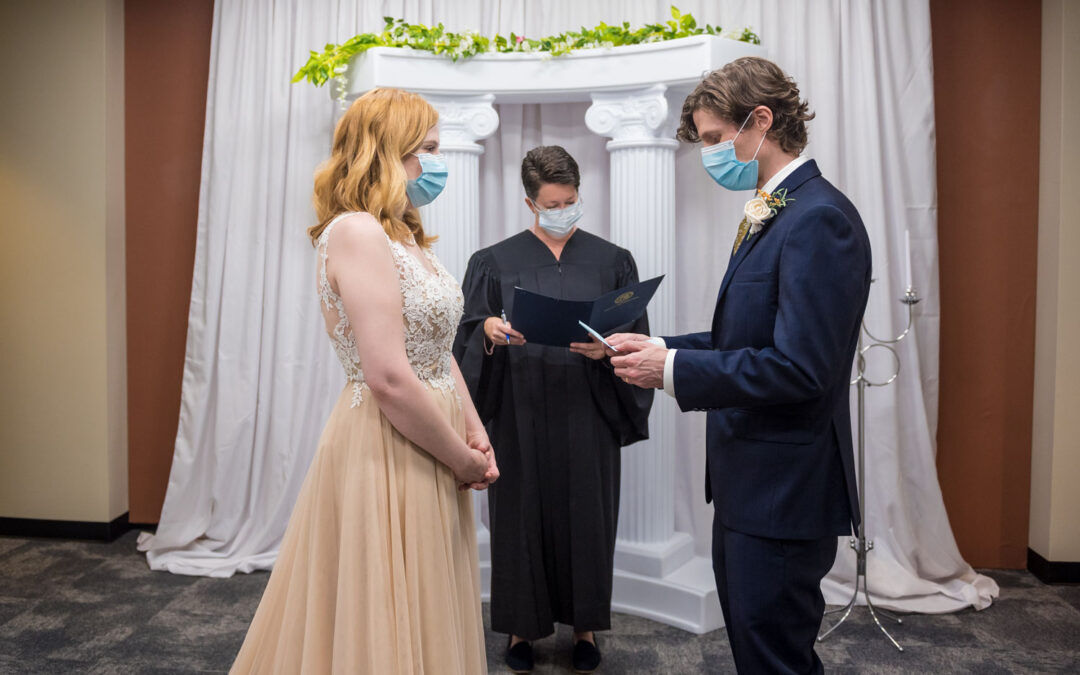
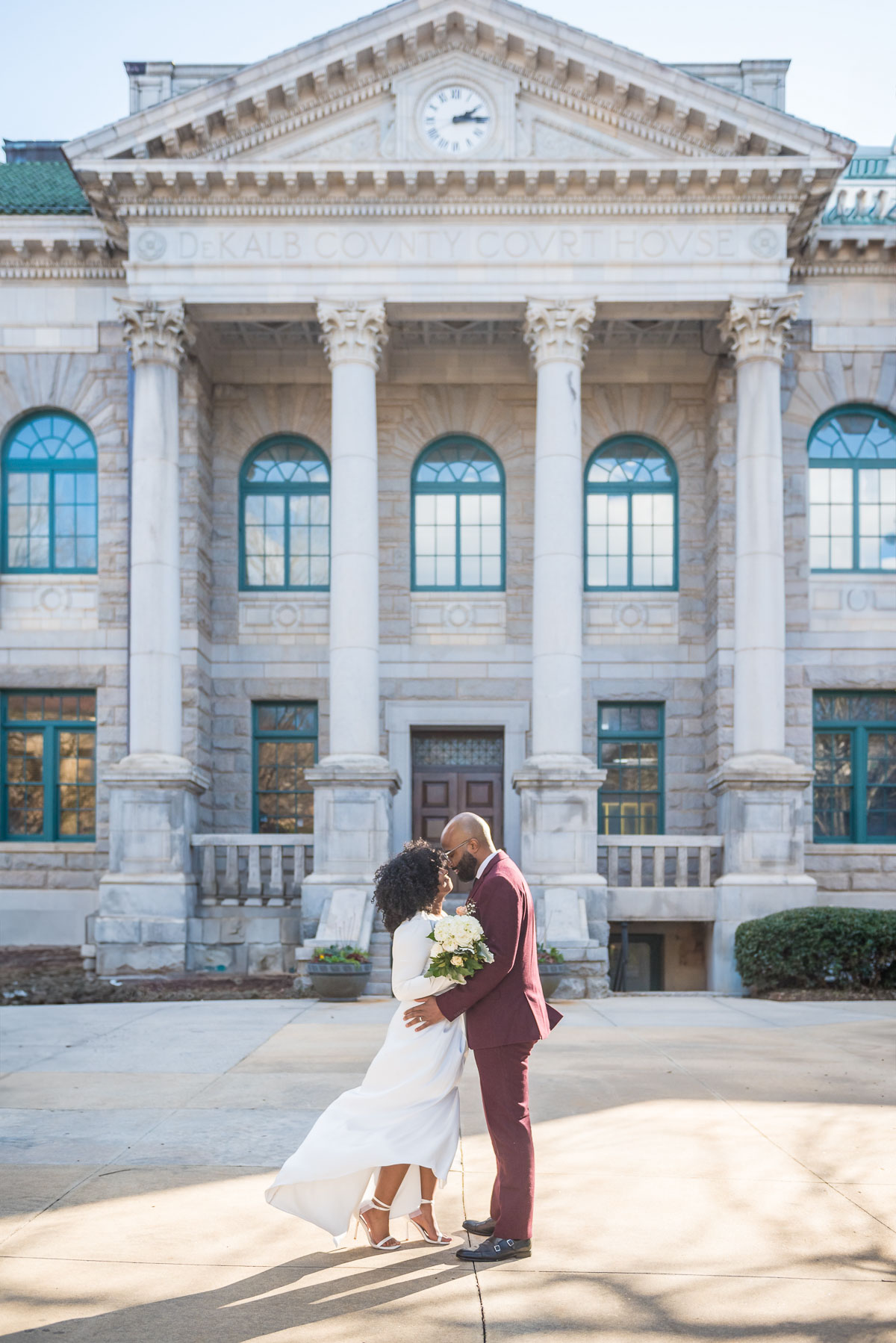
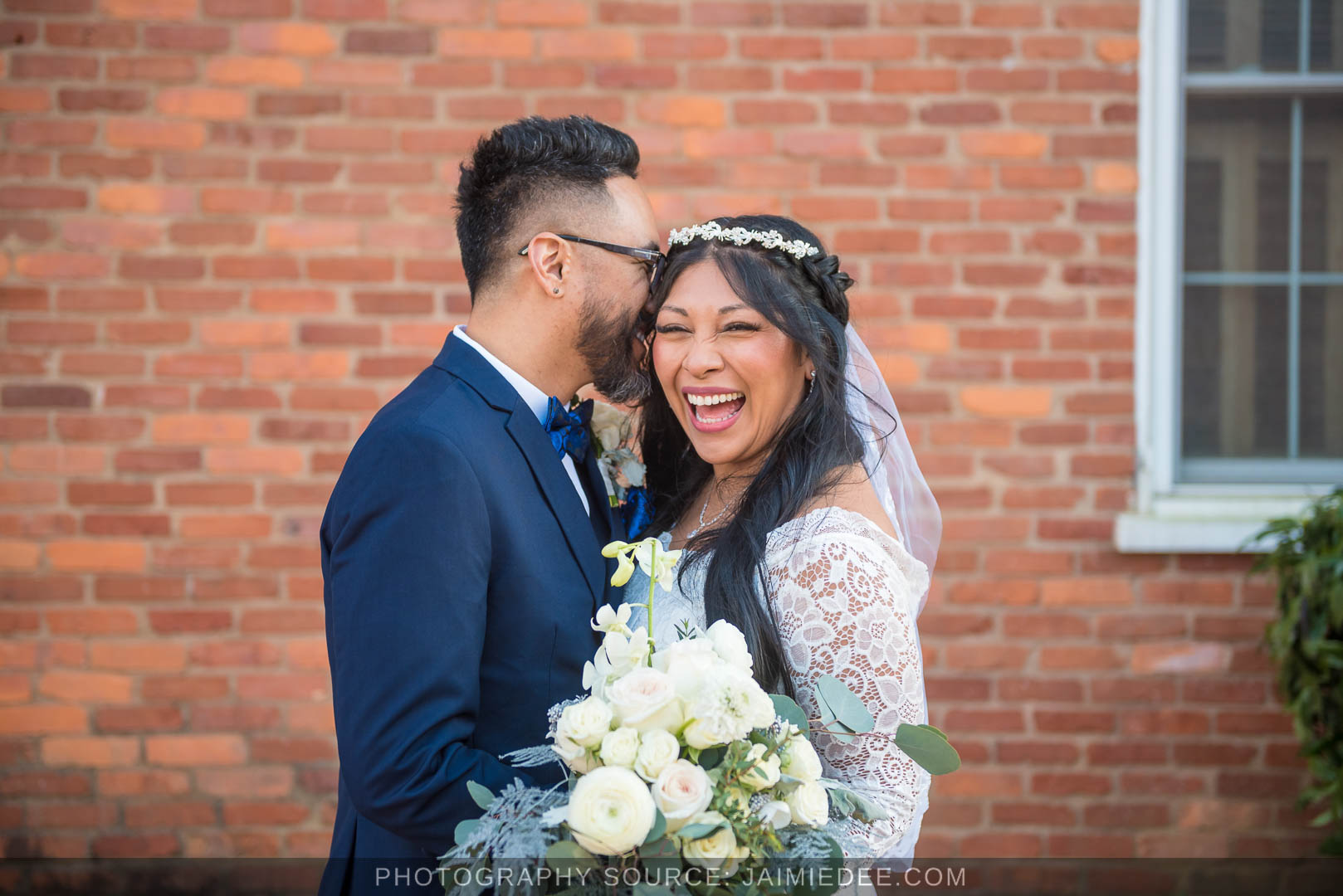
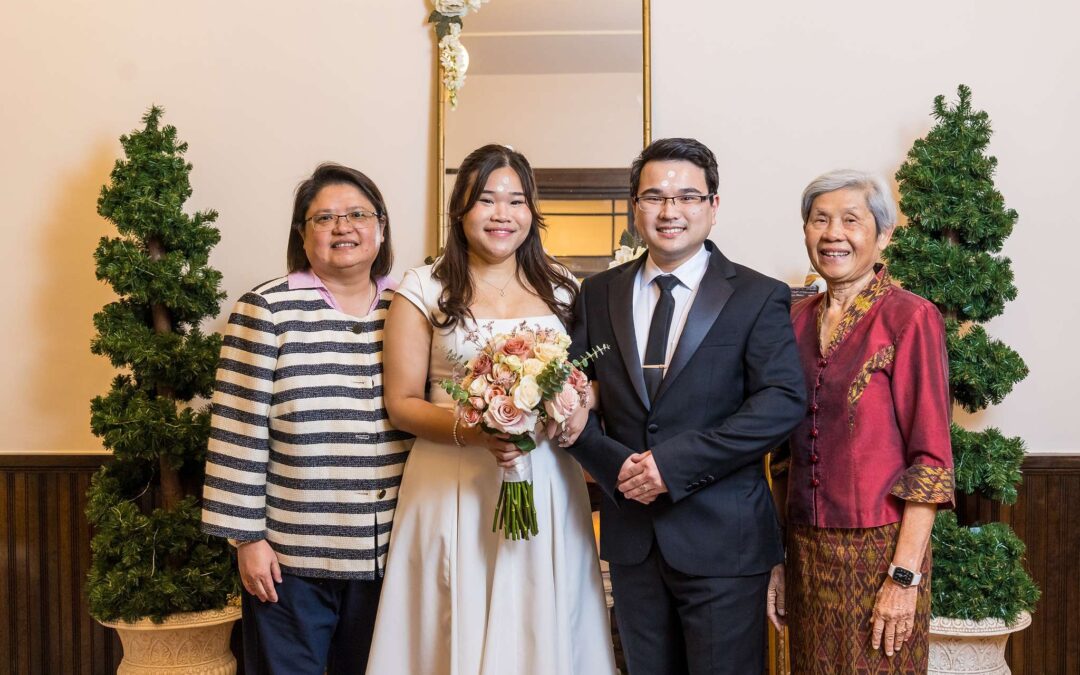
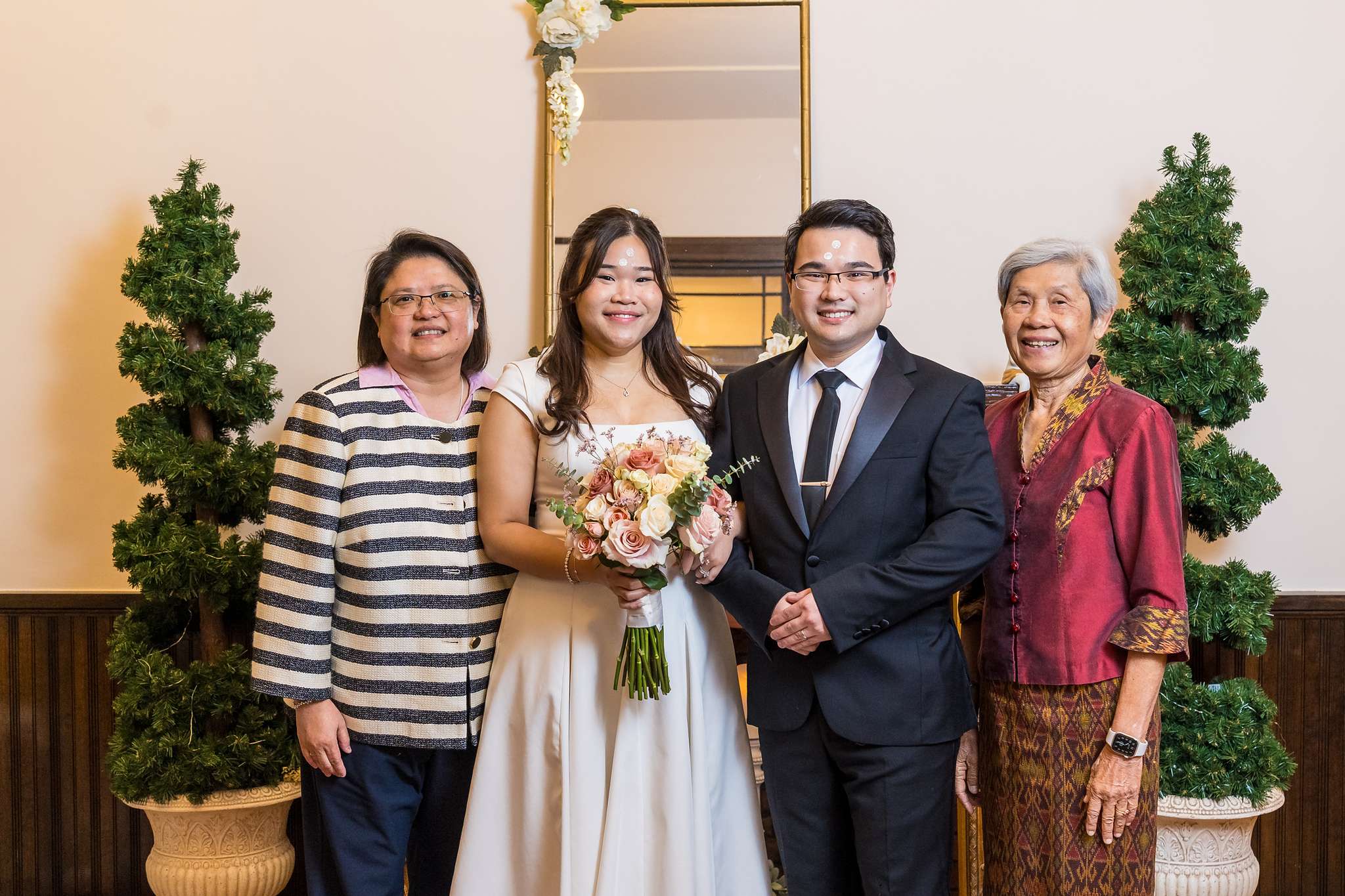
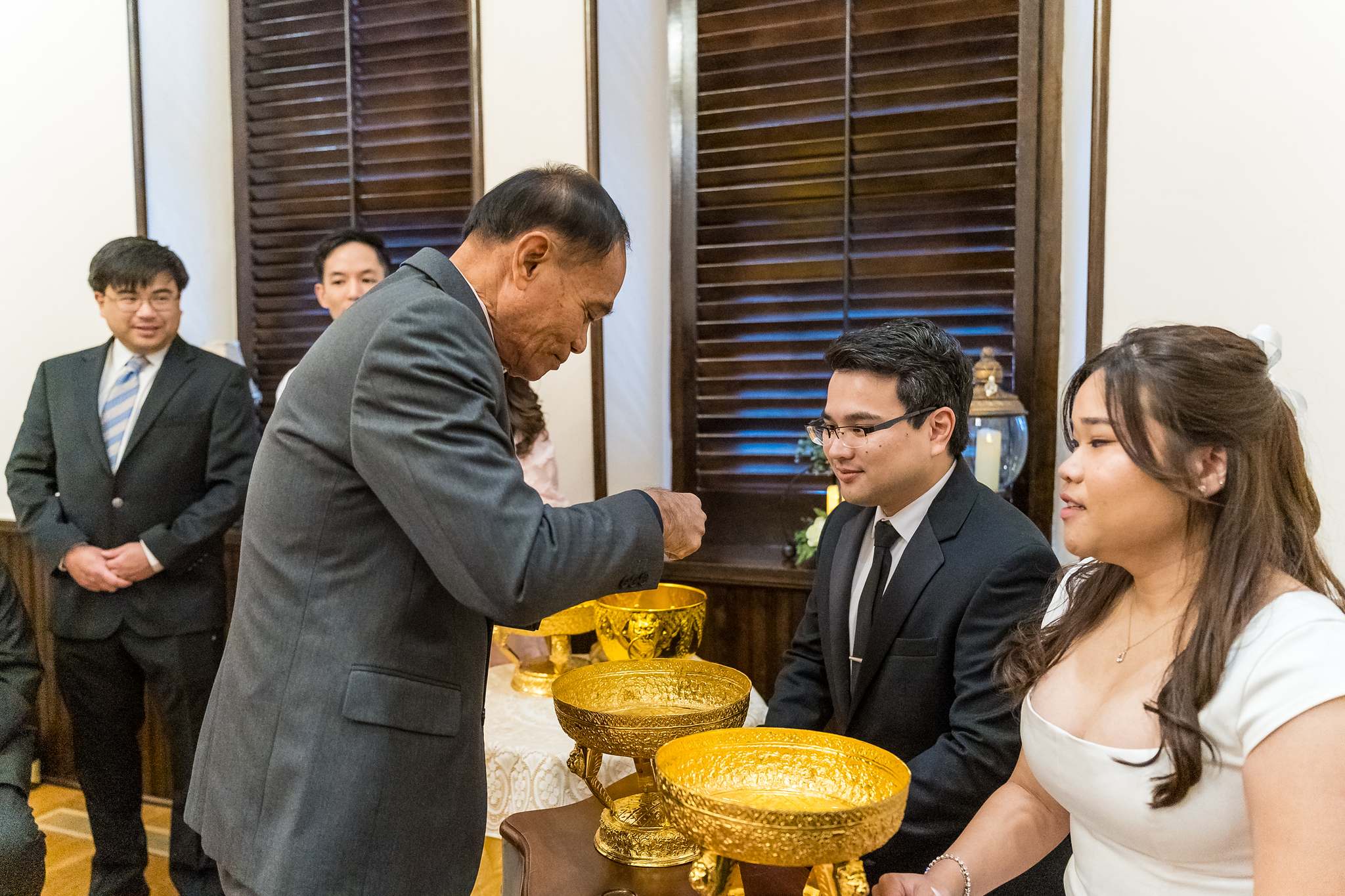
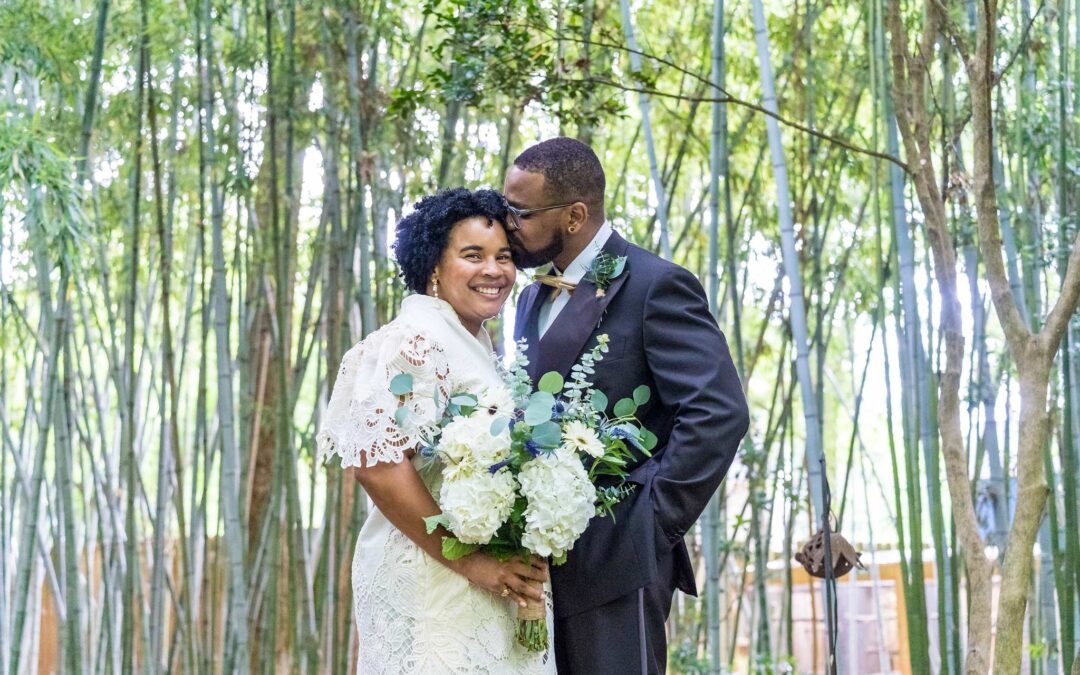
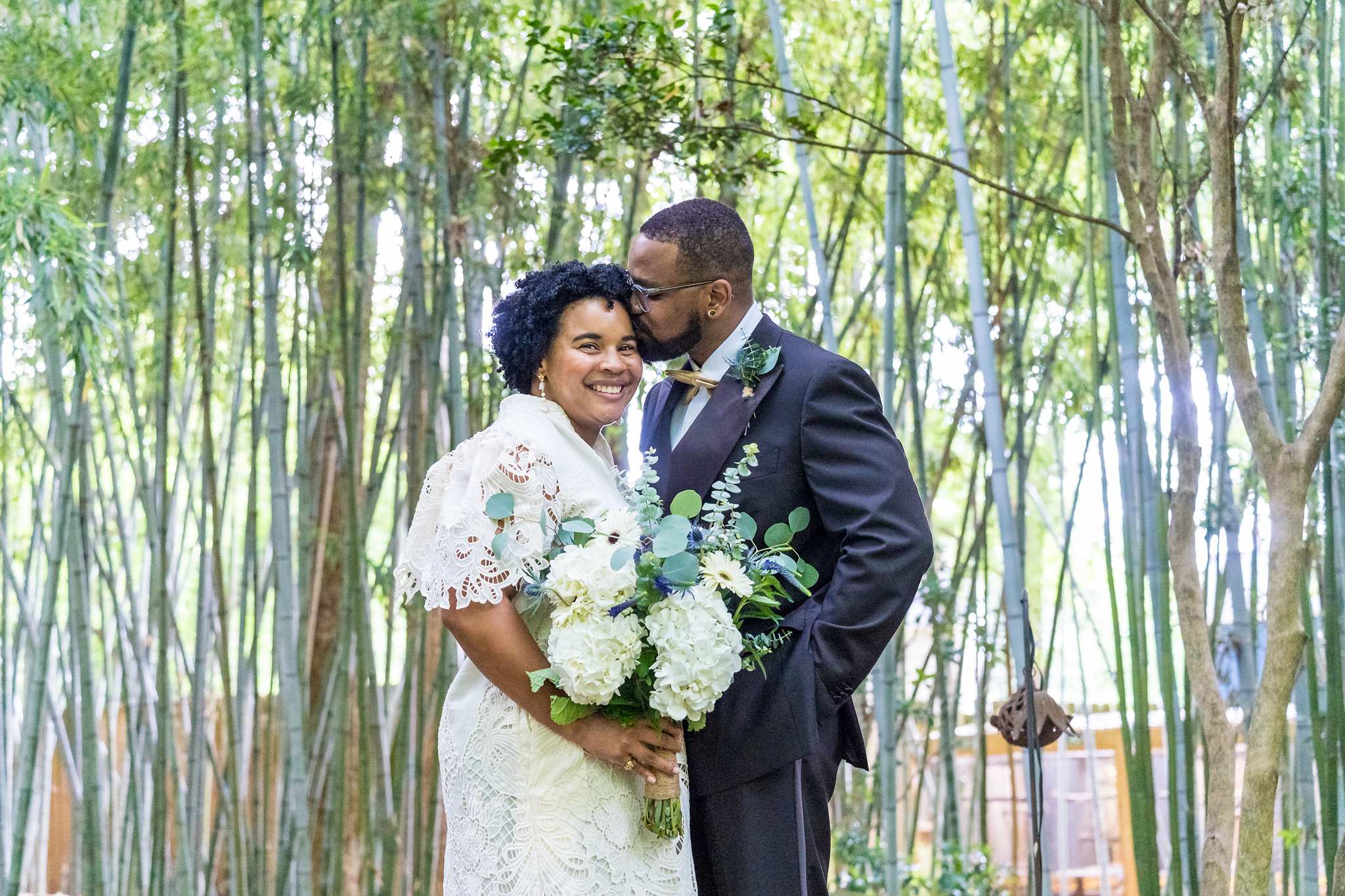
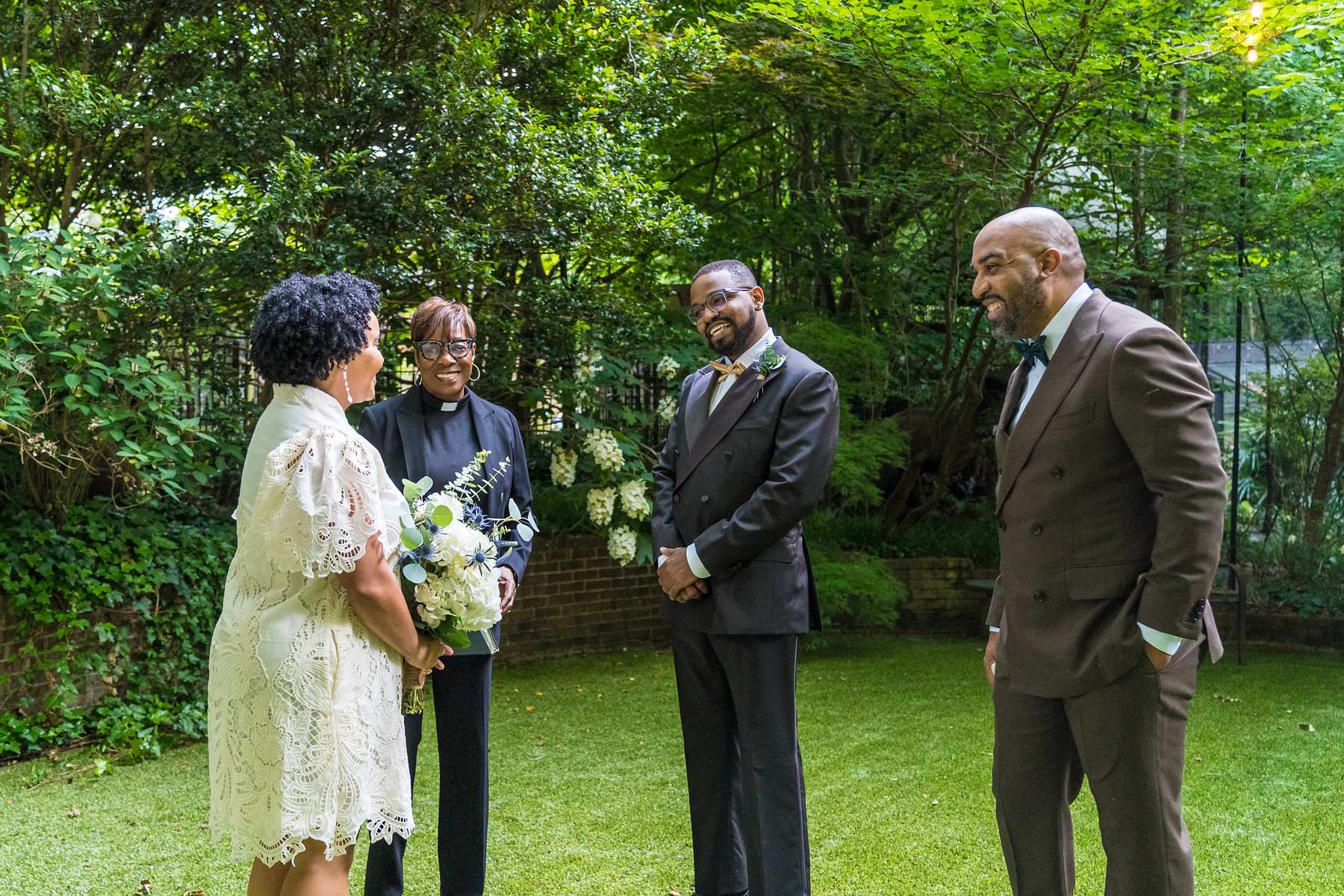
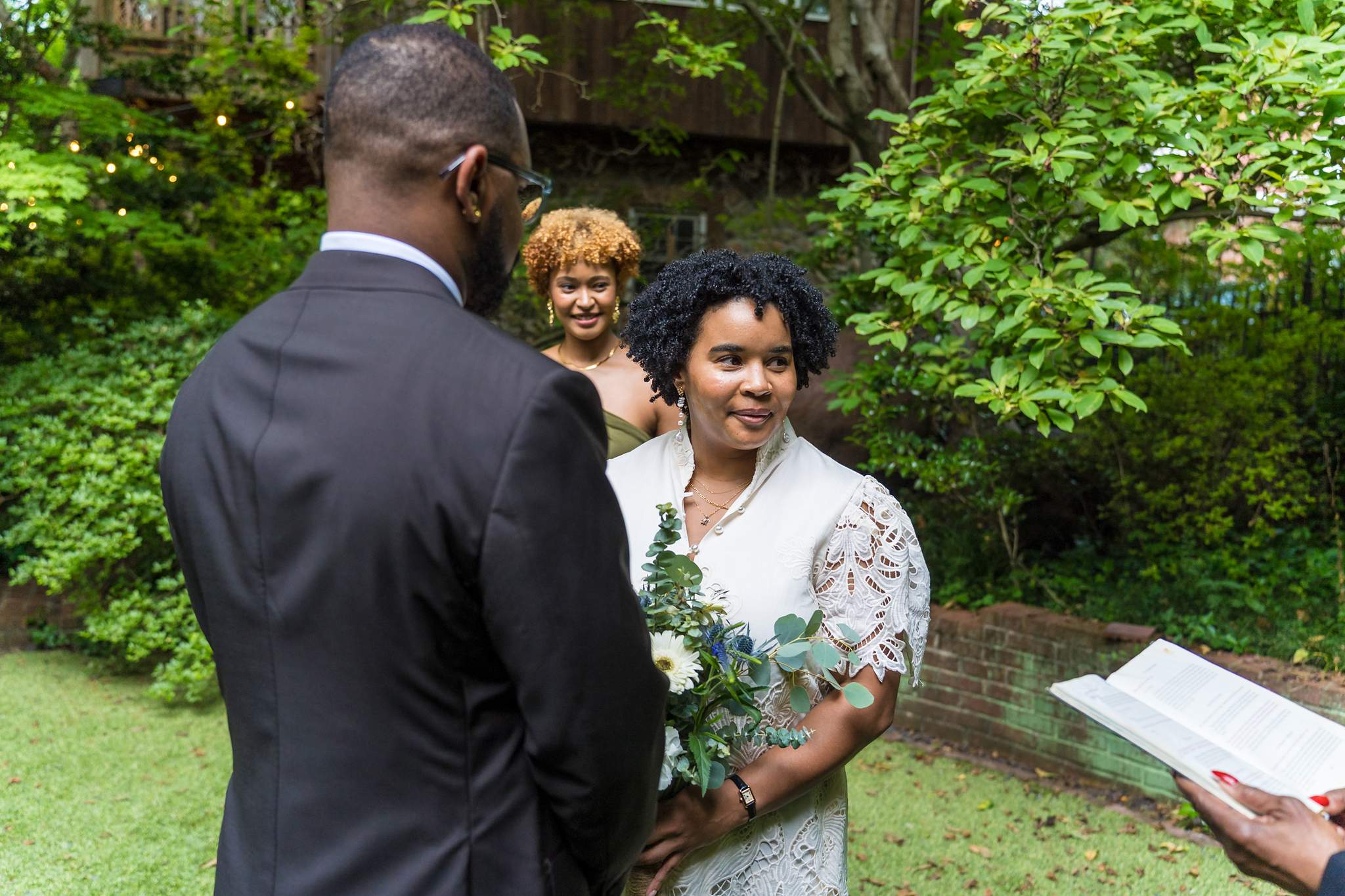
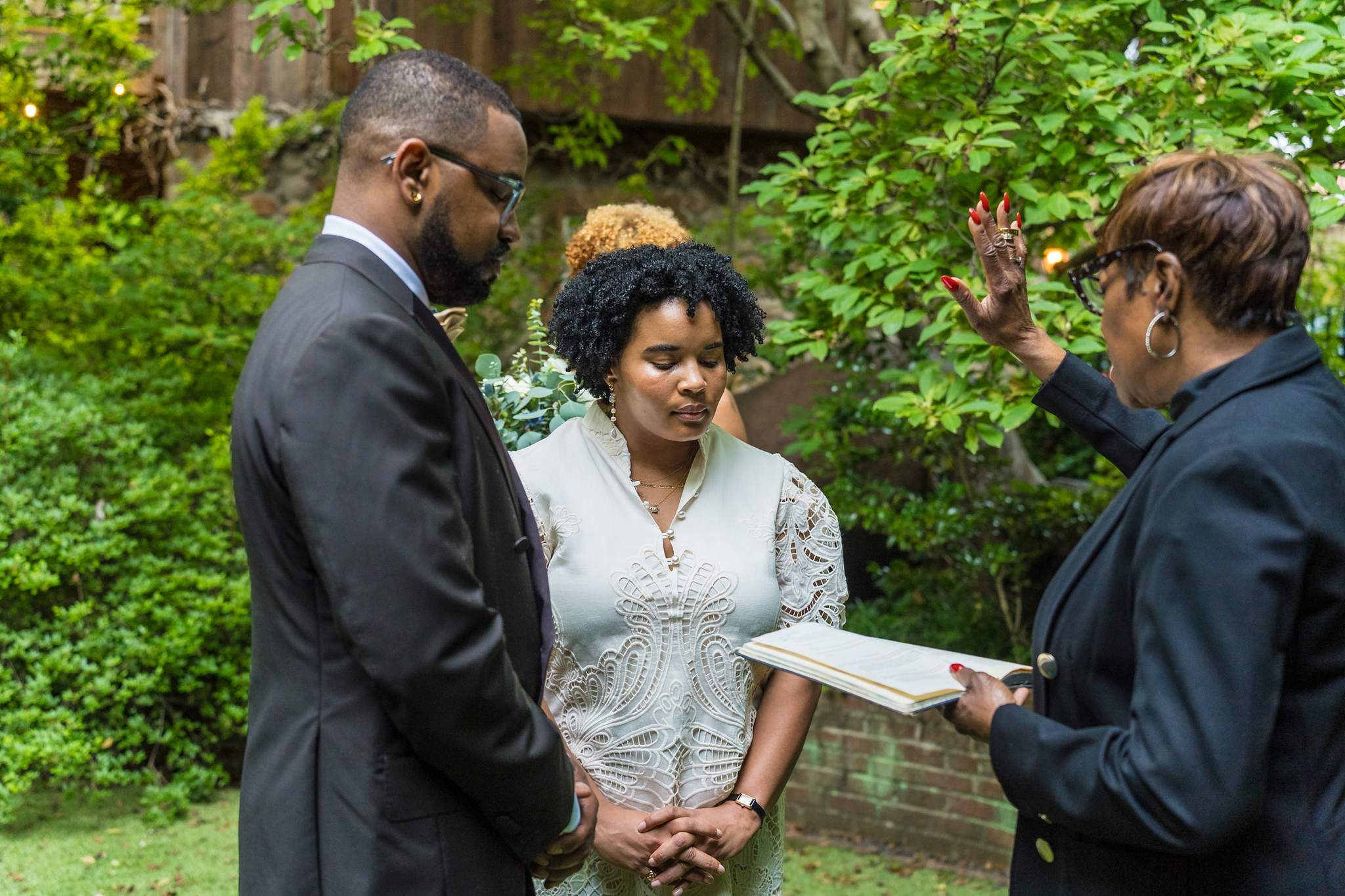
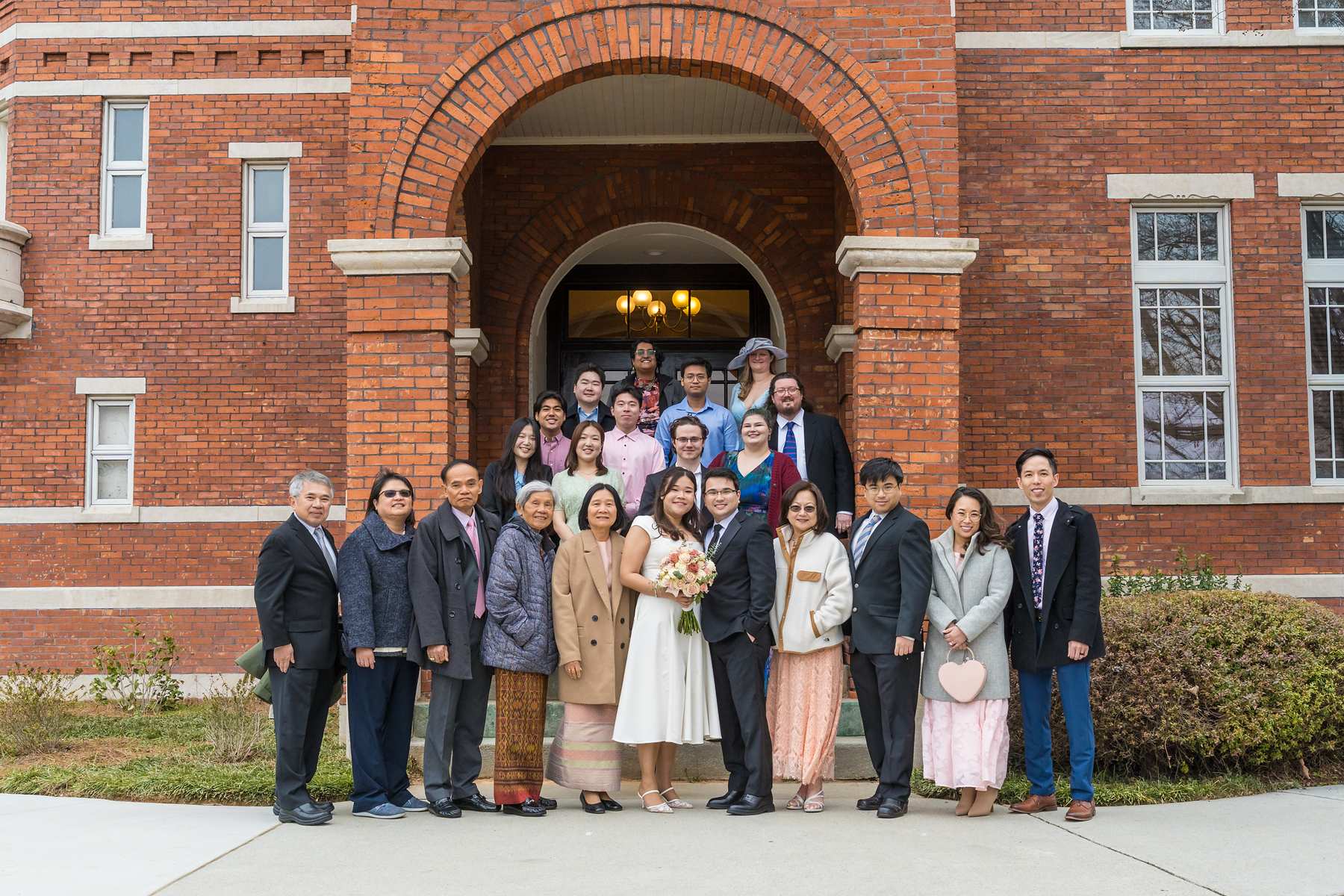
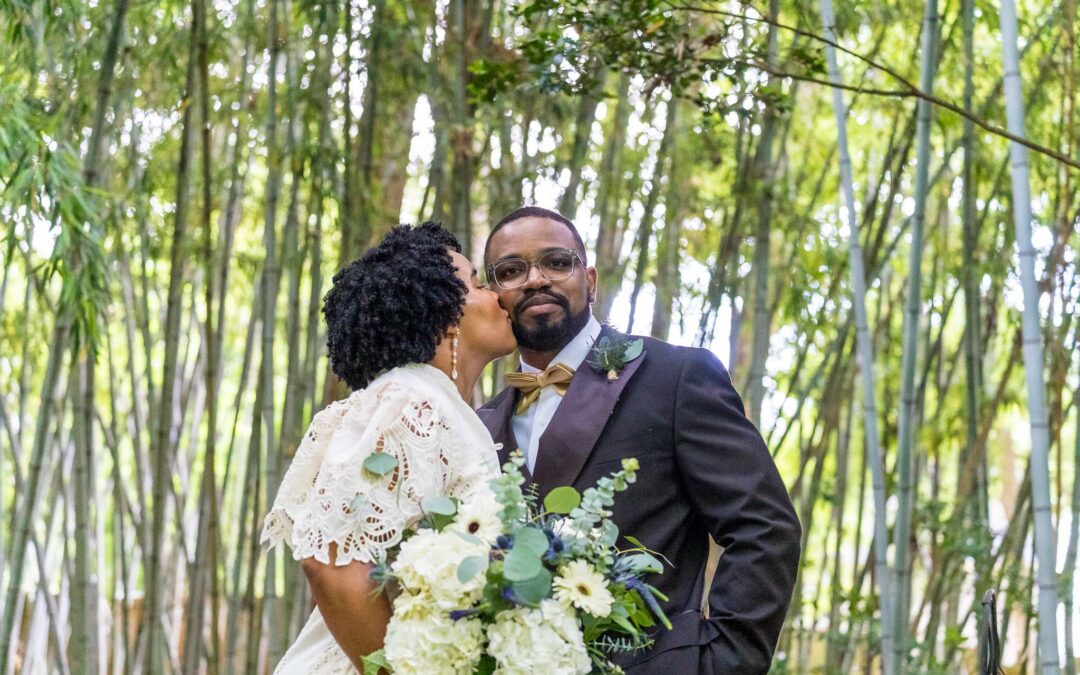
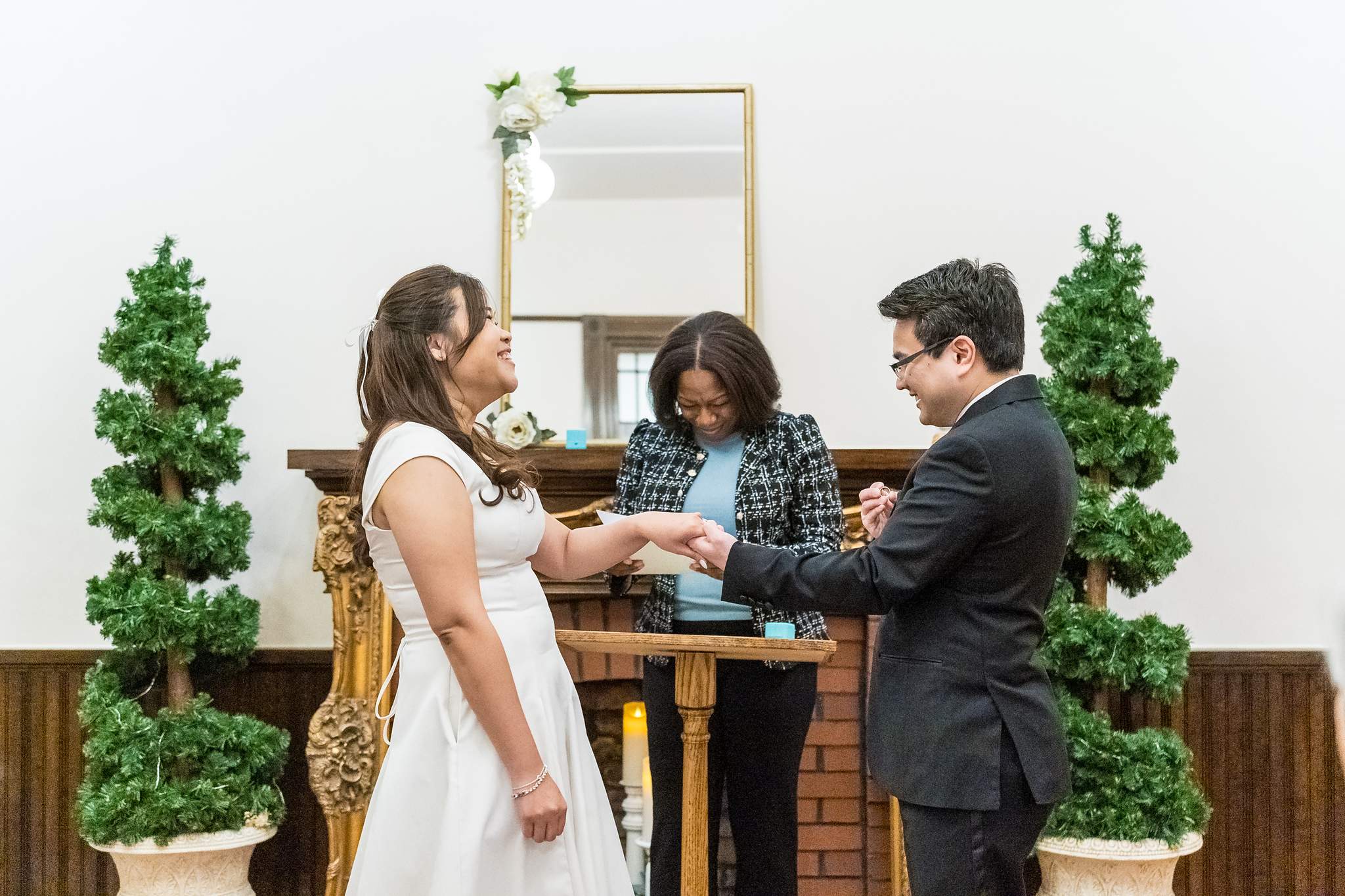
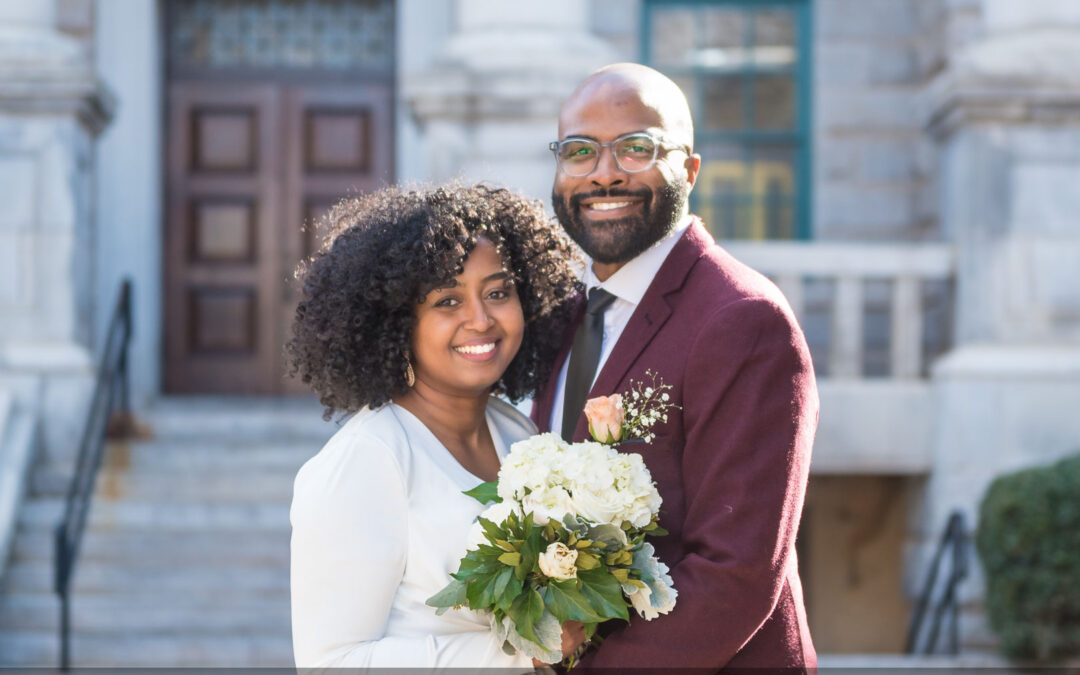
Most courthouses don’t post a strict dress code, so you can wear what feels like you on your wedding day. Cobb County’s Magistrate Court, for example, says casual or formal attire is acceptable for its wedding ceremonies. So, what should you wear to a courthouse wedding? A white or ivory midi dress, a short wedding dress, a simple gown, a jumpsuit or a tailored suit all work beautifully, as long as you can move easily through security, up courthouse steps and around town for portraits.
We’ve photographed courthouse weddings and elopements around Atlanta since 2008, from county courtrooms to historic courthouses and garden ceremonies. This guide shares what we’ve seen photograph well, outfit ideas for couples and guests, what to wear in each Atlanta season and how to dress for the setting you choose.
Table of Contents
What to Wear to a Courthouse Wedding: The Quick Answer
Choose an outfit you love that fits the feel of your day: a white or ivory midi dress, a short wedding dress, a simple floor-length gown, a jumpsuit or a suit.
Pick a silhouette that’s easy to move in. You’ll walk through security, stand for the ceremony and climb steps for portraits.
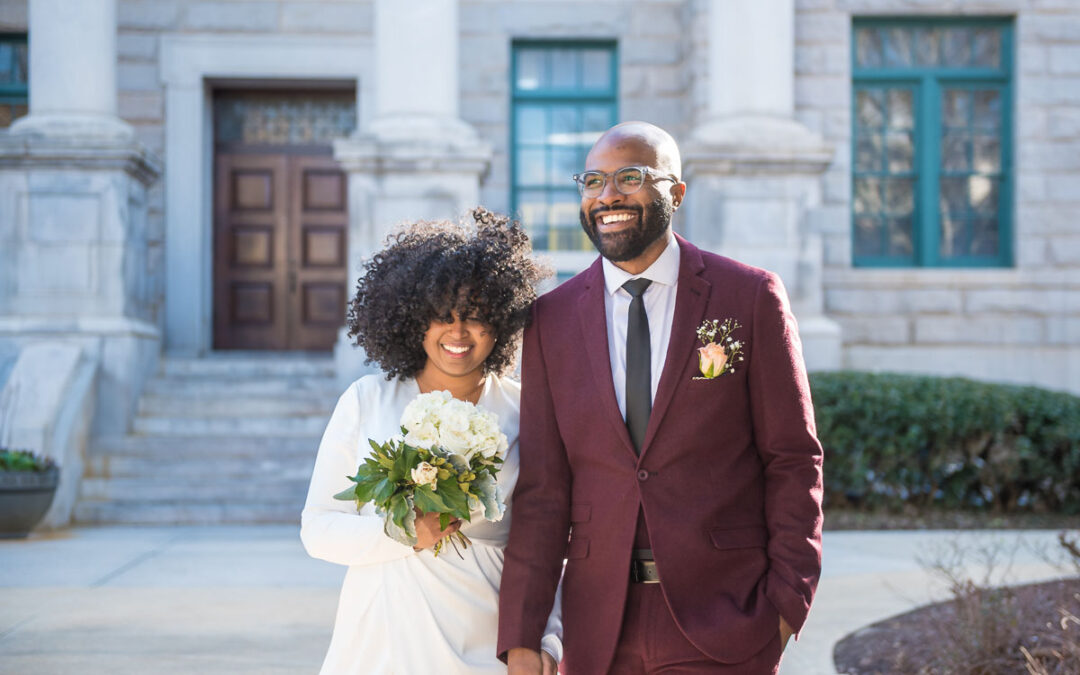
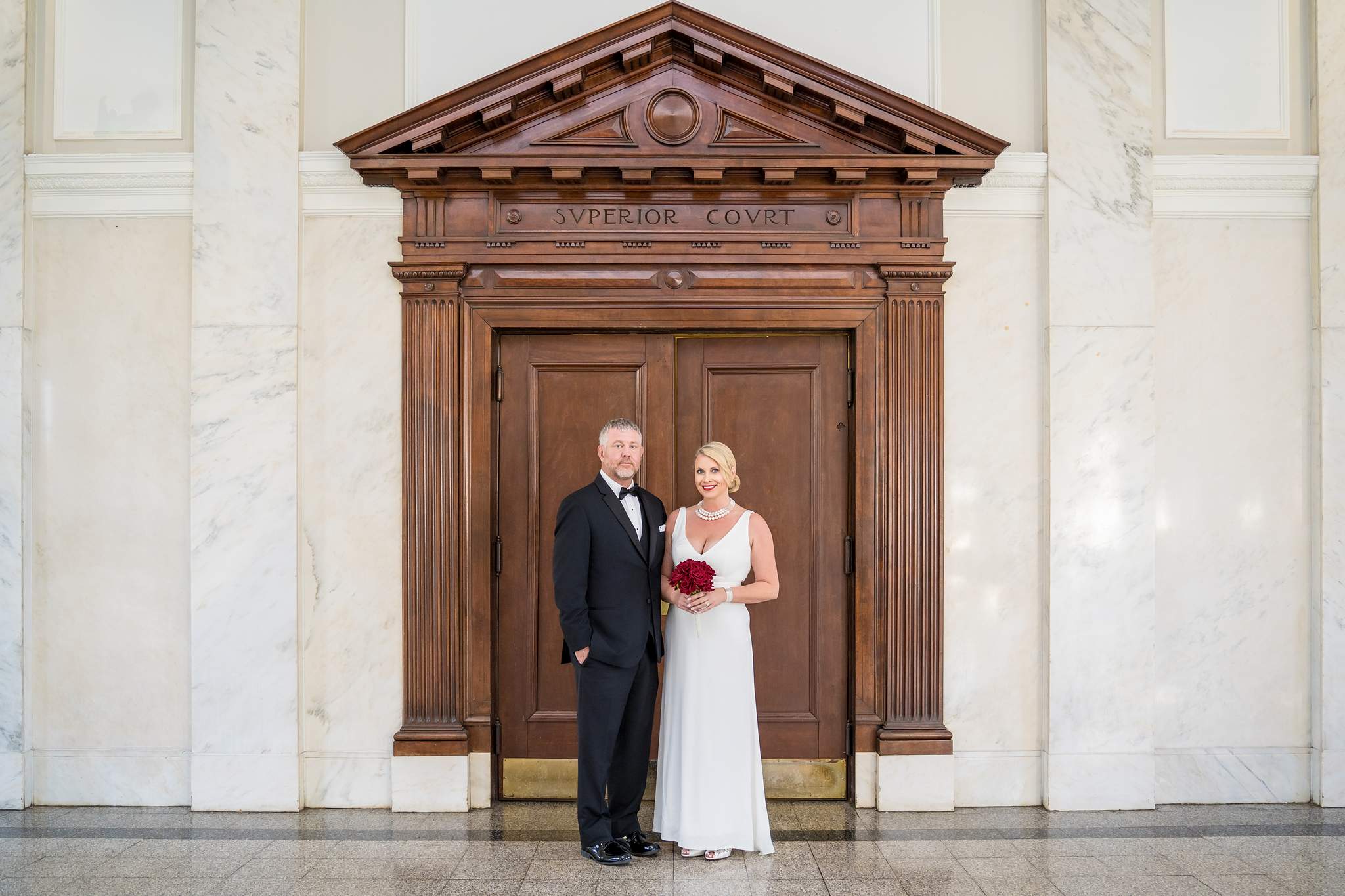
Partners look great in a well-fitted suit in navy, charcoal, gray, burgundy or black, or a tuxedo for a dressier look.
Dress for the season: breathable fabrics for Atlanta summers, a wrap or coat for winter.
Bring comfortable shoes, your photo IDs and marriage license, and a small bag that moves easily through screening.
Guests can dress as they would for a nice dinner and follow the couple’s lead.
Is There a Dress Code for a Courthouse Wedding?
Most Georgia courts don’t publish a specific dress code for wedding ceremonies. Cobb County’s Magistrate Court answers the question directly on its wedding ceremony page: casual or formal attire is acceptable. Courthouses are still working government buildings, so dress the way you would for any important appointment, and keep your bag and accessories simple so security goes quickly.
Rules vary by county and by court, so check your court’s current guidelines for attire, guests and photography before your date. In Fulton County, for example, bringing a photographer into a Magistrate Court wedding requires a Rule 11 approval form signed by the judge ahead of time. Our Fulton County courthouse wedding guide walks through it.
Do You Have to Wear a Wedding Dress to Get Married at the Courthouse?
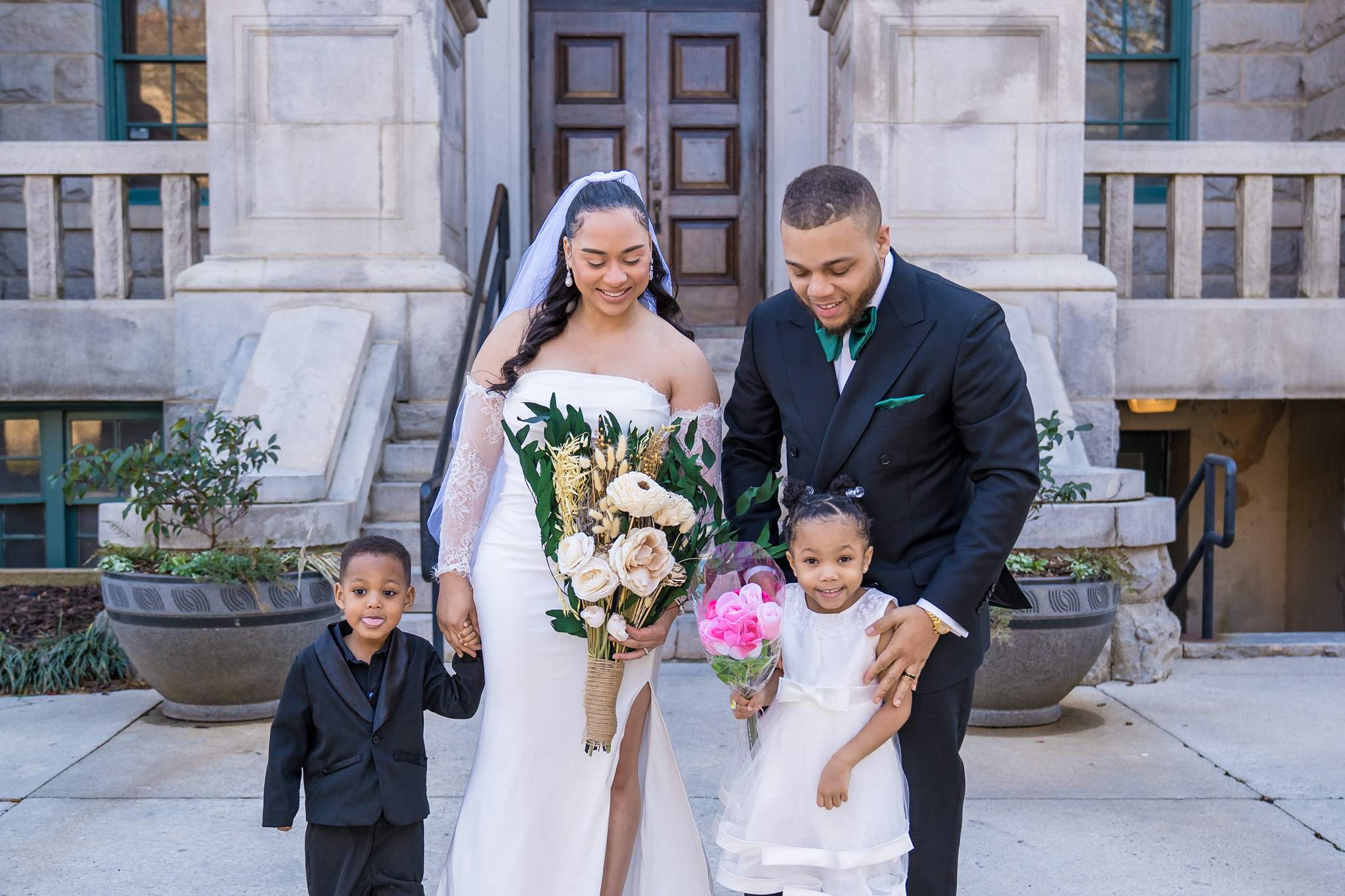
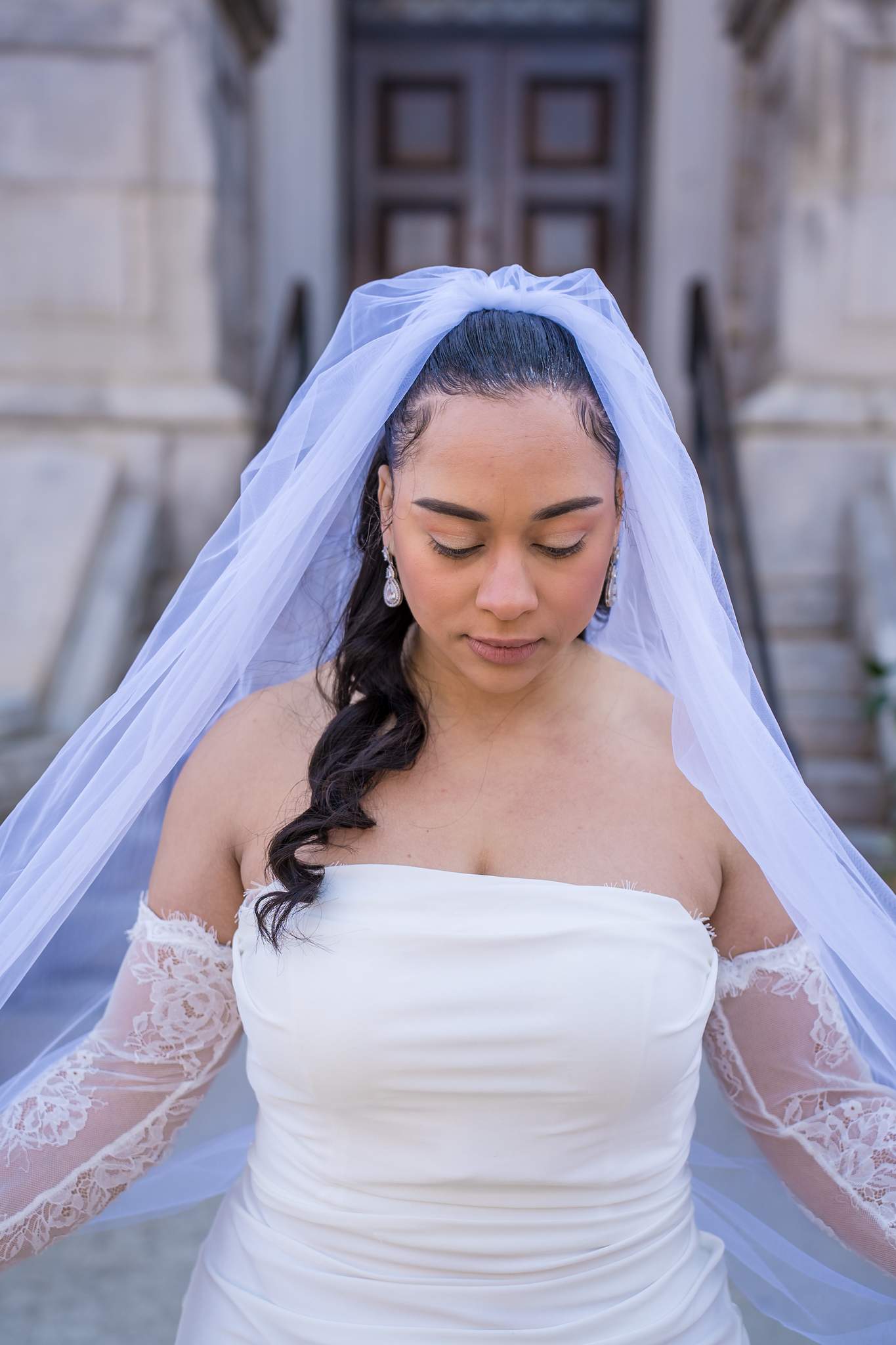
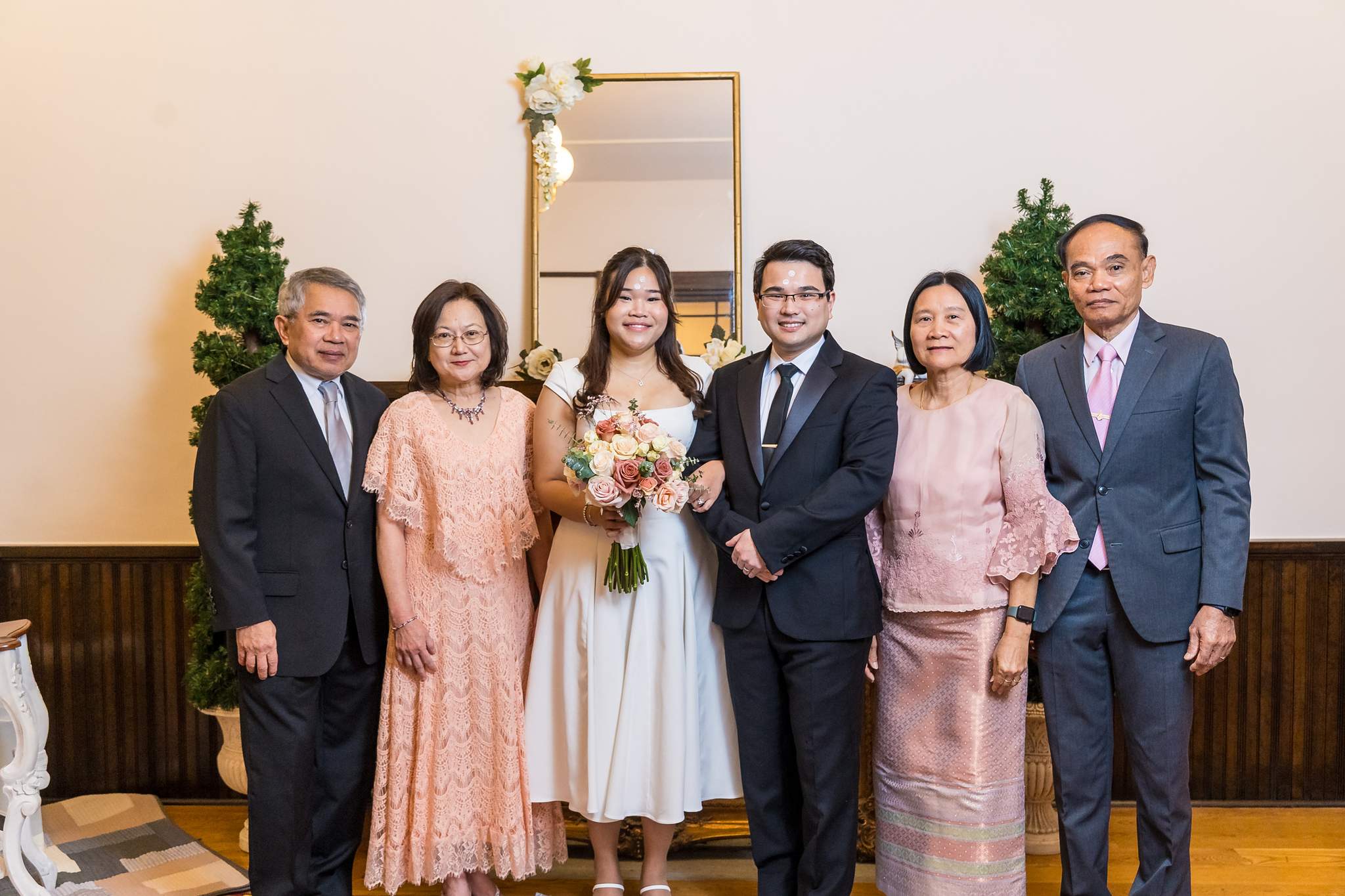
No. You can wear a full wedding gown, a short white dress, a dress in your favorite color or a suit, and you’ll be just as married. Many of the couples we photograph choose something that feels special and simple: a midi or tea-length dress in ivory, champagne or blush, often with a bouquet and a veil to make it feel bridal.
If you’ve always pictured yourself in a full gown, wear it. Courthouse halls and front steps make a striking backdrop for a long dress, and we’ll help you arrange the skirt and train for portraits. Just give yourself a little extra time for the walk in and the security line.
Courthouse Wedding Outfit Ideas for Brides
Midi or tea-length dress: easy to walk in, dressy enough for portraits and comfortable through a wait.
Short white dress: playful and modern, and a great fit for a quick ceremony followed by a celebration dinner.
Simple gown: a sheath, slip or A-line gown with a short train moves easily through hallways and up steps.
Jumpsuit or bridal suit: polished and practical, especially for a weekday ceremony.
Color: champagne, blush, sage, dusty blue or a bold jewel tone all photograph beautifully.
Sleeves and layers: a cropped jacket, cape or long sleeves add style and keep you comfortable in air-conditioned buildings.
Whatever you choose, sit, walk and climb a few stairs in it at home. If it feels good for all three, it will feel good on your wedding day.
What Grooms and Partners Wear to a Courthouse Wedding
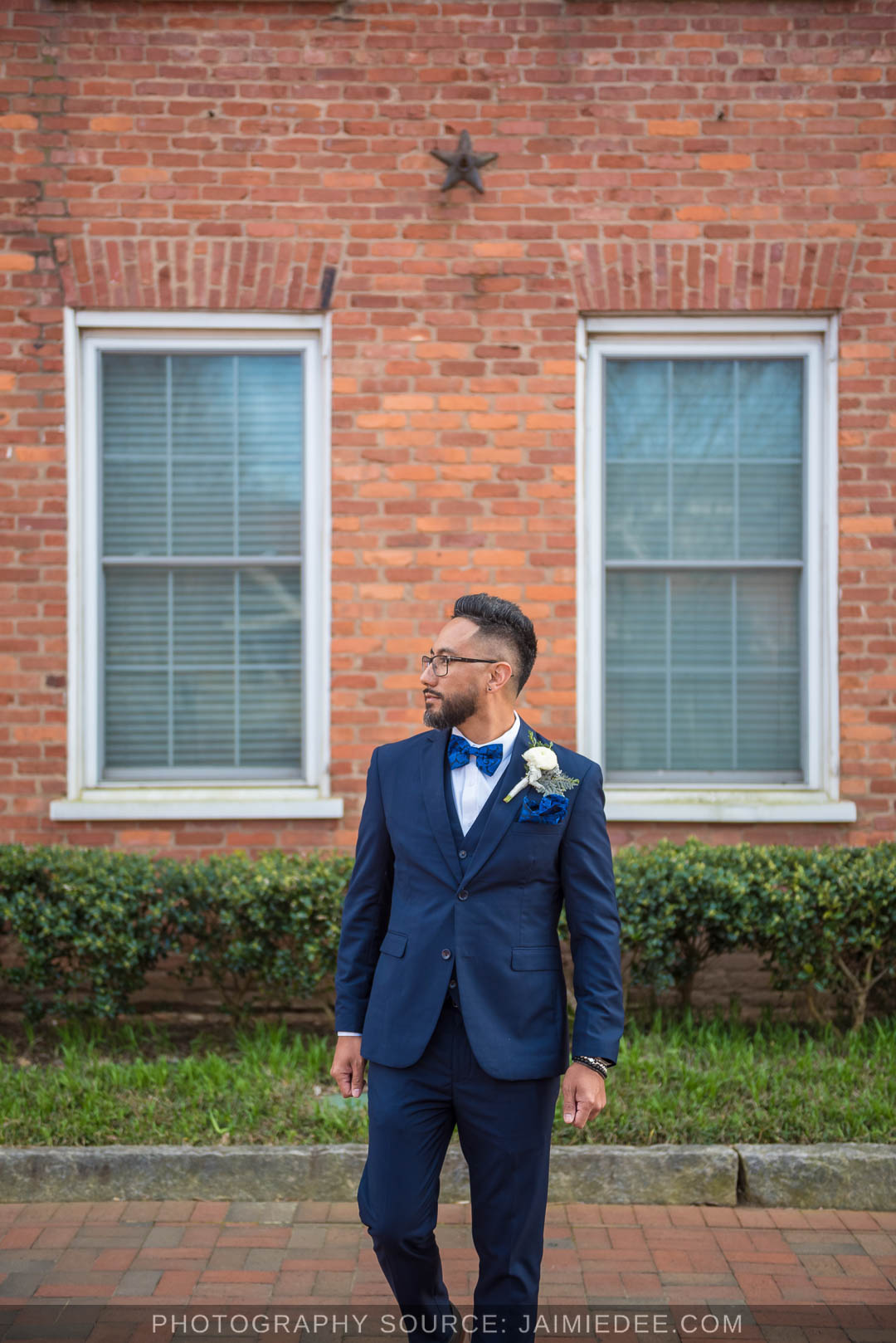
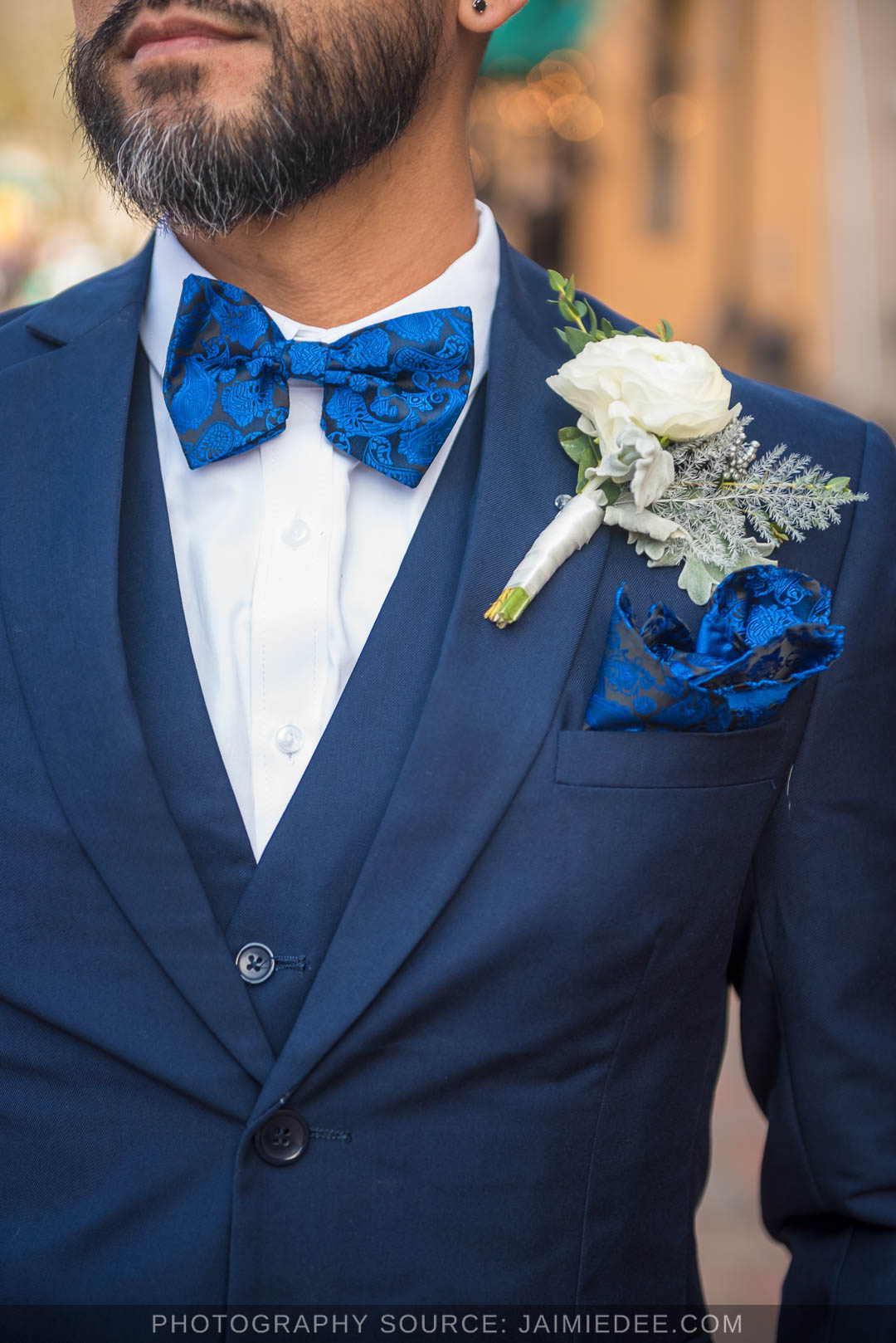
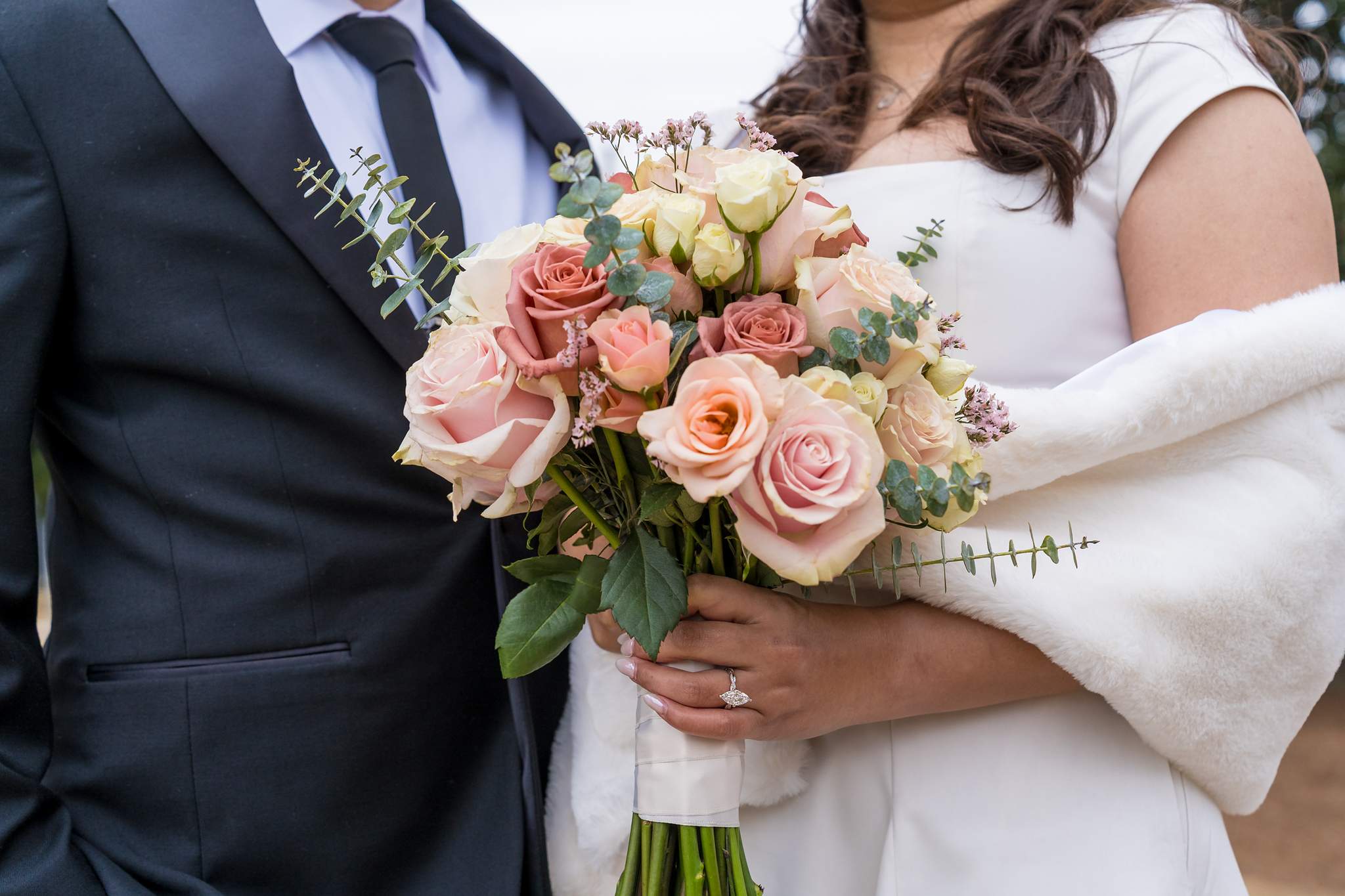
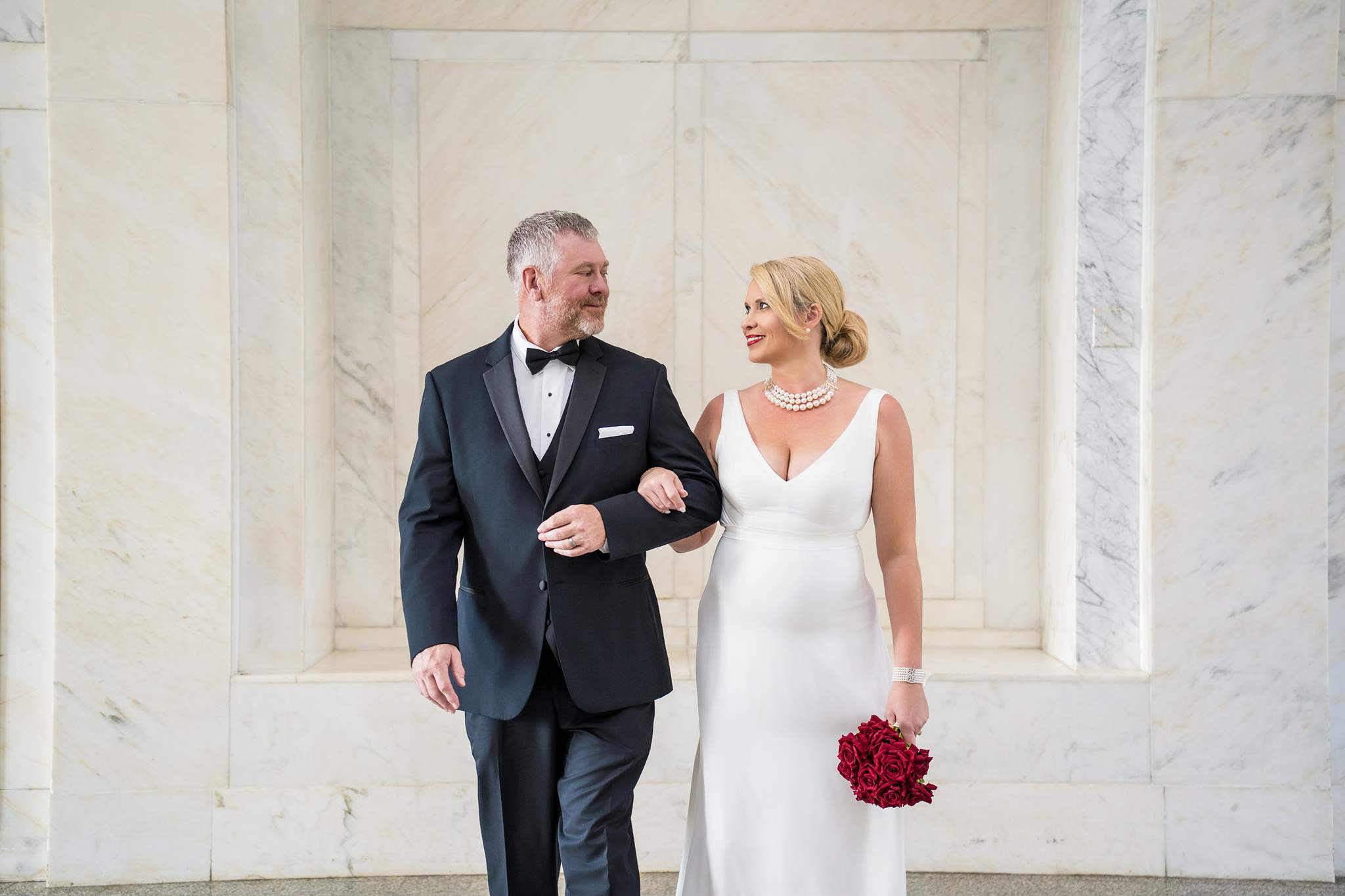
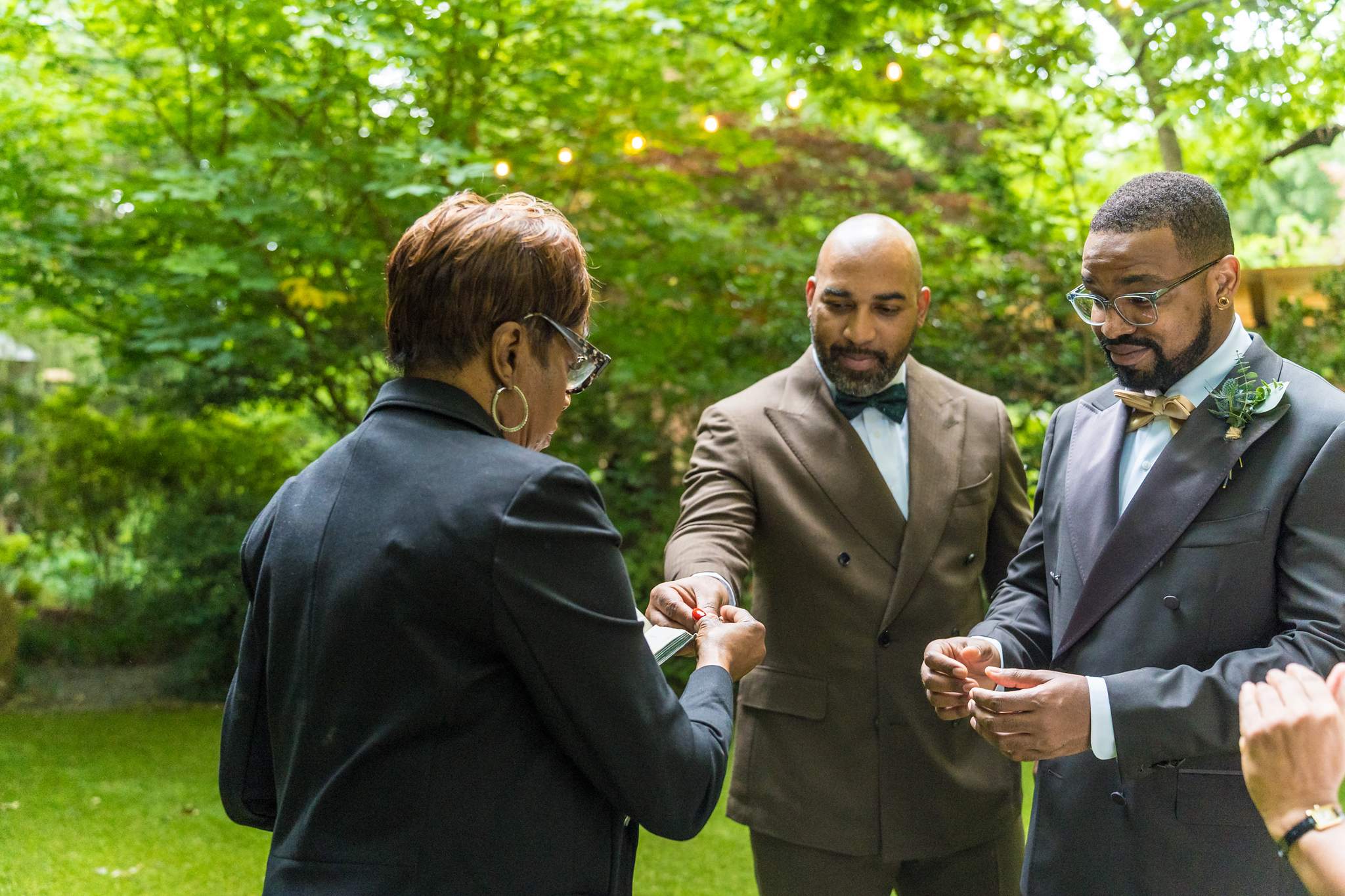
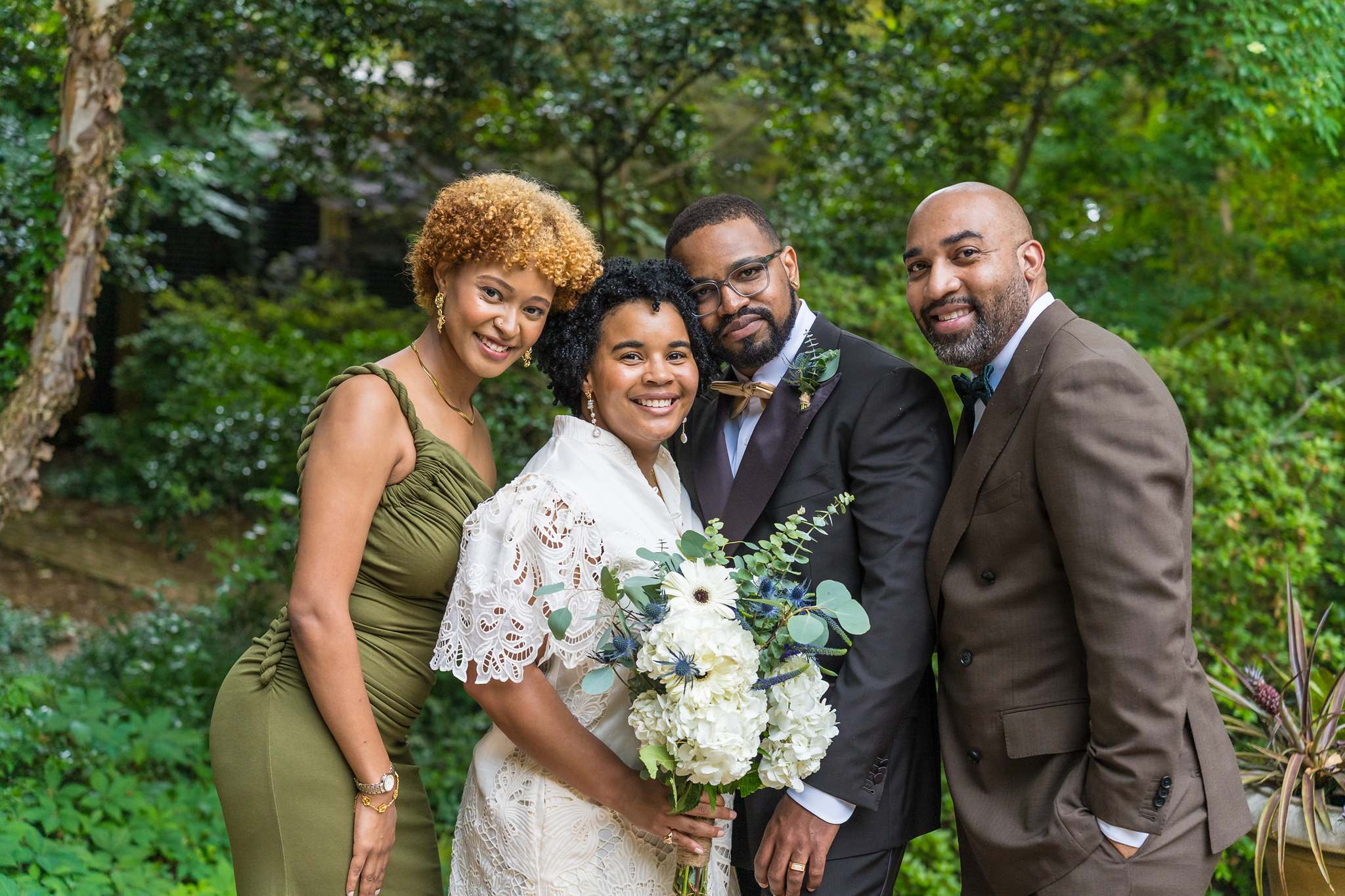
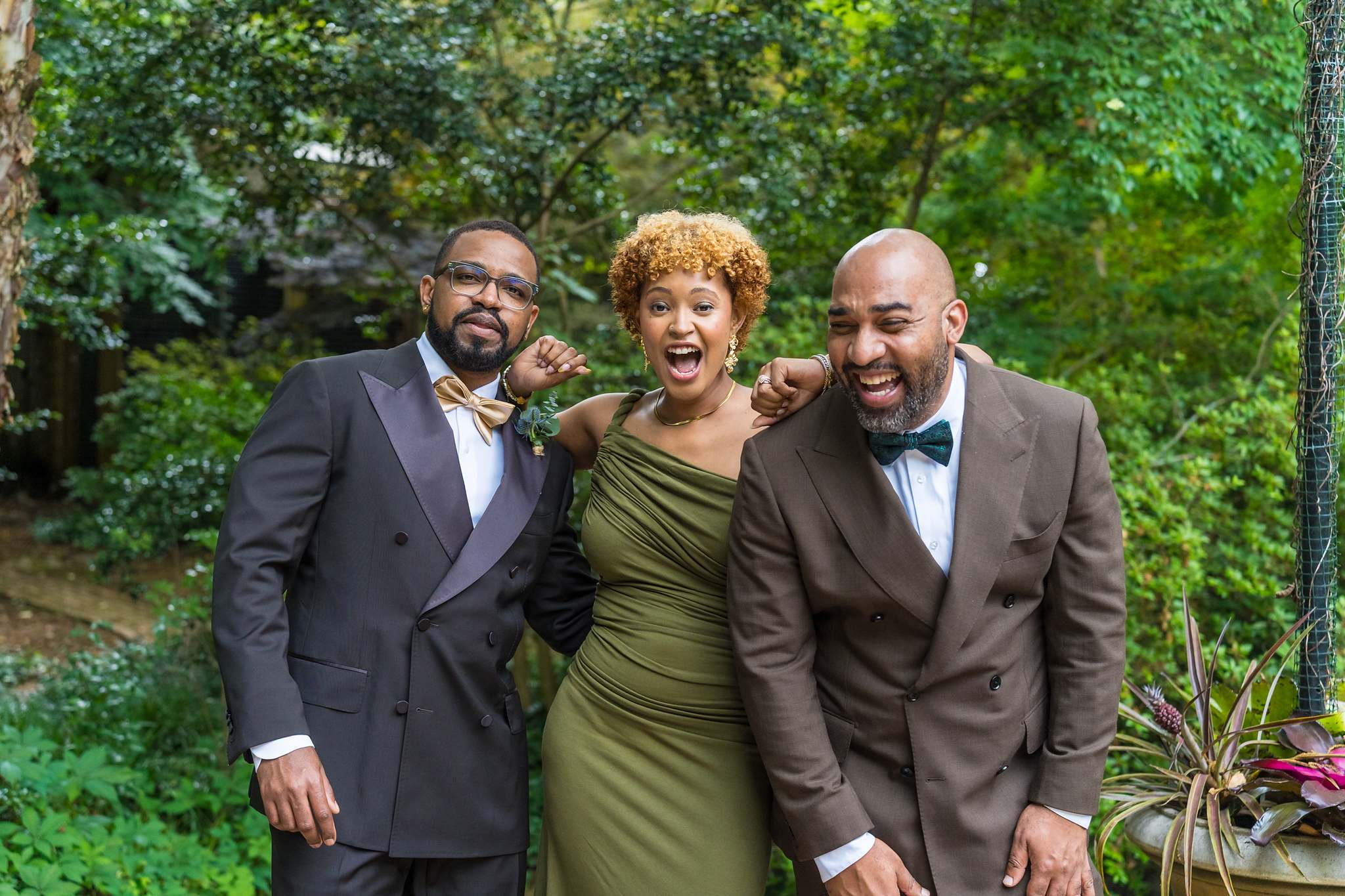
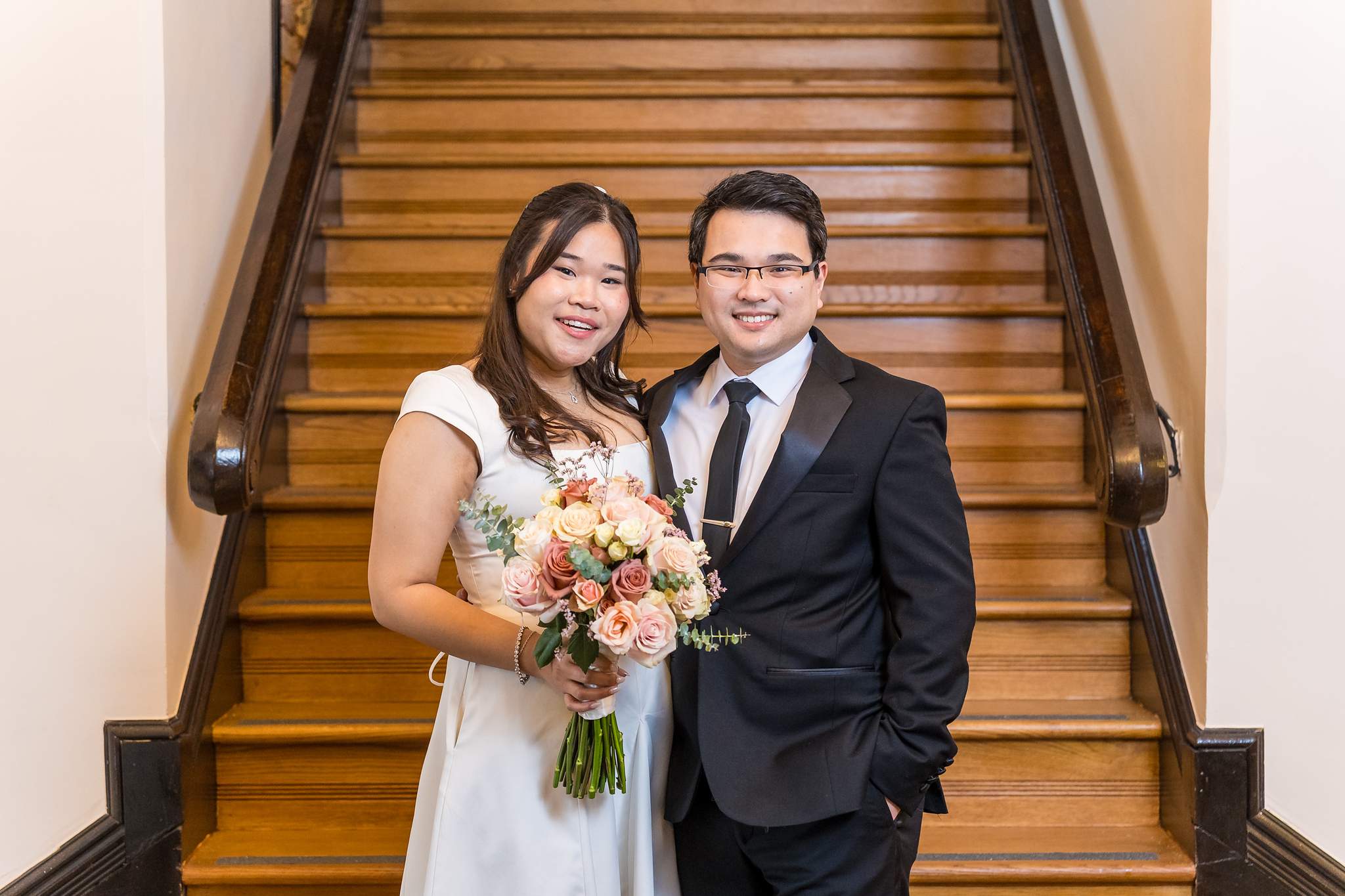
A well-fitted suit is the classic choice for a courthouse wedding. Navy, charcoal and gray look polished against marble, brick and wood, and a burgundy or green suit adds personality. A tuxedo is a great fit for an evening ceremony or a dressier celebration afterward.
Fit is what shows most in photos. A quick visit to a tailor for sleeve and hem length makes a big difference when you’re standing side by side. A tie or bow tie and a boutonniere that echoes the bouquet tie the two of you together in every portrait.
Want to coordinate? Pick one shared accent color, like a tie that picks up the flowers or a pocket square in the same shade as a dress. A shared accent looks effortless in photos.
Colors and Fabrics That Photograph Well
Courthouse interiors range from grand marble halls to rooms that feel more like offices, and the light inside is often a mix of windows and overhead fixtures. Here’s what we’ve seen work best:
Solid colors and soft textures like lace, crepe, satin and wool look rich in photos and keep the focus on your faces.
White, ivory and champagne glow against stone and brick, and a darker suit beside them creates a classic contrast.
Small, busy patterns can look distracting in photos. If you love pattern, choose a bold, simple print.
Wrinkle-resistant fabrics help if you’ll drive between the courthouse and your portrait locations.
Large logos and graphics pull attention in every photo, so save them for another day.
What to Wear to a Courthouse Wedding in Each Season
Atlanta weather changes a lot through the year, and most courthouse weddings include some time outdoors, whether that’s the walk from the parking deck or portraits on the steps afterward. Dress for the forecast and you’ll look and feel your best.
Spring
Spring brings mild temperatures, blooming trees and plenty of pollen. Light fabrics, a dress with a little movement and a cardigan or cropped jacket for cool mornings all work well. Pastels, florals and soft greens look lovely with spring color in the background, and a lint roller in your bag takes care of pollen on dark suits.
Summer
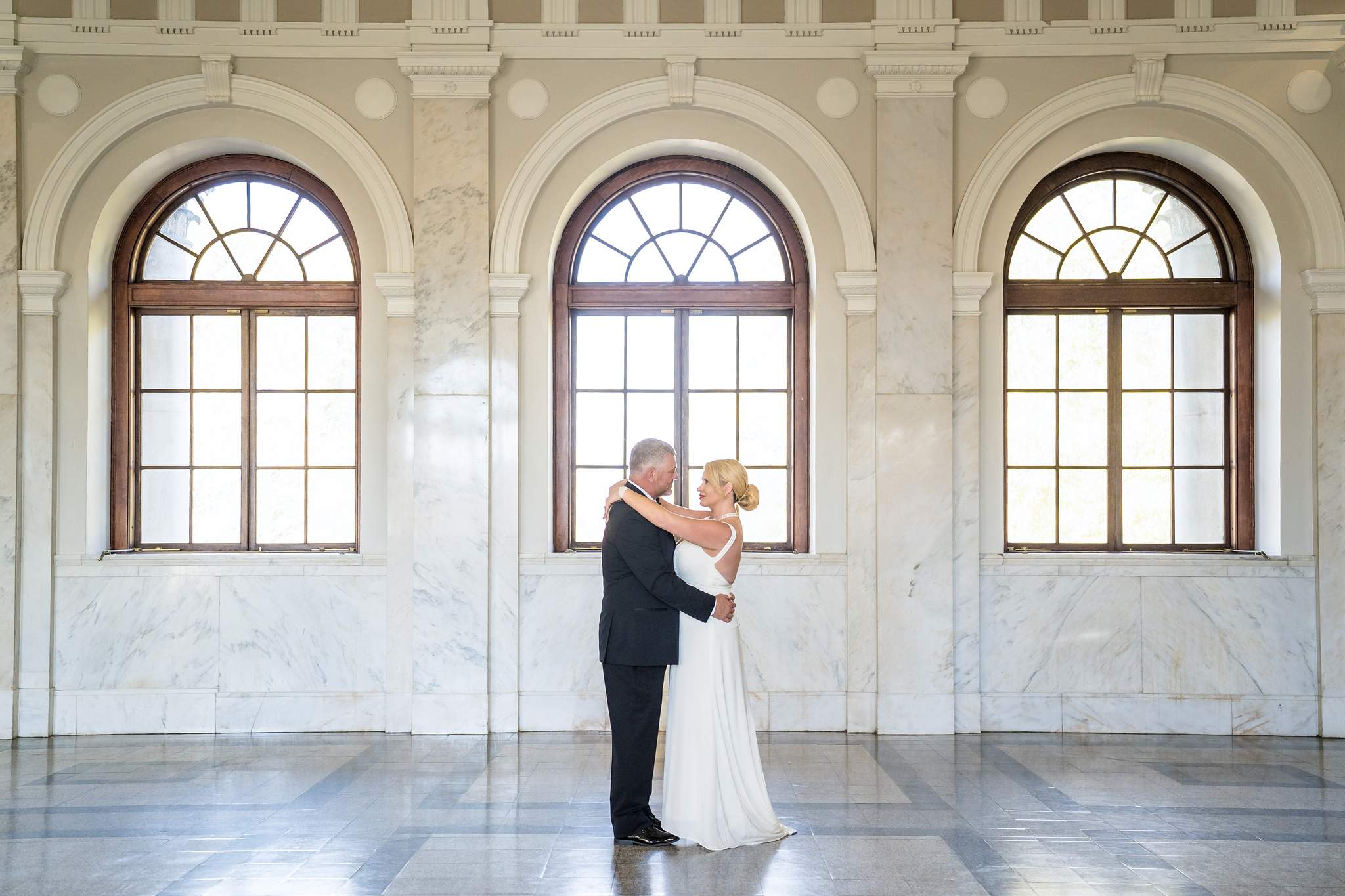
Atlanta summers are hot and humid, often in the 90s, and the humidity makes hair frizz, makeup fade and fabric cling within minutes outdoors. Shade softens the light, but the humidity stays. That’s why we recommend an indoor-first plan for summer: your courthouse ceremony, then portraits in an air-conditioned space like the marble halls of the Historic DeKalb Courthouse or one of our favorite indoor portrait locations in Atlanta. If the day turns out pleasant, a few minutes outside is a bonus. For your outfit, choose breathable fabrics like cotton, linen blends and lightweight crepe, a lighter suit fabric for partners, and bring blotting papers for the walk in. Our summer elopement tips explain the indoor-first plan in more detail.
Fall
Fall is one of the most comfortable seasons for a courthouse wedding in Atlanta, though early fall can still feel like summer. Rich colors like burgundy, rust, emerald and navy look beautiful with changing leaves, and a light jacket or wrap helps once the evening cools down.
Winter
Winter days in Atlanta are often in the 40s and 50s, and some mornings start near freezing. Long sleeves, a faux fur wrap, a tailored coat or a cape keep you warm and photograph beautifully. Velvet, wool and heavier satin feel seasonal, and tights or a dressy pantsuit add warmth. Bring a coat for the walk in, and we’ll help you set it aside for portraits. Planning a December date? Our Christmas wedding ideas have more seasonal inspiration.
Dress for Your Setting: Courthouse, Historic Venue or Garden
County Courthouses and Magistrate Courts
Working courthouses move quickly. You’ll pass through security, wait for your turn and often stand for a short ceremony in a courtroom, office or ceremony room. A dress or suit that’s easy to move and sit in works best, and a long train or a very full skirt can be tricky in tight hallways. Our guide to how long a courthouse wedding takes walks through each step of the visit.
Historic Courthouses
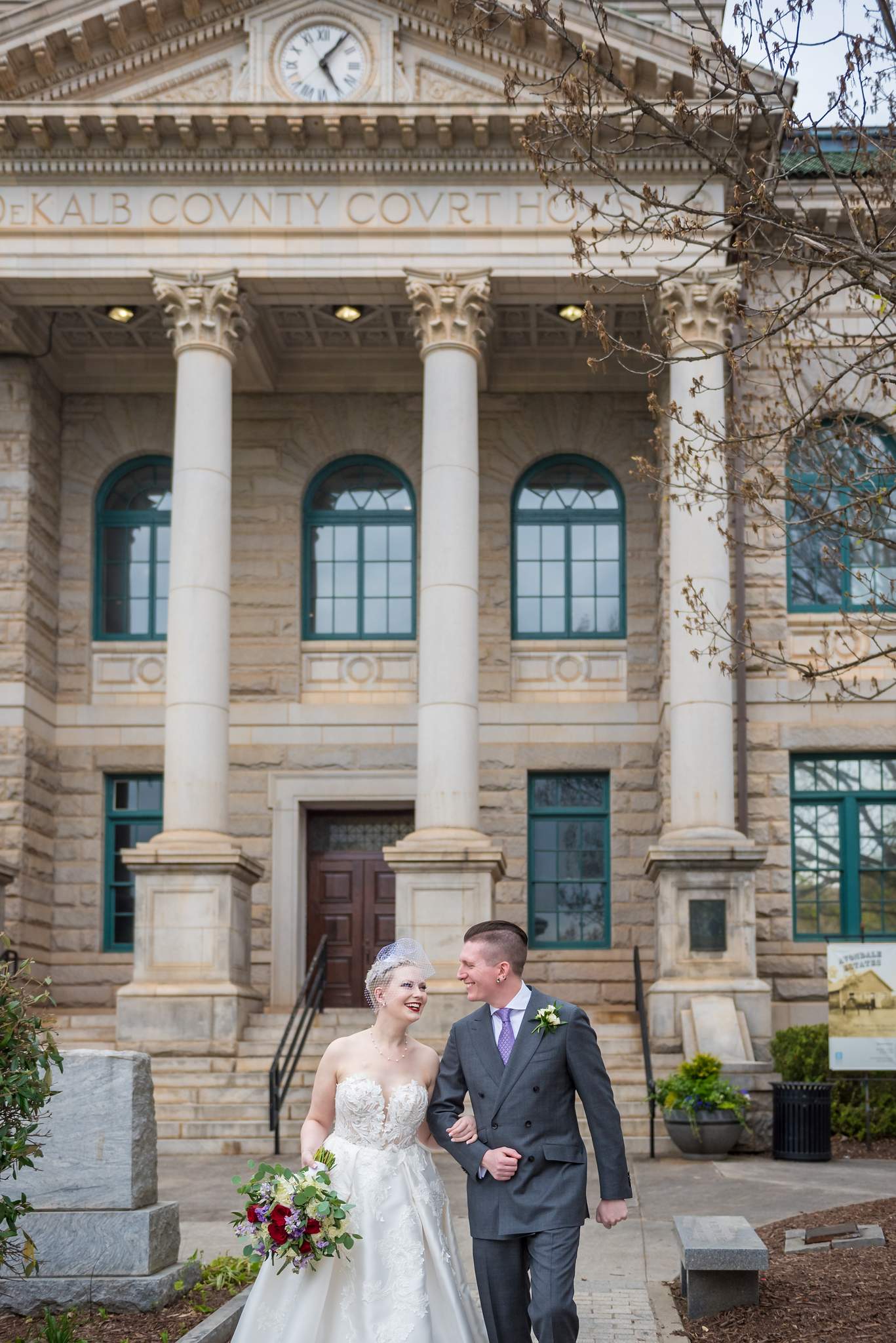
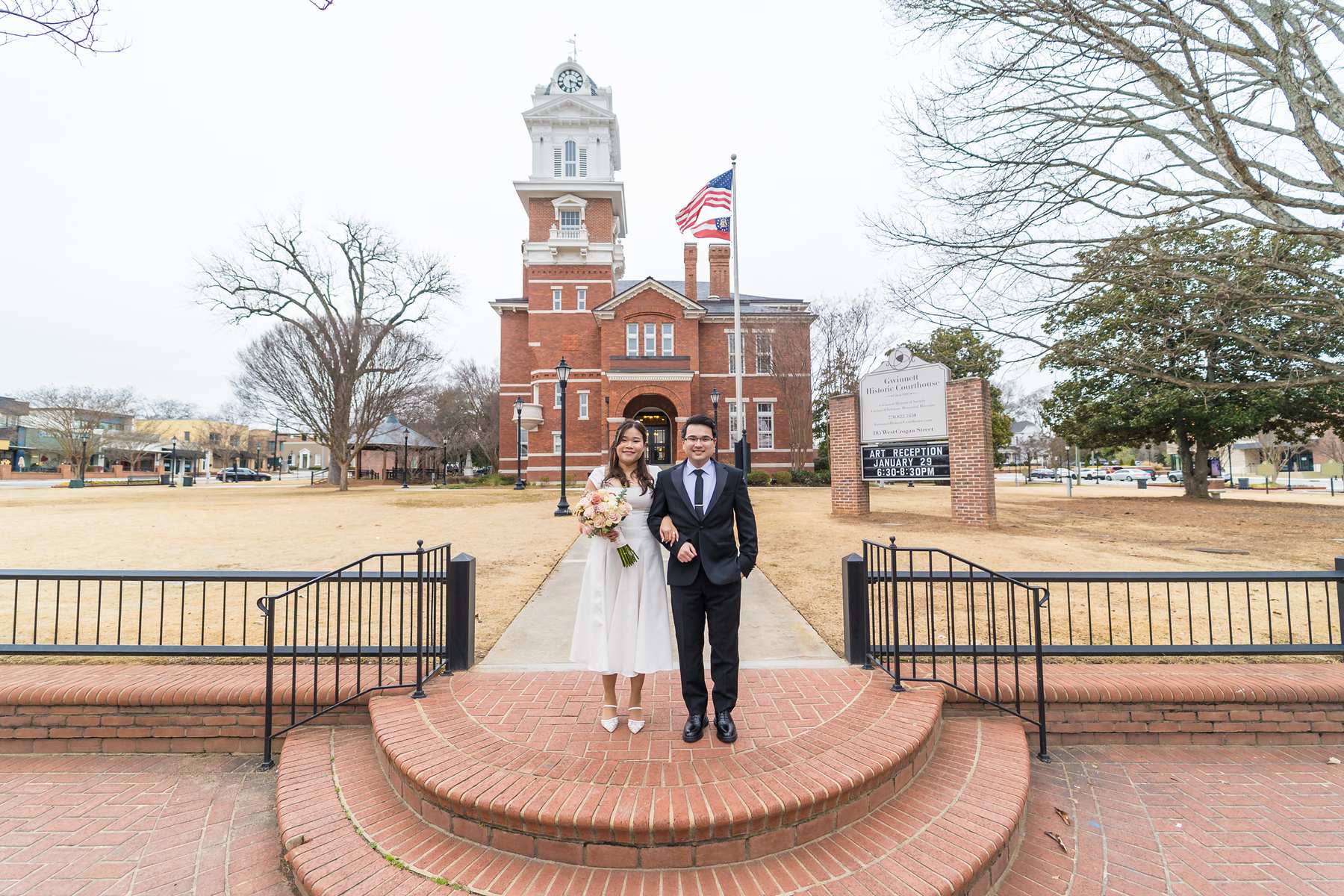
Historic courthouses like the Historic DeKalb Courthouse in Decatur and the Gwinnett Historic Courthouse in Lawrenceville host weddings as event venues, with marble, brick, staircases and tall windows that give you more room to dress up. This is a beautiful place for a full gown, a dramatic veil or a bold suit color.
Courthouse Squares and Downtown Portraits
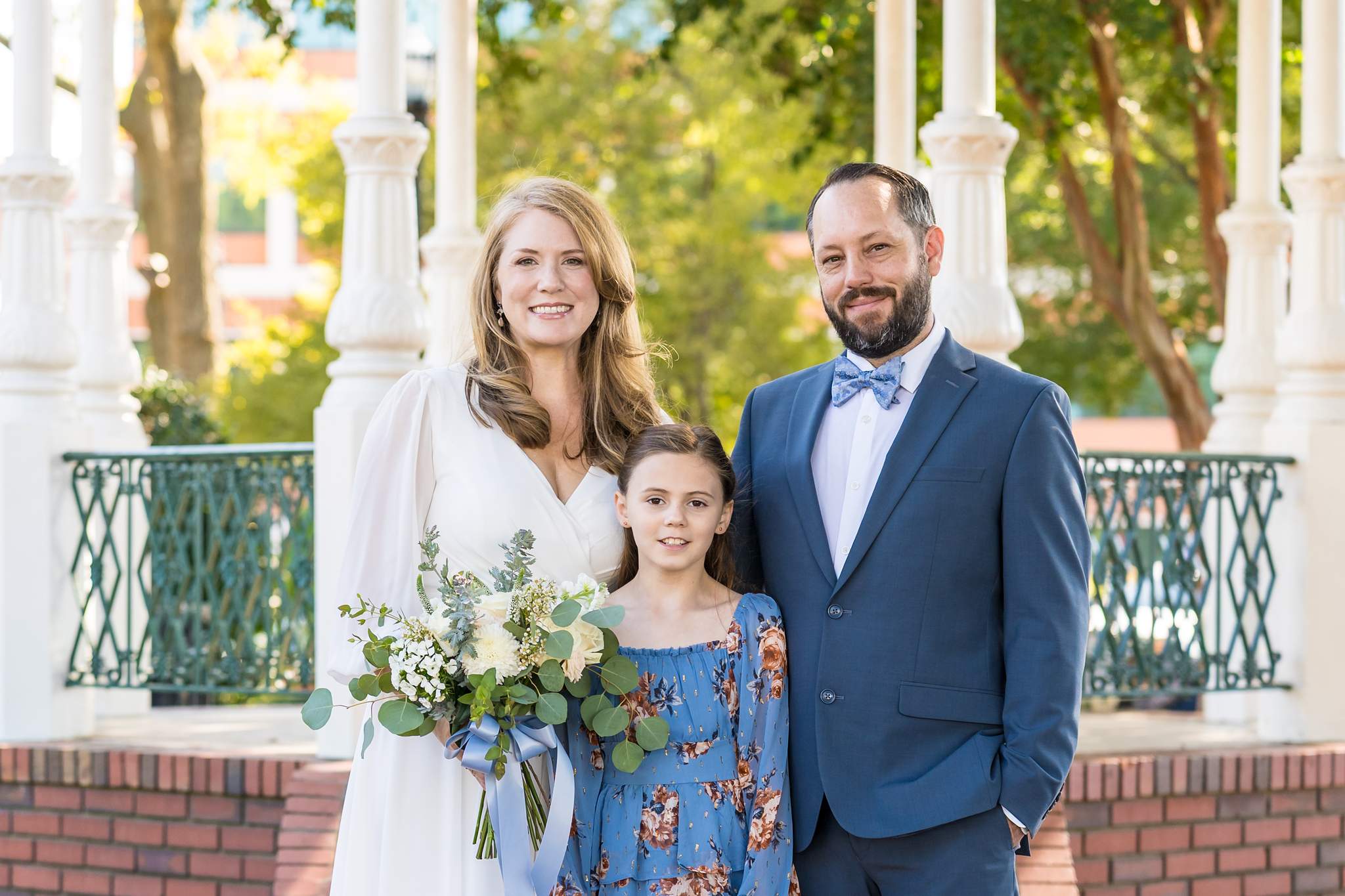
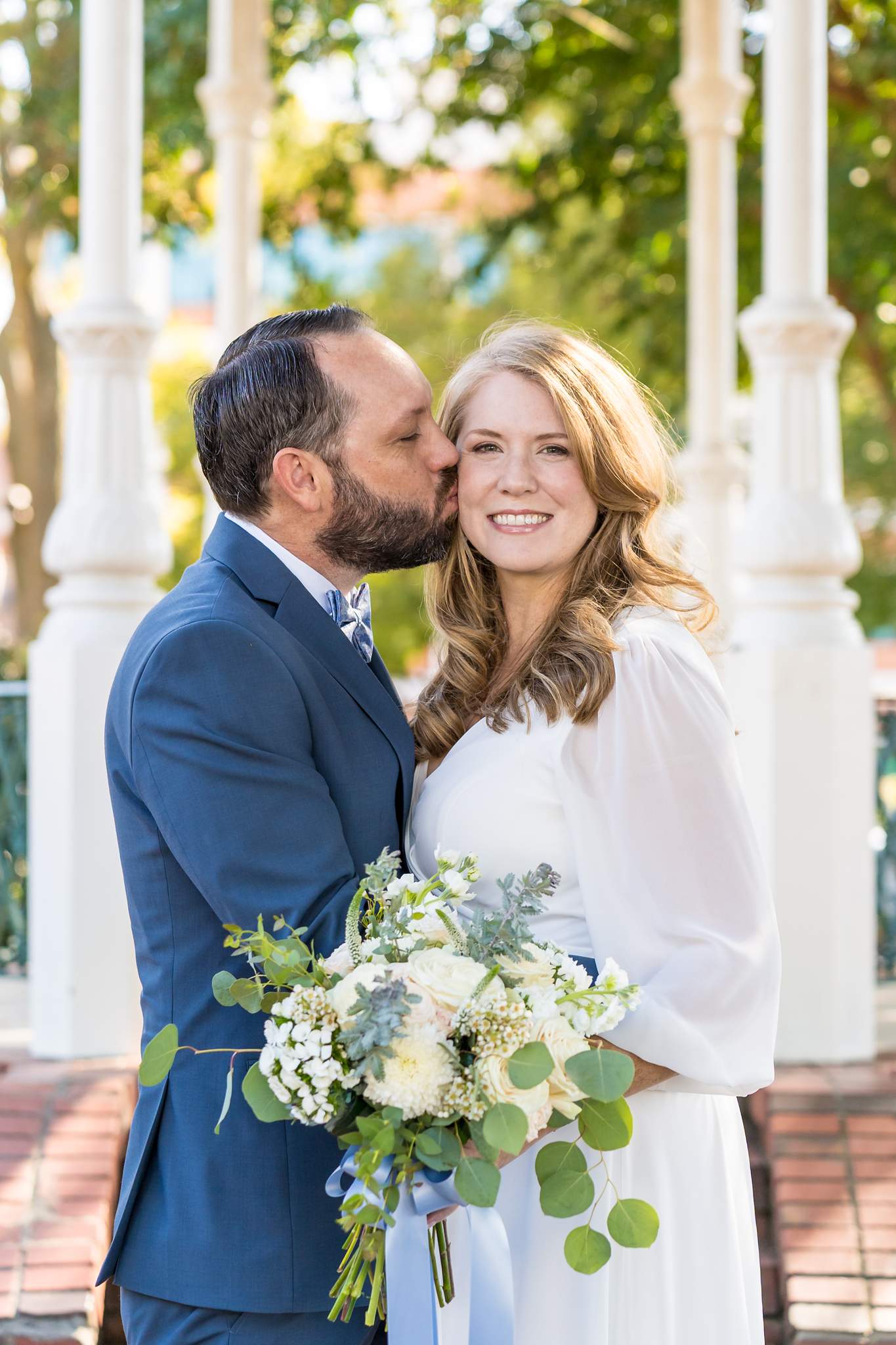
Many couples take portraits around a courthouse square after the ceremony, like the gazebo and murals around Marietta Square. You’ll walk on brick and pavement, so block heels or dressy flats are a smart choice, and a hem that clears the ground stays clean.
Garden and Outdoor Elopements
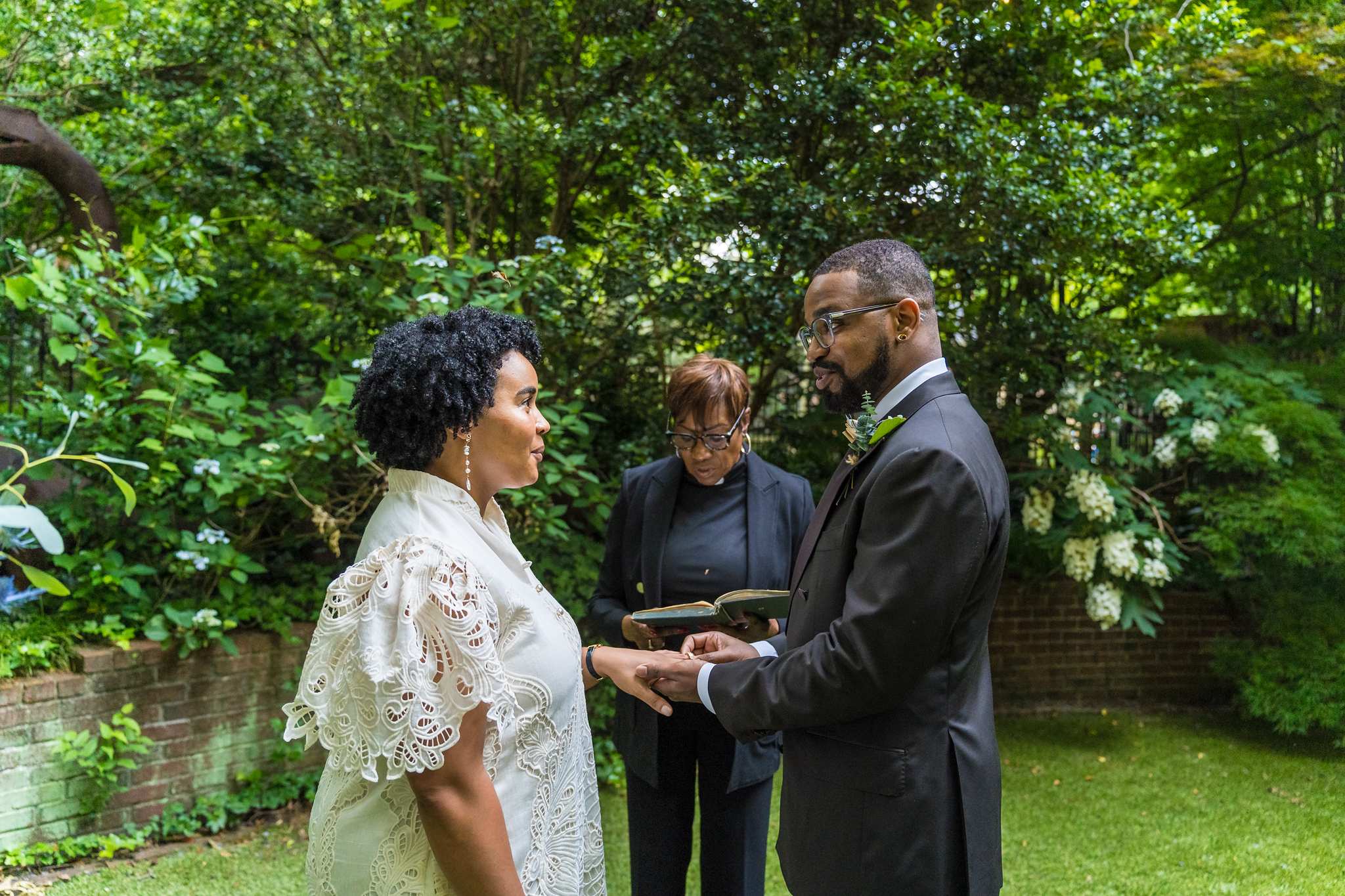
Grass, gravel and garden paths call for flats, wedges or block heels. Light, flowing fabrics move beautifully in a breeze, and a shorter hem or a bustle keeps your dress clean. For ideas on where to go, see our guide to places to elope in Atlanta.
Shoes, Accessories and What to Bring
Comfortable shoes, plus a second pair if you’d like to change for portraits.
Your marriage license and photo IDs for both of you. Gwinnett County’s ceremony check-in, for example, asks for a valid Georgia marriage license and photo ID for both partners.
A small bag that moves easily through security.
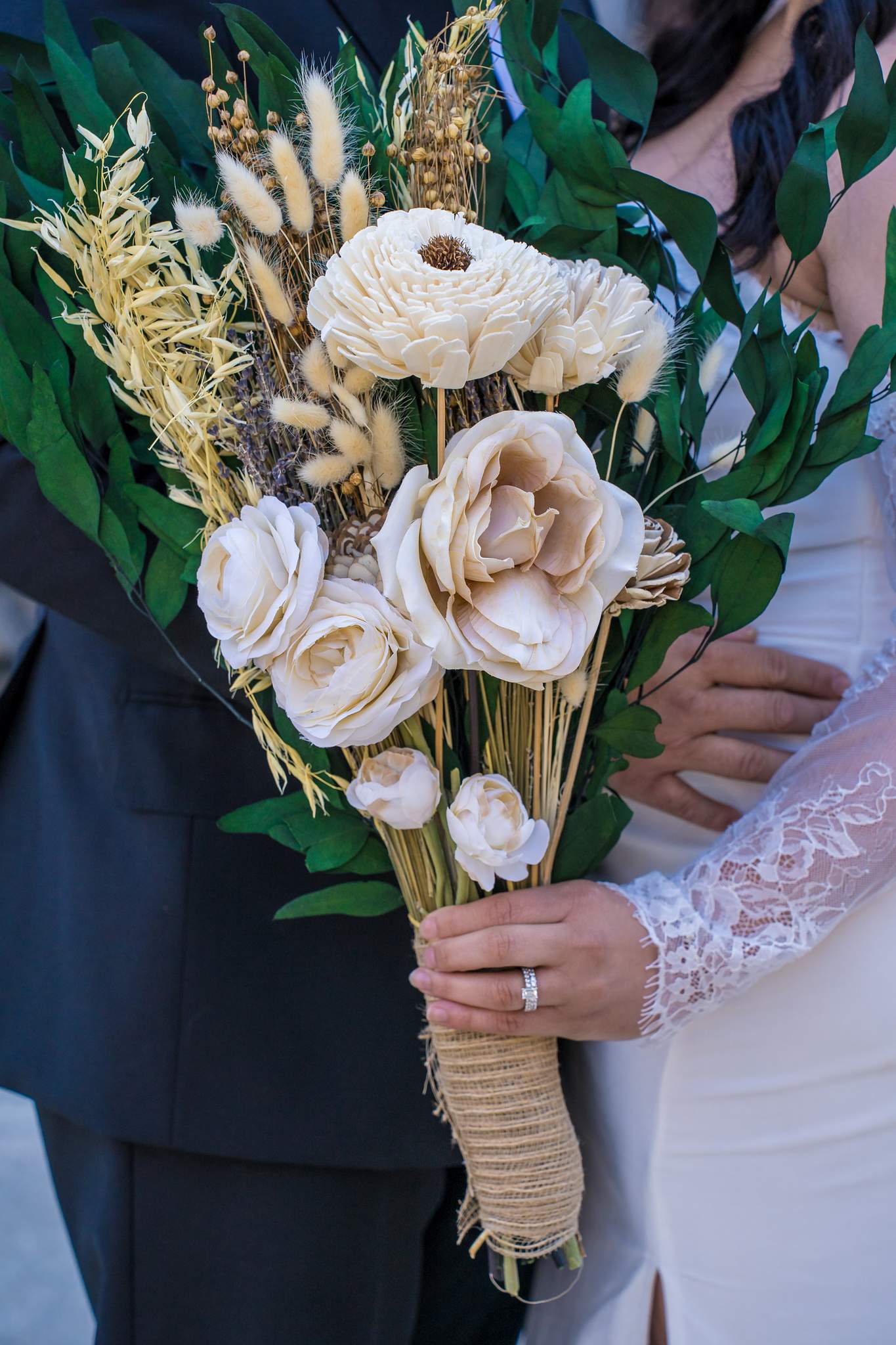
A bouquet or a few stems and a boutonniere. Flowers add color to every photo, especially in neutral courthouse rooms.
A veil, hair accessory or statement earrings for a bridal touch with a simple dress.
Blotting papers, lip color, bobby pins and a small mirror for touch-ups between the ceremony and portraits.
What to Wear to a Courthouse Wedding as a Guest
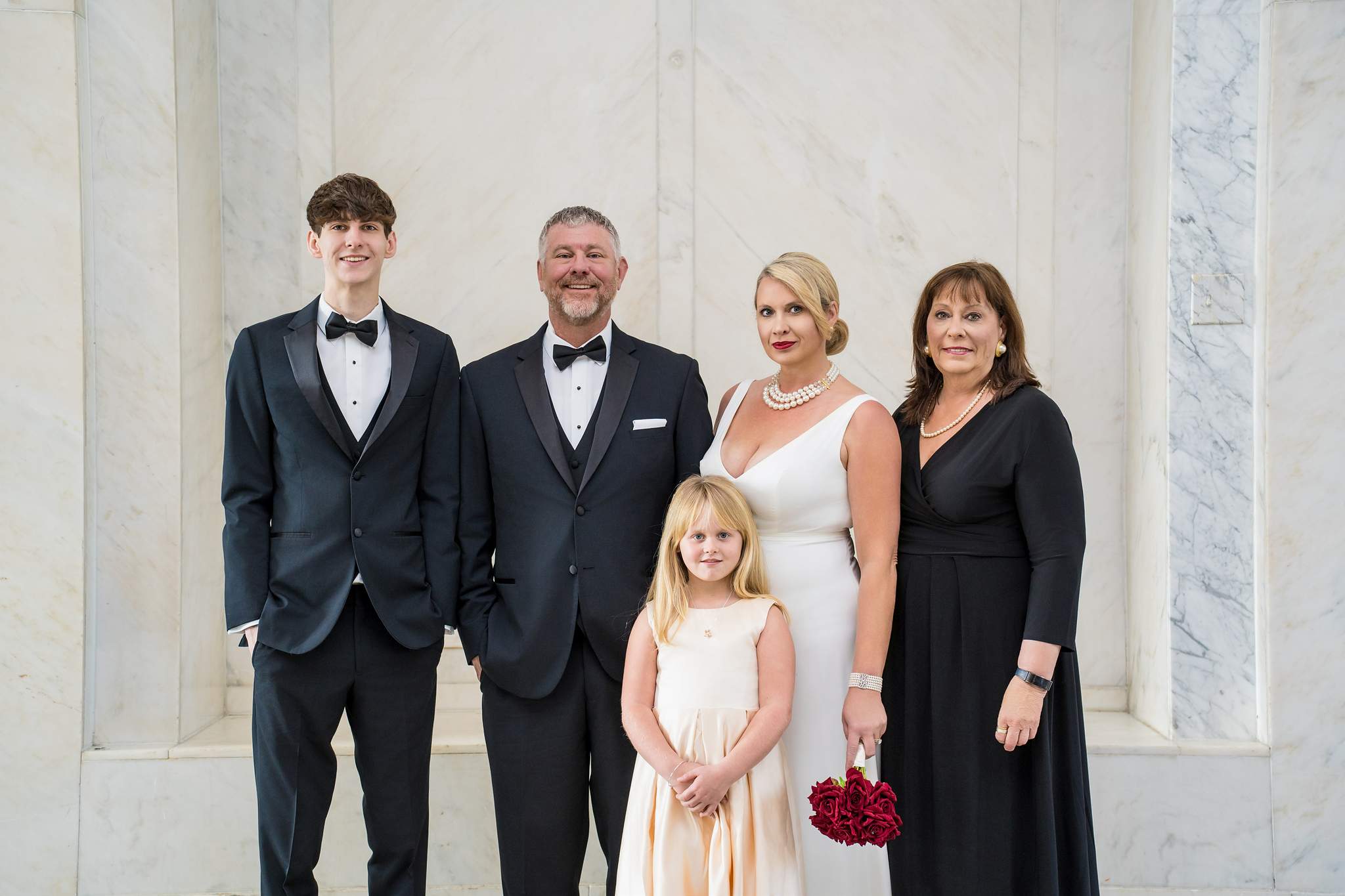
Guests can dress as they would for a nice dinner or a daytime event: a dress, a skirt or dressy pants with a nice top, or slacks with a button-down or blazer. Follow the couple’s lead. If they’re wearing a gown and suit, lean dressier. If the day is relaxed, smart casual is perfect.
Leave white and ivory to the couple unless they’ve asked guests to wear it, and wear shoes you can stand in, since you may stand for the ceremony. Courts set their own guest limits, so check with the couple before inviting a plus-one. Our guide to courthouse weddings in Georgia covers how each county works.
Courthouse Wedding Outfit FAQ
Do You Dress Up for a Courthouse Wedding?
Most couples do, at least a little. The ceremony is short, but it’s still your wedding day, and you’ll keep the photos for a lifetime. Dress up as much as feels like you, from a gown and tuxedo to a simple dress and blazer.
Can You Wear Jeans to a Courthouse Wedding?
Cobb County’s Magistrate Court says casual attire is acceptable, so jeans are fine there. Check your own court’s guidelines first. If you love a casual look, pair dark jeans with a crisp white top and a blazer or dressy jacket so your photos still feel like a wedding day.
Can You Wear Black to a Courthouse Wedding?
Yes. A black dress or suit looks elegant and timeless, especially with flowers for a pop of color. Guests can wear black too.
What Color Should You Wear to a Courthouse Wedding?
White, ivory, champagne and blush are the most traditional choices for couples, and any color you love works too. Jewel tones like emerald and burgundy look rich in fall and winter, and soft pastels feel fresh in spring.
What Not to Wear to a Courthouse?
Large bags and lots of metal accessories slow you down at security, and a very long train can be hard to manage in a small courtroom. Shoes you can’t stand in for an hour and fabrics that crease in the car can make the day harder too. Check your court’s rules for anything specific to your county.
What Should You Wear to the Courthouse for a Marriage License?
Wear whatever is comfortable. Getting your license is an administrative visit to the county probate court, and both of you need to be there in person with valid ID. Some couples dress up and take a few photos on the courthouse steps to remember the day.
What Should a Witness Wear to a Courthouse Wedding?
A witness can dress like any other guest, matching the couple’s level of formality. You’ll be standing right beside them in photos, so a solid color that complements their outfits looks great.
Plan Your Courthouse Wedding or Elopement With Us
The best courthouse wedding outfit is the one that feels like you and lets you move easily through the whole day. Choose something that suits your setting and season, plan a layer or two and bring your flowers.
A courthouse wedding ceremony usually lasts 5 to 20 minutes, but the whole visit takes longer once you count parking, security, check-in, waiting for your turn and photos afterward. So, how long does a courthouse wedding take? Plan on about 1 to 2 hours at the courthouse, and more if you still need your marriage license that day.
We’ve photographed courthouse weddings around Atlanta since 2008, from county courtrooms to historic courthouse squares. Below, we walk through what happens at a courthouse wedding, how long each step takes, what Georgia courts publish about timing and how much photography coverage you need.
How Long Does a Courthouse Wedding Take? The Quick Answer
Here’s how a typical courthouse wedding visit breaks down. Every court runs a little differently, so treat these as planning ranges.
Step
Typical time
Parking and walking in
10 to 20 minutes
Security screening
5 to 20 minutes
Check-in and paperwork
10 to 15 minutes
Waiting for your turn
10 minutes to an hour or more
The ceremony
5 to 20 minutes
Signing, hugs and family photos
10 to 15 minutes
Total at the courthouse
About 1 to 2 hours
Getting your marriage license is usually a separate step at the county probate court, and it can add an hour or more if you do it the same day. Gwinnett County Probate Court, for example, notes that license processing may take over an hour when applications are incomplete.
What Happens at a Courthouse Wedding?
Most courthouse weddings in Georgia follow the same basic order:
You arrive, park and walk in. Leave time for parking decks, busy lots and finding the right building and floor.
You go through security. Courthouses screen visitors at the entrance, so expect a line, especially when the building opens and around lunch.
You check in. The court reviews your marriage license and photo IDs. Gwinnett County, for example, asks for a valid Georgia marriage license and a government-issued photo ID for both partners.
You wait for your turn. Some courts hold group ceremonies at set times, while others call couples one at a time.
The ceremony. A judge, magistrate or court officiant leads short vows, and you can usually exchange rings.
You sign and celebrate. After the paperwork comes time for hugs, family photos and your first portraits as a married couple.
How Long Is a Courthouse Wedding Ceremony?
The ceremony itself is short. Most courthouse ceremonies last 5 to 20 minutes, depending on the officiant, whether you exchange rings or read your own vows, and whether the court marries one couple at a time or holds a group ceremony.
That simplicity is part of the appeal: the focus stays on the two of you and the people standing with you. It also means the big moments happen fast. The vows, the ring exchange and your first kiss can all happen within a few minutes, so we plan where we’ll stand before the ceremony begins. Each court sets its own rules for photographers, so we plan around them ahead of time and keep a low profile during the ceremony.
Why Courthouse Weddings Take Longer Than You Expect
The ceremony is quick. Everything around it takes time. These are the delays we plan for at every courthouse wedding:
Atlanta traffic. A short drive across town can take much longer at rush hour or when there’s an accident on the interstate.
Parking. Courthouse lots and nearby decks fill up, and some buildings sit a short walk from the closest parking.
Security. Entrance lines move at their own pace, and everyone in your group goes through screening.
Paperwork. A missing document or a name that doesn’t match an ID can slow down check-in.
The court’s schedule. Courts handle other business throughout the day, so ceremonies don’t always start at the posted time.
Build in 15 to 20 minutes of buffer for Atlanta traffic, courthouse security and parking, then arrive by the time your court asks. Your guests need the same buffer: Gwinnett County Probate Court notes that the ceremony may begin without guests who arrive late.
What Georgia Courts Say About Timing
Each county runs its courthouse weddings differently, so check your court’s website before you plan your day. Here are a few examples from metro Atlanta courts’ own websites.
Cobb County
Cobb County Magistrate Court offers free group wedding ceremonies at set times, with evening ceremonies on weekdays and additional midday times on weekends and county holidays. Couples are asked to arrive 30 minutes before the scheduled time, and the marriage license must come from Cobb County Probate Court. See our Cobb County courthouse wedding guide.
Gwinnett County
Gwinnett County Probate Court hosts free wedding ceremonies most Friday afternoons, and reservations are required. The couple and guests should reach the check-in table at least 10 minutes before the ceremony, and the court specifically asks couples to plan for traffic, parking and security delays. It also recommends applying for your marriage license well before the ceremony day. See our Gwinnett County courthouse wedding guide.
Fulton County
Fulton County Magistrate Court uses a Rule 11 form for cameras and recording at weddings, so if you’d like a photographer with you, look into the court’s requirements well ahead of your date. See our Fulton County courthouse wedding guide.
Schedules, reservation systems and requirements change, so confirm the details directly with your court before your date. For a county-by-county look at how courthouse weddings work, see our guide to courthouse weddings in Georgia.
Sample Courthouse Wedding Timeline
Here’s how a 2-hour courthouse wedding often comes together with us. Your timeline will shift with your court’s schedule, but the shape stays the same.
First 15 minutes: We meet you outside the courthouse for relaxed portraits and photos with your guests as everyone arrives.
Next 15 to 30 minutes: Security, check-in and paperwork. We stay with you and capture the moments in between.
The wait: However long the court takes, we’re there for the nervous wait and the hugs from your people.
The ceremony: 5 to 20 minutes, photographed quietly from the spots the court allows.
Right after: Signing, family photos and your first portraits as a married couple.
Remaining time: Portraits at the courthouse or a nearby spot, like a historic square, a mural or a park.
How Much Photography Coverage Do You Need for a Courthouse Wedding?
Courthouse ceremonies always start at 2 hours of coverage. Courthouses run on their own schedule, and it’s common to wait well past your appointment time. Two hours means we’re there for the whole experience, from the nervous wait to the ceremony to your first portraits as a married couple, without anyone watching the clock or needing to add time on the day.
Plan more time if you’d like getting-ready photos, portraits at a second location or photos at a dinner or celebration afterward. For sample timelines with more coverage, see our elopement timeline guide, and for the bigger planning picture, our step-by-step guide on how to plan an elopement.
Nervous about being photographed in front of a judge and court staff? Here’s how we help camera-shy couples feel at ease.
Tips to Keep Your Courthouse Wedding on Schedule
Get your marriage license early. Both of you must apply in person at a Georgia probate court, and same-day applications can take longer than expected.
Bring your documents. Check your court’s list, which usually includes your marriage license and a government-issued photo ID for both of you.
Arrive early. Add 15 to 20 minutes for traffic, security and parking on top of the arrival time your court gives you.
Share the plan with your guests. Give them the arrival time, the building entrance and where to park.
Plan portraits around the light. If you’d like outdoor portraits, talk with us about timing so the light works in your favor.
Check the court’s photography rules. Some courts have forms or limits for outside photographers, so look into them before your date.
Courthouse Wedding FAQ
Do You Walk Down an Aisle at a Courthouse Wedding?
Usually there’s no formal processional. Many courthouse ceremonies take place in a courtroom, a judge’s chambers or a designated ceremony room, and you step forward when your names are called. Some courts and special ceremony events have a short aisle or an arch, so ask your court what the space looks like.
How Long Is the Process to Get Married at the Courthouse?
Plan for two parts. First, both of you apply in person for a marriage license at a Georgia county probate court; some courts let you start the application online and finish in person. Then the ceremony visit itself usually takes 1 to 2 hours. Afterward, the signed license goes back to the probate court within 30 days of the ceremony, and Georgia notes that the marriage certificate typically arrives by mail within 30 days.
Can You Get Married at the Courthouse in Georgia?
Yes. Several metro Atlanta county courts perform wedding ceremonies, including free group or reserved ceremonies at some magistrate and probate courts. Some counties only issue marriage licenses, so check what your county offers. Our guide to courthouse weddings in Georgia compares the options.
Can You Get Married at the Courthouse the Same Day?
Sometimes. Cobb County, for example, says marriage licenses can be obtained the same day, with applicants reporting to its probate court licensing office by 4:30 p.m. on weekdays. Other courts, like Gwinnett, require ceremony reservations and advise against waiting until the ceremony day to apply for your license. Check your court’s rules before you plan a same-day wedding.
How Long Does It Take to Plan a Courthouse Wedding?
It depends on your court. Reservation-based courts fill their calendars, so reserve your ceremony first, then plan photography and any celebration around it. Courthouse weddings can come together quickly, and we’re happy to help with short-notice dates. A few days’ notice is usually too tight for us to plan well, so reach out as soon as you have a date in mind.
What Should You Do After a Courthouse Wedding?
Many couples head out for portraits nearby, then celebrate with a meal or a small party with their guests. Remember the paperwork too: the signed license needs to go back to the probate court within 30 days of the ceremony.
Plan Your Courthouse Wedding With Us
A courthouse wedding takes about 1 to 2 hours from arrival to your first portraits as a married couple, even though the ceremony itself lasts only minutes. Give yourselves a buffer, know your court’s rules and choose photography coverage that lets you enjoy the whole experience.
Yes, you can have an elopement with family. An elopement is a small, intentional wedding, usually just the two of you or up to about 20 guests, so inviting parents, siblings, children or a few close friends still counts as eloping. You decide who stands with you. We have photographed elopements, courthouse weddings and micro weddings around Atlanta since 2008, and many of our favorite small ceremonies include the people who raised the couple, standing just a few feet away.
This guide covers who to invite, who can officiate a wedding in Georgia, whether you need witnesses, how to tell family you’re eloping, and how to plan your photos so everyone gets a moment with you. If you’re still choosing where to marry, start with our guide to places to elope in Atlanta.
Can Family Come to an Elopement?
Yes. Eloping once meant running off to marry in secret. Today most couples use the word for a small, planned wedding, often with the people closest to them, and who comes is entirely up to you. Some couples marry with only their officiant present. Others invite both sets of parents, a grandparent and a sibling or two. Both are elopements.
The working line we use: an elopement has up to about 20 guests. If your list is growing toward 20 to 50 people, you’re planning something closer to a micro wedding, and our guide to elopement vs. micro wedding explains how the planning changes.
How to Plan an Elopement With Family
Planning an elopement with family follows the same basic steps as any elopement, with a little more thought about your guests:
Decide who you want there before you choose a place.
Choose a location that fits your group, with an indoor backup.
Book your officiant and confirm any witness requirements with your county.
Tell your family early, in person or on a call when you can.
Plan your photography time with room for family photos.
Plan a meal or small celebration afterward.
For the full process, from your marriage license to your timeline, see our step-by-step guide on how to plan an elopement.
Decide Who to Invite First
The size of your group shapes every other choice: the location, how much time you need and whether a courthouse can fit everyone. A simple rule makes this easier, like parents and siblings only, or immediate family plus one friend each. A clear line also makes the conversation kinder with relatives who aren’t on the list, because the choice is about the size of the day.
Choose a Location That Fits Your Group
A garden corner or a historic room that feels spacious for two can feel crowded with fifteen people. Think about where older relatives will sit or stand, how far everyone walks from parking, and whether there’s shade or air conditioning on a warm day. Courthouses and city halls each set their own rules for ceremonies and guests, so check with the court before you invite a group. Our guide to courthouse weddings in Georgia walks through the details county by county.
Every elopement with a ceremony should have an indoor backup location, and weekend elopements take place rain or shine. Our weather policy for elopements explains how we handle the forecast for weekday outdoor ceremonies.
Who Can Officiate a Wedding in Georgia?
Under Georgia law (O.C.G.A. § 19-3-30), a marriage ceremony can be performed by any judge, including judges of state and federal courts of record in Georgia, a city recorder, a magistrate, the Governor or a former Governor, or a minister or other person authorized by the rules of their religious society to perform marriages. That gives you several good ways to involve family:
A family member or close friend who is ordained. Having someone who knows you lead the ceremony is one of the most personal ways to include family. Our Atlanta elopement guide explains how to get ordained in Georgia online.
A religious leader from your family’s congregation, who can bring the traditions you grew up with into a short ceremony.
A professional officiant, who can write a short ceremony and invite a parent to give a reading or a blessing.
A judge or magistrate, including at a probate court that performs ceremonies, if you want something simple and official.
Whoever you choose, ask them to confirm they can legally perform marriages in Georgia and how your signed license will be returned to the probate court that issued it.
Do You Need Witnesses to Get Married in Georgia?
Ask your county probate court, or your officiant, whether your marriage license needs witness signatures before the day. If it does, signing as a witness is an easy and meaningful role for a parent, sibling or best friend, and it gives someone you love a moment of their own in the ceremony. If you’re eloping with only your officiant, ask the court or your officiant ahead of time how to arrange any witnesses your license requires.
Ways to Include Family in Your Elopement Ceremony
Even a 15-minute ceremony has room for the people you love. A few ideas couples choose:
Walk in with a parent, or walk in together as a family.
Ask a family member to officiate, read a passage or give a blessing.
Include a blessing, prayer or ritual from your family’s tradition.
Have a sibling or child hold the rings.
Ask a family member to sign your license as a witness, if your license needs one.
Wear or carry something that belongs to the family, like a grandmother’s ring or a piece of a parent’s wedding dress.
Bring in loved ones who can’t travel on a video call.
Read letters from family before or after the ceremony.
Plan More Time for Family Photos Than You Expect
Family photos almost always take longer than couples expect. Someone steps away to hug a cousin, the wind catches a veil, the light shifts behind a building, or a busy park fills up around you. It adds up quickly, even with a short list. That’s why we build family photos into every timeline and talk through your groupings on your planning call, so you know exactly who you want in each photo before the day.
Coverage that includes a ceremony starts at 2 hours with us. For most elopements with family, two hours covers the ceremony, hugs and congratulations, family photos and relaxed portraits of the two of you. If your guest list is on the larger side, or you’d like photos at dinner, plan for more time. Our sample elopement timelines show how the hours usually fit together.
A few things help family photos go smoothly:
Plan family photos right after the ceremony, while everyone is together.
Ask one family member who knows everyone to help gather people for each grouping.
Let guests know ahead of time that family photos come first, before anyone heads to dinner.
How to Tell Your Family You’re Eloping
Some couples tell everyone in advance, some invite a few people and tell the rest afterward, and some share the news once they’re married. Whichever you choose, a little care goes a long way:
Tell the people closest to you first, in person or on a call, so they hear it from you.
Share why the day matters to you: a calm, personal ceremony focused on your vows.
If not everyone is invited, explain the guest line you chose, so no one feels singled out.
Offer a way to celebrate together, like a dinner, a party later in the year or a look at your photos.
If you’re telling everyone afterward, decide who hears first so close family hear the news from you directly.
Celebrate With Everyone Else Afterward
A small ceremony pairs well with a bigger celebration later: a family dinner the same evening, a backyard party a few weeks after, or a reception with friends once you’re home. When the guest list is small, your photos become the way everyone else gets to share the day, whether you show them at a celebration, in an album or as framed prints for parents and grandparents.
Elopement With Family FAQ
Can You Elope With Family Present?
Yes. Eloping describes a small, personal wedding. Many couples invite parents, siblings, children or a few close friends to watch them say their vows.
How Many Guests Can You Have at an Elopement?
We consider an elopement to be up to about 20 guests. From about 20 to 50 guests, you’re usually planning a micro wedding, with a little more structure for the day.
Can You Elope With Just Immediate Family?
Yes, and it’s one of the most common ways to elope. Parents and siblings fit easily into most small ceremony spaces, and keeping the list to immediate family makes the guest conversation simpler.
How Does Eloping Work Legally?
An elopement is legally the same as any other wedding in Georgia. You get a marriage license from a county probate court, a qualified officiant performs the ceremony, and the signed license is returned to the court. Our guide to getting married at a Georgia courthouse covers the license steps.
How Do You Celebrate an Elopement With Family?
Many couples plan a dinner with their guests right after the ceremony, then host a casual party or reception for everyone else later. Sharing your photos at that celebration helps the whole family feel part of the day.
Plan Your Elopement With Family
Including family in your elopement comes down to a clear guest list, the right officiant, a location that fits your group and enough time for photos with the people who matter most. If you’re eloping in Atlanta, we’d love to help you plan it. Meet your Atlanta elopement photographer, compare our elopement collections, or tell us about your plans.
The quickest way to start is to schedule a quick call with Jaimie. We’ll talk through your date, your guest list and the coverage that fits.
Courthouse wedding, elopement and micro wedding all describe a smaller way to get married, and couples often use the words interchangeably. The simplest way to tell them apart is guest count and how much celebration you plan around the ceremony. An elopement is usually just the two of you or up to about 20 guests, a micro wedding has about 20 to 50 guests with a meal or small reception, and a courthouse wedding is a legal ceremony at a county court that can be either one.
We have photographed courthouse ceremonies, elopements and micro weddings around Metro Atlanta since 2008, and one of the questions we hear most on planning calls is which of these a couple is actually planning. This guide puts elopement vs micro wedding vs courthouse wedding side by side, with what each one looks like in Atlanta and how much photography coverage each usually needs.
Courthouse Wedding vs Elopement vs Micro Wedding at a Glance
Courthouse Wedding
Elopement
Micro Wedding
Guest count
Usually small; space and guest rules vary by court
Up to about 20 guests
About 20 to 50 guests
Where it happens
A county courthouse or probate court
A place you choose: a garden, park, chapel, home or small venue
A small venue, restaurant, garden or private home
Ceremony length
Often 5 to 10 minutes
Usually 10 to 20 minutes
Usually 15 to 30 minutes
Planning time
Depends on the court’s ceremony schedule
Can come together in a few weeks
Usually a few months for the venue, meal and invitations
Celebration
Optional portraits or dinner afterward
Portraits, and often a dinner for two or with your small group
A meal or small reception with toasts, a first dance or cake
Photography coverage
Starts at 2 hours
Starts at 2 hours for ceremony coverage
Often about 4 hours
What Is a Courthouse Wedding?
A courthouse wedding is a civil ceremony performed at a county courthouse or probate court, usually by a judge or court officiant. It is the most direct path to being legally married, and many couples choose it because the ceremony is short, simple and focused on the vows.
In Georgia, every marriage starts with a marriage license from a county probate court, and both partners apply in person. What happens next varies a lot by county. Some courts hold ceremonies on a set schedule, such as Cobb County’s fixed group ceremony times or Gwinnett County’s Friday afternoon ceremonies by reservation. Others, including Bartow, Cherokee and Pickens counties, issue licenses only and don’t perform ceremonies. Our guide to courthouse weddings in Georgia compares ceremony options, scheduling and guest rules county by county.
An elopement is a small, intentional wedding that centers on the two of you. Today it rarely means running off in secret. Most elopements are planned, include up to about 20 guests (often just the couple, or a handful of your closest people), and skip most of the traditional wedding-day structure, like a long reception, a wedding party or a seating chart.
Eloping is legally the same as any other wedding. You still need a Georgia marriage license, an authorized officiant and a signed license returned to the probate court within 30 days. What makes it an elopement is the size and the freedom: you choose the place, whether that’s a garden, a park, a chapel, a historic courthouse or a quiet corner of downtown. Our step-by-step guide on how to elope walks through the license, officiant, location and timeline, and our guide to eloping in Atlanta covers favorite places around the city.
What Is a Micro Wedding?
A micro wedding is a small wedding with about 20 to 50 guests that keeps the main parts of a traditional wedding day: a ceremony, family photos, a meal and often a few reception moments like toasts, a first dance or cutting the cake. Think of it as a full wedding day, scaled down so you can spend real time with every guest.
Micro weddings work beautifully at small venues, restaurants with private dining rooms, gardens and private homes. A shorter guest list also opens up beautiful places that couldn’t host a large wedding. For ideas, browse our list of Atlanta small wedding venues, or see micro wedding photos from Piedmont Park.
How Many Guests Is an Elopement vs a Micro Wedding?
Guest count is the clearest line between the two. Here’s how we define them when couples ask:
Elopement: up to about 20 guests. Many elopements are just the couple and an officiant, or a few family members and close friends.
Micro wedding: about 20 to 50 guests, usually with a meal or small reception.
Courthouse wedding: depends on the court. Space is limited and rules vary by county, so check the court’s current guest policy before you invite anyone.
Small wedding: once a guest list grows past about 50, most couples and vendors call it a small wedding, and the day needs a fuller timeline.
There’s no official rule, and these numbers are guidelines. If your plans fall right on the line, the more helpful question is what kind of day you want: a quiet ceremony centered on the two of you, or a celebration built around your guests.
How Much Photography Coverage Each One Needs
The size of your day shapes how much time it takes to photograph it well. Fewer guests means family photos and transitions move faster, so a smaller wedding fits more into the same amount of time.
Courthouse Weddings
Courthouse ceremonies always start at 2 hours of coverage. Courthouses run on their own schedule, and it’s common to wait well past your appointment time. Two hours means we’re there for the whole experience, from the nervous wait to the ceremony to your first portraits as a married couple, without anyone watching the clock or needing to add time on the day. See how we plan the day on our courthouse wedding photographer page.
Elopements
Coverage that includes a ceremony starts at 2 hours. For most elopements, 2 hours covers the ceremony, a few family photos and a relaxed portrait session. Our elopement timeline guide shows sample schedules and when it makes sense to plan more time. If you’d like portraits on their own, before or after your ceremony, a wedding portrait session gives you the most freedom with date, time and location.
Planning an outdoor elopement? Our weather policy for elopements explains how weather plans work, including why we ask every couple to have an indoor backup.
Micro Weddings
Micro weddings usually need more time, and about 4 hours is often a great fit. That’s typically enough for the ceremony, family photos, couple portraits and part of the meal or reception. With a smaller guest list, everything moves faster than at a large wedding, so those 4 hours go further. If you’d like getting-ready photos or full reception coverage, plan for more. Our guide to how long you need a wedding photographer breaks down longer days, and our Atlanta micro wedding photographer page shows what we cover.
Weekday or Weekend?
Weekdays, Monday through Thursday, are a favorite for all three. Locations are quieter, venues have more open dates, and outdoor weekday elopements can move to a new weekday if the weather turns, with at least 24 hours’ notice and subject to availability. Weekends are our most requested dates and are priced to reflect that demand. If you’re inviting guests to a weekday celebration, our weekday wedding etiquette guide has helpful tips.
Should I Elope or Have a Micro Wedding?
Both are wonderful ways to get married. A few questions usually make the choice clear:
Who do you picture there? If it’s the two of you and a few of your closest people, an elopement fits. If you can’t imagine the day without your extended family and friends, a micro wedding gives everyone a seat at the table.
How much do you want to host? An elopement keeps the focus on the two of you. A micro wedding comes with hosting: a venue, a meal, invitations and time with your guests.
How soon do you want to get married? Elopements can come together quickly, sometimes in a matter of weeks. Micro weddings usually need more lead time to book a venue and send invitations. If your date is coming up fast, our guide to a last-minute elopement in Atlanta can help.
Do you want the legal part separate? Some couples marry at the courthouse first and celebrate with a micro wedding or portraits later. It’s a lovely way to have both.
Whichever you choose, a small wedding still deserves a thoughtful photo plan, beautiful light and calm direction, especially if you feel a little awkward in front of the camera. Here’s how we help camera-shy couples feel comfortable.
Courthouse Wedding, Elopement and Micro Wedding FAQ
Is a Courthouse Wedding Considered an Elopement?
It can be. “Courthouse wedding” describes where the legal ceremony happens, and “elopement” describes the size and style of the day. A courthouse ceremony with just the two of you or a few guests is an elopement. If you invite 30 people and host a dinner afterward, your day works more like a micro wedding with a courthouse ceremony.
How Many Guests Is Considered an Elopement?
Most couples and photographers consider up to about 20 guests an elopement. Many elopements are just the couple and their officiant, or a few family members and close friends.
How Many Guests Are Considered a Micro Wedding?
A micro wedding usually has about 20 to 50 guests. That’s enough for close family and friends, and still small enough to spend real time with everyone.
Is 100 People a Micro Wedding?
At 100 guests, you’re planning a small to midsize wedding. Most definitions cap a micro wedding at about 50 guests.
Is Eloping Getting Legally Married?
Yes, as long as the legal steps are complete. In Georgia, you need a marriage license from a county probate court, a ceremony performed by an authorized officiant, and the signed license returned to the probate court within 30 days. Once it’s recorded, your marriage is legal, the same as any other wedding.
Do You Need a Marriage License for a Courthouse Wedding?
Yes. Every Georgia wedding needs a marriage license from a probate court, including courthouse ceremonies. Some probate courts issue licenses only and don’t perform ceremonies, so check your county’s options before you plan the day.
Can You Get Married at the Courthouse and Still Have a Wedding?
Yes. Many couples take care of the legal ceremony at the courthouse, then plan a micro wedding, reception or vow renewal later with family and friends. You can also plan a wedding portrait session on a date that suits you, so you have beautiful portraits in your wedding attire at a location you love.
What Is the Difference Between a Micro Wedding and an Intimate Wedding?
The terms overlap. “Micro wedding” usually means about 20 to 50 guests, while “intimate wedding” is a looser term couples and vendors use for any small wedding. If your guest list is around 50 or fewer, either word fits.
Plan Your Courthouse Wedding, Elopement or Micro Wedding With Us
Whether you’re planning a quick courthouse ceremony, an elopement with your closest people or a micro wedding with everyone you love, our team will help you plan the timing, light and locations so the day feels easy. Learn more about our Atlanta elopement photography, or check availability for your date and schedule a call with us.
Eloping in Atlanta can cost as little as a Georgia marriage license, which is $56 in many metro Atlanta counties, if you marry at a courthouse that offers free ceremonies. Most couples who add a professional photographer, an officiant, outfits and a celebration dinner spend somewhere between about $3,000 and $10,000 in total. Compare that with a full wedding: Zola estimates a 150-guest wedding in Atlanta at about $48,500.
We’ve photographed elopements and courthouse weddings around Atlanta since 2008, and one of the first questions couples ask us is what it all adds up to. Below is each cost, item by item, with the ranges couples actually see and the choices that move the total up or down.
Atlanta Elopement Cost at a Glance
Cost
Typical Range
What Changes It
Georgia marriage license
$56 in many metro Atlanta counties ($16 with premarital education)
Set by each county probate court
Courthouse ceremony
Free in some probate courts
County, day of the week and guest limits
Officiant (private ceremony)
About $200 to $1,200
Ceremony length and personalization
Venue or ceremony site
Free to about $5,000
Location, day, season and hours reserved
Photography
About $2,000 to $10,000 (portrait sessions can start lower)
Ceremony or portraits only, hours, albums and prints, day and season
Outfits, flowers, rings and dinner
Entirely your choice
Your style and guest count
Officiant and venue ranges are national figures from The Knot. Adding them together, a courthouse elopement with a photographer usually lands in the low thousands, and a private garden or venue elopement with an officiant, dinner and a few guests often reaches $5,000 to $10,000. The choices you make set the final number.
The Georgia Marriage License
Every Georgia elopement starts with a marriage license from a county probate court. Both of you apply in person with proof of age, and each county sets its own fee. In Gwinnett and Douglas counties, for example, the license is $56, or $16 with proof of completing at least six hours of premarital education with a qualified provider. Some counties outside metro Atlanta charge more, so check your probate court’s website before you go.
Georgia has no waiting period, so you can marry the same day your license is issued, and the license is valid only for ceremonies in Georgia. After the ceremony, your officiant signs it and returns it to the probate court. Our step-by-step guide on how to elope walks through the whole process.
How Much Does It Cost to Get Married at the Courthouse in Georgia?
A courthouse ceremony is the simplest way to elope. Several metro Atlanta probate courts, including Gwinnett and Fulton, offer free ceremonies to couples who hold a marriage license from that county. Days, times and guest limits change, and some programs allow only two guests, so confirm the details with the court before you plan around one. For locations and what to expect on the day, see our guide to courthouse weddings in Georgia.
If you’d like professional photos, plan for at least two hours. Courthouse ceremonies always start at 2 hours of coverage. Courthouses run on their own schedule, and it’s common to wait well past your appointment time. Two hours means we’re there for the whole experience, from the nervous wait to the ceremony to your first portraits as a married couple, without anyone watching the clock or needing to add time on the day. Learn more about our courthouse wedding photography.
Officiant Costs
A courthouse ceremony comes with its own officiant. For a ceremony anywhere else, you’ll hire one or ask someone you love to officiate. The Knot puts the national average for an officiant at about $200 to $1,200, with personalized, custom-written ceremonies at the higher end. If a friend or family member will officiate, our Atlanta elopement guide covers getting ordained.
Venue and Location Costs
Where you say your vows has the widest range of any elopement cost. A courthouse, your own backyard or a family member’s home can cost nothing at all. Gardens, historic homes, chapels and small event spaces charge site fees that The Knot puts at roughly $500 to $5,000, depending on the location, the day of the week, the season and how many hours you reserve. For ideas around the city, browse our small wedding venues in Atlanta.
Planning an outdoor ceremony? Line up an indoor backup too. Every outdoor elopement we photograph needs one, and weekend elopements go ahead rain or shine. Weekday outdoor elopements can move indoors or to a new weekday, subject to availability, with at least 24 hours’ notice. Our elopement weather policy has the details.
Elopement Photographer Cost
Photography is usually the largest single cost of an elopement, and it’s the part of the day you’ll keep. The Knot’s 2026 Real Weddings Study found couples with 50 or fewer guests spent an average of about $2,000 on their photographer in 2025, and The Knot’s elopement cost guide puts elopement photography anywhere from $2,000 to $10,000. Where you land depends on what you choose. A few hours of coverage with digital images sits toward the lower end, while longer coverage, a wedding album, parent albums as gifts and printed wall art for your home can bring the total toward the top of that range. For a full wedding day, our guide to how much a wedding photographer costs breaks down the national averages.
Those averages cover a wide spread. Here is what moves the cost of elopement photography, and what each factor means for your photos.
Ceremony Coverage or a Portrait Session
Elopement photography generally falls into two categories, and each is priced to reflect what it requires. Ceremony coverage is event coverage. A ceremony takes place once, on a single date, rain or shine, and it cannot be recreated afterward. Covering it requires a firm commitment: a photographer who will be there regardless of circumstances, a qualified replacement on call should illness or an emergency arise, and, for some events, a second photographer for additional angles and added security. That level of reliability is built into every event we photograph.
A portrait session celebrating your elopement, scheduled before or after the ceremony, follows a different structure. Because it can be planned around your calendar, the date and time remain flexible, and outdoor sessions can be rescheduled for weather. For that reason, portrait sessions begin at a lower starting price than ceremony coverage. Some couples choose a quiet courthouse or private ceremony and schedule their portraits on a day with better light. Both options are outlined on our elopement collections and pricing page.
Hours of Coverage
Coverage time is the biggest factor. Any coverage that includes a ceremony starts at two hours. For most elopements, two hours covers the ceremony, a few family photos and a relaxed portrait session. Plan three to four hours if you want getting-ready photos, a second location or photos at dinner. Our elopement timeline guide shows sample schedules for each.
Weekday or Weekend
Weekend dates, Friday through Sunday, are the most requested days of the week, and pricing reflects that demand. Weekday elopements, Monday through Thursday, come with their own advantages: quieter parks and courthouses, more open venue dates, and the option to move an outdoor elopement indoors or to a new weekday if the forecast turns. If your schedule is flexible, a weekday gives you the most options.
Season
In Georgia, spring and fall are the most requested seasons, and those dates are the first to go. If you’re dreaming of fall color or spring blooms, reach out as soon as you know your date.
Extra Team Members
One photographer covers most elopements beautifully. A second photographer or a lighting assistant adds to the cost and makes sense when you have more guests, two things happening at once, or an evening celebration that needs extra lighting.
What You Take Home
Ask how your images are delivered, whether digital images are part of the collection, and whether albums and prints are available afterward. Our elopement collections include an online gallery and digital images, and an album can be added after your photos are delivered.
Planning Support
Thoughtful planning shapes the day as much as the coverage itself. Before every elopement, we schedule a planning call to map out your timeline, locations and family photo groupings, so that on the day you can be fully present while we carry out a plan you’ve already approved.
Some of these choices will shape photographs you’ll keep for the rest of your lives, so you’re never expected to decide everything on the spot. Anything that needs more thought can wait until you’ve had time to talk it over, and we’ll revisit it with you before the day. If something new comes to mind on the day itself, we’ll incorporate it whenever time allows. Every elopement also includes gentle posing guidance and true-to-life editing.
Questions to Ask When Comparing Elopement Photography Quotes
Two quotes can look far apart and cover very different days. These questions show you what each quote really includes:
Does your coverage include the wait at the courthouse? Courthouses run on their own schedule. If coverage is too short, time can run out before your ceremony starts.
What happens if you’re sick or have an emergency on our date? Your ceremony can’t be moved. Ask who would step in and whether the studio has trusted photographers ready to cover it.
How do you protect our photos from being lost? Look for cameras that record to two memory cards at once, backups to both the cloud and local drives, and memory cards kept until your photos are delivered.
How do you photograph in dim courthouses, indoor rooms and evening ceremonies? Indoor spaces are darker than they look, and added lighting isn’t always allowed. Professional full-frame cameras with lenses made for low light capture clear, true-to-color photos where entry-level gear struggles.
Do you carry liability insurance? Some venues ask vendors for proof of insurance, and it’s a sign you’re hiring an established business.
Will you help us plan our timeline and family photo list before the day? A plan made ahead of time means nothing important is left to memory on the day.
What’s the plan if it rains? A written weather policy and an indoor backup keep your day calm, whatever the forecast.
The remaining costs are entirely up to you. Some couples wear something they already own and carry a small bouquet. Others plan a custom gown, florist-designed flowers, hair and makeup, and a private dinner for their guests afterward.
Guest count shapes these costs more than anything else. We think of an elopement as up to about 20 guests; once your list grows past that, you’re planning a micro wedding, with the food, space and coverage that come with it. Our micro wedding photography page covers those days.
Yes, in almost every case. Zola estimates a 150-guest wedding in Atlanta at about $48,500, because venue, food and rentals grow with every guest. An elopement keeps the guest list to about 20 people or fewer, so more of your spending goes to the things you’ll keep, like your photos.
What Is the Average Cost to Elope?
There’s no single official average, since elopements range from a free courthouse ceremony to a destination trip. The Knot’s elopement cost guide describes a simple city hall elopement at a couple of hundred dollars and many elopements in the $5,000 to $10,000 range. In Atlanta, most couples who hire a photographer and an officiant land between about $3,000 and $10,000.
How Much Does It Cost to Elope in Georgia?
The legal minimum is the marriage license: $56 in counties like Gwinnett and Douglas, or $16 with premarital education. With a free probate court ceremony, that can be the entire cost. Photography, an officiant, a venue and dinner make up the rest.
What Is the Least Expensive Way to Get Married in Georgia?
Complete premarital education to lower your license fee, then marry at a probate court that offers free ceremonies to couples with a license from that county. If you’d like professional photos of the day, courthouse coverage starts at two hours.
Does Eloping Make You Legally Married?
Yes. If you have a valid Georgia marriage license, a qualified officiant performs the ceremony and the signed license is returned to the probate court, your elopement is a legal marriage, the same as any wedding.
What Do You Need to Elope in Georgia?
You need a marriage license from a Georgia probate court (both of you apply in person with proof of age), an officiant and a place for the ceremony. Georgia no longer requires blood tests. Our guide on how to plan an elopement covers every step.
Can You Get Married the Same Day in Georgia?
Yes. Georgia has no waiting period, so you can marry as soon as your license is issued. If your date is close, our guide to a last-minute elopement in Atlanta shows how to pull it together.
Yes, you can plan an elopement in Atlanta this month. Georgia has no waiting period once your marriage license is issued, so a last minute elopement really can come together in a matter of days. The part that takes the most planning is lining up the people: a courthouse ceremony or an officiant, and a photographer who’s free on your date.
As an Atlanta elopement photography studio, we love last-minute elopements. Below is how quickly our team can usually be there, how to get your Georgia marriage license, and how to choose a date and location that make the whole day feel easy.
How Quickly Can We Photograph Your Elopement?
Our fastest turnaround is usually two to three business days from our first call. For example, if you book a Monday morning call over the weekend, we can often be ready to photograph your ceremony by Wednesday or Thursday.
A few things help us move that fast:
Schedule a call with us. For availability and the details of your day, book a call in our online scheduler, with times Monday through Friday. It’s the quickest way to confirm your date, coverage and location.
Need someone right away? Our office line is answered any time. Our office team can share general studio information and book your call with us. Emails and contact forms get a reply within two business days.
Plan your team size. Coverage with a single photographer can come together within a few days. Additional team members, like a second photographer or lighting assistant, are scheduled based on availability, so a little more lead time gives us the best chance of including them.
Elopements are made for short planning windows. We love booking elopements anywhere from a few days to about three months before the date. That window keeps planning simple and lets you choose your day with your schedule, and the forecast, in view.
Step 1: Get Your Georgia Marriage License
In Georgia, marriage licenses come from the county Probate Court. A few things to know before you go:
Both of you need to be there in person, each with a current photo ID.
There is no waiting period. Once your license is issued, you can marry that same day.
If either of you lives in Georgia, you can apply in any Georgia county. If neither of you lives in Georgia, apply in the county where your ceremony will take place.
A Georgia license is only valid for ceremonies held in Georgia.
Fees vary by county, and completing a premarital education program lowers the fee.
Some offices see couples by appointment. In Fulton County, the downtown office requires an appointment, and the North and South Service Centers accept walk-ins.
Check your county’s Probate Court page before you go, since hours and appointment rules change. Our Georgia courthouse wedding guide compares the metro Atlanta counties side by side.
Step 2: Choose Your Ceremony Location
The two quickest paths are a courthouse ceremony or a ceremony at a place you love with your own officiant.
A Courthouse Ceremony
Several metro Atlanta courts hold civil ceremonies on a set schedule, which makes the courthouse one of the fastest ways to get married. Each county runs its program a little differently, so check the current schedule and any guest limits before you choose a date.
Courthouse ceremonies always start at 2 hours of coverage. Courthouses run on their own schedule, and it’s common to wait well past your appointment time. Two hours means we’re there for the whole experience, from the nervous wait to the ceremony to your first portraits as a married couple, without anyone watching the clock or needing to add time on the day.
A Park, Garden or Indoor Space
For a ceremony somewhere personal, you’ll need a location you can use on your date and an officiant who’s available. Our guide to eloping in Atlanta covers favorite spots across the city, and our elopement timeline shows how a few hours of coverage usually unfolds. Any coverage that includes a ceremony starts at 2 hours.
A Styled Farm Setting at Prospect Farms
For something between a public park and a full venue, consider Prospect Farms in Lawrenceville. Couples can reserve time at the farm and bring their own officiant, so think of it as an upgraded park elopement: you reserve and pay for your space, and you can also reserve some of the farm’s nearby styled sets for even more beautiful portrait backdrops. It is an outdoor setting, so it shines in good weather, which makes it a great fit for a last-minute elopement. Book it once your date is close enough to see the forecast, and check with Prospect Farms ahead of time about any details for your ceremony. Our Prospect Farms guide walks through the farm and how booking works.
Step 3: Choose a Weekday or a Weekend
Weekdays, Monday through Thursday, are the easiest dates to plan on short notice. Courthouses, parks and popular photo spots are quieter, you’ll have more open dates to choose from, and weekday outdoor elopements can move to a new weekday if the forecast turns.
Weekends, Friday through Sunday, are our most requested days and are priced to reflect that demand. Weekend dates are still possible on short notice when our calendar allows, so reach out and we’ll check what’s open. You can compare weekday and weekend coverage on our elopement collections page.
Step 4: Have a Rain Plan
A ceremony happens at a set time with an officiant, so every elopement should have an indoor backup. Weekend elopements go ahead rain or shine. For weekday outdoor elopements, contact us at least 24 hours before your coverage begins and we’ll work with you on the best option, whether that’s moving indoors or finding a new weekday date, subject to availability. Our inclement weather policy has the full details.
Planning a Fall or Spring Elopement?
Fall and spring are the most requested times to elope in Atlanta. Fall brings mild temperatures and changing leaves, and spring brings dogwoods and azaleas blooming across the city. Within our booking window of a few days to about three months, these are the dates that fill first, so if your date falls in either season, reach out as soon as you have it in mind.
Ready to Plan Your Elopement?
Tell us your date, your location ideas and who’s coming, and we’ll set up a quick call to put the plan together. Contact our team and let’s get you married.
Last-Minute Elopement FAQs
Can You Get Married the Same Day in Georgia?
Yes. Georgia has no waiting period, so once your marriage license is issued you can hold your ceremony that same day, as long as you have a courthouse ceremony or an officiant lined up.
How Fast Can You Get Married in Georgia?
As fast as you can get to the Probate Court together with your IDs and line up a ceremony. Many couples get their license and marry within the same week. For photos, our team can usually be ready within two to three business days of our first call.
Where Can You Get Married Last Minute in Atlanta?
Courthouses are the quickest option, since several metro Atlanta counties hold civil ceremonies on a set schedule. Parks, gardens and indoor spaces work well too when you have an available officiant. Our elopement guide walks through your options.
Can You Get Married at the Courthouse in Georgia?
Yes. Many Georgia counties offer civil ceremonies, though schedules, appointment rules and guest limits vary by county. Our courthouse wedding guide compares the options around Atlanta.
How Far in Advance Should We Book an Elopement Photographer?
For an elopement, anywhere from a few days to about three months ahead works beautifully. Fall and spring dates are the most requested, so if your date falls in either season, reach out as soon as you know it.
Hi! We're Jaimie & Kyle (+Associates) with Jaimie Dee Photography. We're Atlanta photographers based in the metro area and service clients all over the globe. Jaimie Dee Photography was established in 2008. We're primarily a wedding and portrait studio. Our images are crisp, clean & colorful and strike a balance between classic and candid styled portraits. Aside from the photography, we help you craft the perfect photo experience - from the beginning planning stages to the finished artwork hanging on your walls. When you're in front of our camera, we'll also offer you gentle guidance through a combo of stationary and movement based poses. We'll help bring out your inner diva too - even if you're shy! If you're looking for a photographer in the metro Atlanta area or beyond, we'd love to meet you!